



 Chat with AI
Exam 30: Conserving Earths Biodiversity

Exam 1: An Introduction to Life on Earth91 Questions
Exam 2: Atoms, Molecules, and Life90 Questions
Exam 3: Biological Molecules98 Questions
Exam 4: Cell Structure and Function90 Questions
Exam 5: Cell Membrane Structure and Function96 Questions
Exam 6: Energy Flow in the Life of a Cell90 Questions
Exam 7: Capturing Solar Energy: Photosynthesis101 Questions
Exam 8: Harvesting Energy: Glycolysis and Cellular Respiration91 Questions
Exam 9: The Continuity of Life: Cellular Reproduction90 Questions
Exam 10: Patterns of Inheritance93 Questions
Exam 11: Dna: the Molecule of Heredity90 Questions
Exam 12: Gene Expression and Regulation90 Questions
Exam 13: Biotechnology90 Questions
Exam 14: Principles of Evolution98 Questions
Exam 15: How Populations Evolve110 Questions
Exam 16: The Origin of Species92 Questions
Exam 17: The History of Life119 Questions
Exam 18: Systematics: Seeking Order Amidst Diversity91 Questions
Exam 19: The Diversity of Prokaryotes and Viruses97 Questions
Exam 20: The Diversity of Protists102 Questions
Exam 21: The Diversity of Plants103 Questions
Exam 22: The Diversity of Fungi105 Questions
Exam 23: Animal Diversity I: Invertebrates101 Questions
Exam 24: Animal Diversity Ii: Vertebrates118 Questions
Exam 25: Animal Behavior119 Questions
Exam 26: Population Growth and Regulation116 Questions
Exam 27: Community Interactions124 Questions
Exam 28: How Do Ecosystems Work124 Questions
Exam 29: Earths Diverse Ecosystems126 Questions
Exam 30: Conserving Earths Biodiversity110 Questions
Exam 31: Homeostasis and the Organization of the Animal Body95 Questions
Exam 32: Circulation89 Questions
Exam 33: Respiration92 Questions
Exam 34: Nutrition and Digestion91 Questions
Exam 35: The Urinary System90 Questions
Exam 36: Defenses Against Disease89 Questions
Exam 37: Chemical Control of the Animal Body: the Endocrine System129 Questions
Exam 38: The Nervous System111 Questions
Exam 39: The Senses90 Questions
Exam 40: Action and Support: the Muscles and Skeleton90 Questions
Exam 41: Animal Reproduction117 Questions
Exam 42: Animal Development123 Questions
Exam 43: Plant Anatomy and Nutrient Transport95 Questions
Exam 44: Plant Reproduction and Development90 Questions
Exam 45: Plant Responses to the Environment87 Questions
Select questions type


The term ________ refers to the ways in which natural communities influence human life.
(Essay)
4.8/5  (73)
(73) ________ are strips of protected land that allow animals to travel between core reserves.
(Essay)
4.9/5 (82)
(82) Under the redundancy hypothesis, if one species is removed from an ecosystem, then another organism in that ecosystem who occupies a similar niche will take its place, leading to minimal disruption. True or False?
(True/False)
4.9/5 (73)
(73) Some biologists believe that life on Earth is in the midst of a sixth major mass extinction event caused by:
(Multiple Choice)
4.8/5 (90)
(90) In an attempt to control aphids that are destroying his plums, a farmer in Iowa imports a colony of Asian ladybugs that feast on the aphids. The local ladybugs cannot keep up with the aphid population. The Asian ladybugs are not eaten by the local bird populations, which do feed on the local ladybugs. The Asian ladybug population multiplies quickly, displacing the local ladybugs, cleaning up the aphids, and moving on to eat other local insects. The Asian ladybug:
(Multiple Choice)
4.9/5 (79)
(79) Wetlands neutralize pollutants and provide breeding grounds for many animals. True or False?
(True/False)
4.8/5 (67)
(67) A species that is in danger of extinction is described by the IUCN as ________.
(Essay)
4.9/5 (74)
(74) In an ideal biosphere reserve, like the one in the illustration, what activities occur in the central (darkest)area? 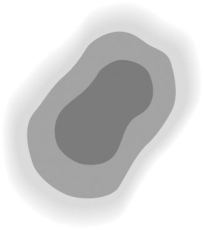
(Multiple Choice)
4.9/5 (80)
(80) The United Nations has established a network of Biosphere Reserves, each of which consists of a:
(Multiple Choice)
4.8/5 (81)
(81) Attempts are being made to restore the Kissimmee River in order to:
(Multiple Choice)
4.8/5 (81)
(81) A ________ species is fundamentally essential to an ecosystem; its loss changes the structure of the entire community.
(Multiple Choice)
4.9/5 (78)
(78) The ________ of the planet is the area of Earth's surface that is actually available to generate resources and process wastes.
(Essay)
4.8/5 (79)
(79) Overexploitation is a problem for more than ________% of threatened mammals and birds.
(Multiple Choice)
4.8/5 (76)
(76) Trees alter runoff patterns, causing increased erosion and potential flooding. True or False?
(True/False)
4.8/5 (87)
(87) The term ________ describes the variety of life, whether organismal, genetic, or among species.
(Essay)
5.0/5 (77)
(77) It is difficult to estimate current rates of extinction because:
(Multiple Choice)
4.7/5 (82)
(82) 
Filters
- Essay(0)
- Multiple Choice(0)
- Short Answer(0)
- True False(0)
- Matching(0)