



 Chat with AI
Exam 33: Respiration

Exam 1: An Introduction to Life on Earth91 Questions
Exam 2: Atoms, Molecules, and Life90 Questions
Exam 3: Biological Molecules98 Questions
Exam 4: Cell Structure and Function90 Questions
Exam 5: Cell Membrane Structure and Function96 Questions
Exam 6: Energy Flow in the Life of a Cell90 Questions
Exam 7: Capturing Solar Energy: Photosynthesis101 Questions
Exam 8: Harvesting Energy: Glycolysis and Cellular Respiration91 Questions
Exam 9: The Continuity of Life: Cellular Reproduction90 Questions
Exam 10: Patterns of Inheritance93 Questions
Exam 11: Dna: the Molecule of Heredity90 Questions
Exam 12: Gene Expression and Regulation90 Questions
Exam 13: Biotechnology90 Questions
Exam 14: Principles of Evolution98 Questions
Exam 15: How Populations Evolve110 Questions
Exam 16: The Origin of Species92 Questions
Exam 17: The History of Life119 Questions
Exam 18: Systematics: Seeking Order Amidst Diversity91 Questions
Exam 19: The Diversity of Prokaryotes and Viruses97 Questions
Exam 20: The Diversity of Protists102 Questions
Exam 21: The Diversity of Plants103 Questions
Exam 22: The Diversity of Fungi105 Questions
Exam 23: Animal Diversity I: Invertebrates101 Questions
Exam 24: Animal Diversity Ii: Vertebrates118 Questions
Exam 25: Animal Behavior119 Questions
Exam 26: Population Growth and Regulation116 Questions
Exam 27: Community Interactions124 Questions
Exam 28: How Do Ecosystems Work124 Questions
Exam 29: Earths Diverse Ecosystems126 Questions
Exam 30: Conserving Earths Biodiversity110 Questions
Exam 31: Homeostasis and the Organization of the Animal Body95 Questions
Exam 32: Circulation89 Questions
Exam 33: Respiration92 Questions
Exam 34: Nutrition and Digestion91 Questions
Exam 35: The Urinary System90 Questions
Exam 36: Defenses Against Disease89 Questions
Exam 37: Chemical Control of the Animal Body: the Endocrine System129 Questions
Exam 38: The Nervous System111 Questions
Exam 39: The Senses90 Questions
Exam 40: Action and Support: the Muscles and Skeleton90 Questions
Exam 41: Animal Reproduction117 Questions
Exam 42: Animal Development123 Questions
Exam 43: Plant Anatomy and Nutrient Transport95 Questions
Exam 44: Plant Reproduction and Development90 Questions
Exam 45: Plant Responses to the Environment87 Questions
Select questions type


In the lungs, ________ diffuses into the bloodstream where it is in low concentration, and ________ diffuses from the bloodstream into the lungs.
(Essay)
4.9/5  (74)
(74) Movement of O2 from the outside air to respiratory surfaces by breathing is an example of:
(Multiple Choice)
4.9/5 (90)
(90) Cystic fibrosis (CF)is a disease caused by a mutation in a gene called the cystic fibrosis transmembrane conductance regulator (CFTR). Among other functions, this gene helps create sweat and mucus. There is no cure for CF, and most individuals who have it die in their twenties and thirties. Based on this scenario, what would you conclude about people who have CF?
(Multiple Choice)
4.9/5 (74)
(74) Closed air sacs in which gas exchange occurs in mammals are called;
(Multiple Choice)
5.0/5 (79)
(79) When a cell is respiring, carbon dioxide is in ________ concentration inside the cell, causing it to diffuse out, whereas ________ is in high concentration outside the cell, causing it to diffuse in.
(Essay)
5.0/5 (69)
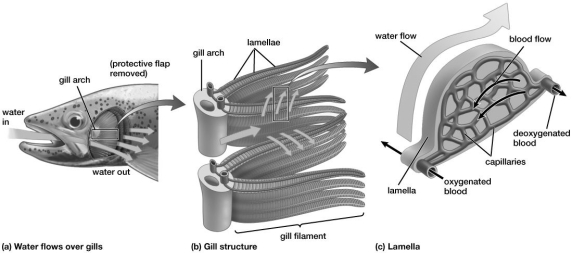
(69) What structures make up the large surface area for gas exchange in fish?
(Essay)
4.8/5 (85)
(85) Most of the carbon dioxide released from cells is transported as:
(Multiple Choice)
4.8/5 (72)
(72) 
Which of the following is one consequence of passive smoking?
(Multiple Choice)
4.9/5 (70)
(70) Imagine that a patient is admitted to the hospital after falling from the second-story window of her apartment. Tests reveal no injuries other than some swelling in the brain. Why, then, would her breathing become irregular?
(Multiple Choice)
4.9/5 (84)
(84) Why do people who have experienced carbon monoxide poisoning tend to look healthy at first glance?
(Multiple Choice)
4.7/5 (79)
(79) 
Filters
- Essay(0)
- Multiple Choice(0)
- Short Answer(0)
- True False(0)
- Matching(0)