



 Chat with AI
Exam 39: The Senses

Exam 1: An Introduction to Life on Earth91 Questions
Exam 2: Atoms, Molecules, and Life90 Questions
Exam 3: Biological Molecules98 Questions
Exam 4: Cell Structure and Function90 Questions
Exam 5: Cell Membrane Structure and Function96 Questions
Exam 6: Energy Flow in the Life of a Cell90 Questions
Exam 7: Capturing Solar Energy: Photosynthesis101 Questions
Exam 8: Harvesting Energy: Glycolysis and Cellular Respiration91 Questions
Exam 9: The Continuity of Life: Cellular Reproduction90 Questions
Exam 10: Patterns of Inheritance93 Questions
Exam 11: Dna: the Molecule of Heredity90 Questions
Exam 12: Gene Expression and Regulation90 Questions
Exam 13: Biotechnology90 Questions
Exam 14: Principles of Evolution98 Questions
Exam 15: How Populations Evolve110 Questions
Exam 16: The Origin of Species92 Questions
Exam 17: The History of Life119 Questions
Exam 18: Systematics: Seeking Order Amidst Diversity91 Questions
Exam 19: The Diversity of Prokaryotes and Viruses97 Questions
Exam 20: The Diversity of Protists102 Questions
Exam 21: The Diversity of Plants103 Questions
Exam 22: The Diversity of Fungi105 Questions
Exam 23: Animal Diversity I: Invertebrates101 Questions
Exam 24: Animal Diversity Ii: Vertebrates118 Questions
Exam 25: Animal Behavior119 Questions
Exam 26: Population Growth and Regulation116 Questions
Exam 27: Community Interactions124 Questions
Exam 28: How Do Ecosystems Work124 Questions
Exam 29: Earths Diverse Ecosystems126 Questions
Exam 30: Conserving Earths Biodiversity110 Questions
Exam 31: Homeostasis and the Organization of the Animal Body95 Questions
Exam 32: Circulation89 Questions
Exam 33: Respiration92 Questions
Exam 34: Nutrition and Digestion91 Questions
Exam 35: The Urinary System90 Questions
Exam 36: Defenses Against Disease89 Questions
Exam 37: Chemical Control of the Animal Body: the Endocrine System129 Questions
Exam 38: The Nervous System111 Questions
Exam 39: The Senses90 Questions
Exam 40: Action and Support: the Muscles and Skeleton90 Questions
Exam 41: Animal Reproduction117 Questions
Exam 42: Animal Development123 Questions
Exam 43: Plant Anatomy and Nutrient Transport95 Questions
Exam 44: Plant Reproduction and Development90 Questions
Exam 45: Plant Responses to the Environment87 Questions
Select questions type


Imagine that the eye functions like a digital camera and that the quality of the image is related to the number of pixels, with more pixels providing better resolution. Which of these animals has an eye with the best resolution (the most "pixels")?
(Multiple Choice)
4.9/5  (74)
(74) Which of the following respond to rapid vibrations or a sharp poke?
(Multiple Choice)
4.8/5 (67)
(67) Which mechanoreceptors are nearest the surface of the epidermis and respond to light touch?
(Multiple Choice)
4.9/5 (78)
(78) There are ________ distinctly different tastes that stimulate receptors on the human tongue.
(Essay)
4.9/5 (82)
(82) Which of these structures can be swiveled around in some animals to better locate a sound?
(Multiple Choice)
4.8/5 (75)
(75) Optometrists, who help patients with their vision problems, know that certain types of repetitive use of the muscles around the lens of the eye can "train" the lens to become fatter than normal. This often occurs in truck drivers, sailors, and other people who focus on the horizon or at great distances for long periods of time. Based on this figure, which of the following would be the consequence of this, and what shape of contact lens (or lens in eyeglasses)would be prescribed? 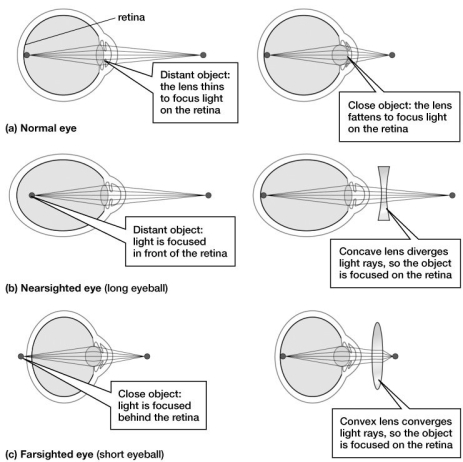
(Multiple Choice)
4.9/5 (80)
(80) If you could monitor the activity from the photoreceptors of rods and cones in the retina during a dream, would you expect these cells to be producing electrical signals? Why?
(Multiple Choice)
4.8/5 (81)
(81) 
Filters
- Essay(0)
- Multiple Choice(0)
- Short Answer(0)
- True False(0)
- Matching(0)