



 Chat with AI
Exam 44: Plant Reproduction and Development

Exam 1: An Introduction to Life on Earth91 Questions
Exam 2: Atoms, Molecules, and Life90 Questions
Exam 3: Biological Molecules98 Questions
Exam 4: Cell Structure and Function90 Questions
Exam 5: Cell Membrane Structure and Function96 Questions
Exam 6: Energy Flow in the Life of a Cell90 Questions
Exam 7: Capturing Solar Energy: Photosynthesis101 Questions
Exam 8: Harvesting Energy: Glycolysis and Cellular Respiration91 Questions
Exam 9: The Continuity of Life: Cellular Reproduction90 Questions
Exam 10: Patterns of Inheritance93 Questions
Exam 11: Dna: the Molecule of Heredity90 Questions
Exam 12: Gene Expression and Regulation90 Questions
Exam 13: Biotechnology90 Questions
Exam 14: Principles of Evolution98 Questions
Exam 15: How Populations Evolve110 Questions
Exam 16: The Origin of Species92 Questions
Exam 17: The History of Life119 Questions
Exam 18: Systematics: Seeking Order Amidst Diversity91 Questions
Exam 19: The Diversity of Prokaryotes and Viruses97 Questions
Exam 20: The Diversity of Protists102 Questions
Exam 21: The Diversity of Plants103 Questions
Exam 22: The Diversity of Fungi105 Questions
Exam 23: Animal Diversity I: Invertebrates101 Questions
Exam 24: Animal Diversity Ii: Vertebrates118 Questions
Exam 25: Animal Behavior119 Questions
Exam 26: Population Growth and Regulation116 Questions
Exam 27: Community Interactions124 Questions
Exam 28: How Do Ecosystems Work124 Questions
Exam 29: Earths Diverse Ecosystems126 Questions
Exam 30: Conserving Earths Biodiversity110 Questions
Exam 31: Homeostasis and the Organization of the Animal Body95 Questions
Exam 32: Circulation89 Questions
Exam 33: Respiration92 Questions
Exam 34: Nutrition and Digestion91 Questions
Exam 35: The Urinary System90 Questions
Exam 36: Defenses Against Disease89 Questions
Exam 37: Chemical Control of the Animal Body: the Endocrine System129 Questions
Exam 38: The Nervous System111 Questions
Exam 39: The Senses90 Questions
Exam 40: Action and Support: the Muscles and Skeleton90 Questions
Exam 41: Animal Reproduction117 Questions
Exam 42: Animal Development123 Questions
Exam 43: Plant Anatomy and Nutrient Transport95 Questions
Exam 44: Plant Reproduction and Development90 Questions
Exam 45: Plant Responses to the Environment87 Questions
Select questions type


The embryo sac of angiosperms consists of eight diploid cells and one haploid egg cell. True or False?
(True/False)
4.8/5  (70)
(70) During a late summer walk through a park, you notice a tree that has remnants of many flowers but no fruit or seed developing. There are no other trees like this one in the area. What could explain this occurrence?
(Multiple Choice)
4.8/5 (92)
(92) The first leaves produced by an embryo while still inside the seed are:
(Multiple Choice)
4.8/5 (74)
(74) Meiosis produces a ________, which eventually gives rise to an egg in an unfertilized seed.
(Multiple Choice)
4.7/5 (84)
(84) The female reproductive structure, the carpel, consists of:
(Multiple Choice)
4.9/5 (73)
(73) In general, plant evolution has moved from ________ to ________.
(Multiple Choice)
5.0/5 (81)
(81) All of the following are processes that occur during angiosperm reproduction EXCEPT:
(Multiple Choice)
4.9/5 (87)
(87) You have some freshly produced seeds that refuse to germinate when placed in moist soil. What can you do to encourage the seeds to germinate?
(Multiple Choice)
4.8/5 (67)
(67) In north-central Florida, the cars, homes, streets, and ponds are covered with an impressive coating of bright yellow dust every spring. Upon closer, microscopic examination, the yellow "dust" turns out to be pollen grains. This area of Florida has pine trees, showy daytime-flowering plants, and often-unnoticed nighttime-flowering plants releasing pollen at the same time of year. Based on this information, which group of plants do you think is responsible for the yellow pollen? Why?
(Multiple Choice)
4.7/5 (75)
(75) Based on this figure, the ________ must have contained two nuclei before fertilization. 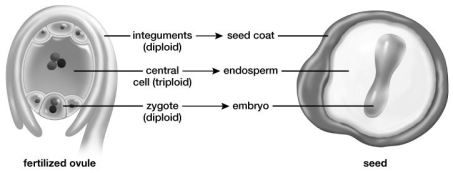
(Multiple Choice)
4.8/5 (79)
(79) Commercials on TV use food and sex as their most effective selling points. Explain how flowers use the same two points to "sell" their pollen to animals.
(Essay)
4.9/5 (81)
(81) ________ are modified leaves that are often brightly colored and fragrant.
(Multiple Choice)
4.9/5 (92)
(92) In many dicots, the first pair of leaves that emerge from the soil after seed germination are completely unlike all the rest of the leaves that form on that plant. In such plants, these leaves are:
(Multiple Choice)
4.9/5 (80)
(80) The aptly named dead horse arum has a heat-producing flower. What advantage does this heat provide?
(Multiple Choice)
4.8/5 (88)
(88) 
Filters
- Essay(0)
- Multiple Choice(0)
- Short Answer(0)
- True False(0)
- Matching(0)