



 Chat with AI
Exam 45: Plant Responses to the Environment

Exam 1: An Introduction to Life on Earth91 Questions
Exam 2: Atoms, Molecules, and Life90 Questions
Exam 3: Biological Molecules98 Questions
Exam 4: Cell Structure and Function90 Questions
Exam 5: Cell Membrane Structure and Function96 Questions
Exam 6: Energy Flow in the Life of a Cell90 Questions
Exam 7: Capturing Solar Energy: Photosynthesis101 Questions
Exam 8: Harvesting Energy: Glycolysis and Cellular Respiration91 Questions
Exam 9: The Continuity of Life: Cellular Reproduction90 Questions
Exam 10: Patterns of Inheritance93 Questions
Exam 11: Dna: the Molecule of Heredity90 Questions
Exam 12: Gene Expression and Regulation90 Questions
Exam 13: Biotechnology90 Questions
Exam 14: Principles of Evolution98 Questions
Exam 15: How Populations Evolve110 Questions
Exam 16: The Origin of Species92 Questions
Exam 17: The History of Life119 Questions
Exam 18: Systematics: Seeking Order Amidst Diversity91 Questions
Exam 19: The Diversity of Prokaryotes and Viruses97 Questions
Exam 20: The Diversity of Protists102 Questions
Exam 21: The Diversity of Plants103 Questions
Exam 22: The Diversity of Fungi105 Questions
Exam 23: Animal Diversity I: Invertebrates101 Questions
Exam 24: Animal Diversity Ii: Vertebrates118 Questions
Exam 25: Animal Behavior119 Questions
Exam 26: Population Growth and Regulation116 Questions
Exam 27: Community Interactions124 Questions
Exam 28: How Do Ecosystems Work124 Questions
Exam 29: Earths Diverse Ecosystems126 Questions
Exam 30: Conserving Earths Biodiversity110 Questions
Exam 31: Homeostasis and the Organization of the Animal Body95 Questions
Exam 32: Circulation89 Questions
Exam 33: Respiration92 Questions
Exam 34: Nutrition and Digestion91 Questions
Exam 35: The Urinary System90 Questions
Exam 36: Defenses Against Disease89 Questions
Exam 37: Chemical Control of the Animal Body: the Endocrine System129 Questions
Exam 38: The Nervous System111 Questions
Exam 39: The Senses90 Questions
Exam 40: Action and Support: the Muscles and Skeleton90 Questions
Exam 41: Animal Reproduction117 Questions
Exam 42: Animal Development123 Questions
Exam 43: Plant Anatomy and Nutrient Transport95 Questions
Exam 44: Plant Reproduction and Development90 Questions
Exam 45: Plant Responses to the Environment87 Questions
Select questions type


A botanist who wants to stimulate flower formation could treat the plants with:
(Multiple Choice)
4.8/5  (77)
(77) Plants that flower in Canada in August and in the United States in July (when nights are short)are ________ plants.
(Multiple Choice)
4.8/5 (80)
(80) Plants are able to measure the length of the night using the ________ system.
(Essay)
4.7/5 (90)
(90) In seeds from northern areas, what plant hormone often needs to be removed to get them to germinate, and how can this be done?
(Essay)
4.8/5 (90)
(90) The relative sizes of roots and shoots are regulated by interactions between:
(Multiple Choice)
4.8/5 (83)
(83) 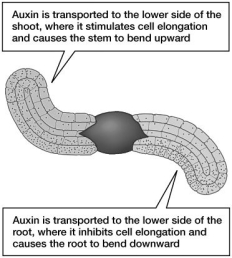
Plants that flower in the United States only in the early spring (when nights are long)are ________ plants.
(Multiple Choice)
4.8/5 (79)
(79) Which of these hormones causes cell elongation, promotes apical dominance, and stimulates root branching?
(Multiple Choice)
4.7/5 (72)
(72) The phytochrome that is active and absorbs far-red light is:
(Multiple Choice)
4.9/5 (78)
(78) The ideal Christmas tree has a conical shape. The top of the tree is pointed and narrow, with clear apical dominance, and the bottom of the tree is wide, with extensive lateral branching. Certain evergreen species are suitable for use as Christmas trees because they have this shape normally and thus require little pruning or training as they grow. For example, spruces and firs are often grown as Christmas trees, whereas yews and longleaf pines are not. Based on this information, tree shape is likely due to:
(Multiple Choice)
4.9/5 (93)
(93) Defend this statement: Plants are just as capable of responding to their environment as are animals.
(Essay)
4.9/5 (80)
(80) Corn plants release chemicals that attract a parasitic wasp. The wasp, in turn, protects the corn plants from destruction by:
(Multiple Choice)
4.9/5 (87)
(87) The only plant hormone that is a gas is cytokinin. True or False?
(True/False)
4.9/5 (81)
(81) Based on this figure, which of the following plants will NOT flower under long-day or interrupted-night conditions? 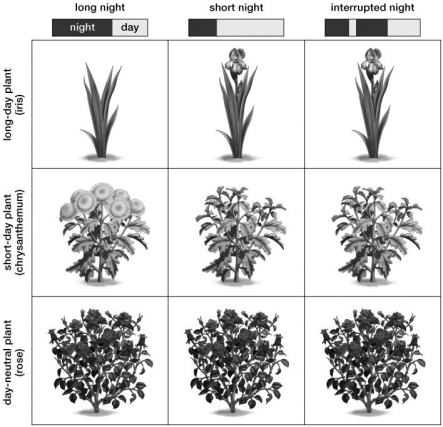
(Multiple Choice)
4.9/5 (84)
(84) 
Filters
- Essay(0)
- Multiple Choice(0)
- Short Answer(0)
- True False(0)
- Matching(0)