



 Chat with AI
Exam 11: Population Distributions

Exam 1: Introduction: Ecology, Evolution, and the Scientific Method65 Questions
Exam 2: Adaptations to Aquatic Environments 67 Questions
Exam 3: Adaptations to Terrestrial Environments 69 Questions
Exam 4: Adaptations to Variable Environments 65 Questions
Exam 5: Climates and Soils68 Questions
Exam 6: Terrestrial and Aquatic Biomes64 Questions
Exam 7: Evolution and Adaptation 68 Questions
Exam 8: Life Histories66 Questions
Exam 9: Reproductive Strategies65 Questions
Exam 10: Social Behaviors67 Questions
Exam 11: Population Distributions70 Questions
Exam 12: Population Growth and Regulation62 Questions
Exam 13: Population Dynamics Over Space and Time69 Questions
Exam 14: Predation and Herbivory69 Questions
Exam 15: Parasitism and Infectious Diseases68 Questions
Exam 16: Competition67 Questions
Exam 17: Mutualism68 Questions
Exam 18: Community Structure 66 Questions
Exam 19: Community Succession 120 Questions
Exam 20: Movement of Energy in Ecosystems 68 Questions
Exam 21: Movement of Elements in Ecosystems71 Questions
Exam 22: Landscape Ecology and Global Biodiversity 68 Questions
Exam 23: Global Conservation of Biodiversity67 Questions
Select questions type


Which dispersion should be favored among plants that compete intraspecifically by casting shade?
(Multiple Choice)
4.8/5  (86)
(86) Scientists commonly use _____ dispersal distance to quantify an organism's dispersal.
(Multiple Choice)
4.9/5 (84)
(84) When individuals have perfect knowledge of habitat variation and distribute themselves in a way that allows all of them to have the same per capita benefit, they display a(n) _____ free distribution.
(Multiple Choice)
4.8/5 (74)
(74) Measuring the lifetime dispersal distance of a species helps scientists to estimate how rapidly a growing population can increase its
(Multiple Choice)
4.9/5 (82)
(82) A species of tree is found from the Canadian border down to the southeast United States. This is called the species'
(Multiple Choice)
4.8/5 (72)
(72) The orange-breasted sunbird (Anthobaphes violacea) lives only in the fynbos region in the Western Cape of South Africa. This is an example of a(n)
(Multiple Choice)
4.8/5 (82)
(82) For a mark-recapture survey, the ratio of the number of marked individuals to the total population is equal to the ratio of the
(Multiple Choice)
4.8/5 (92)
(92) Ants should live in _____ populations, and rhinoceroses should live in _____ populations.
(Multiple Choice)
4.9/5 (75)
(75) Researchers used an experimental design in which they cleared large patches of pine forest in five areas. The central cleared area served as the source of dispersers. The four remaining cleared patches were (1) a rectangular unconnected patch, (2) a rectangular patch connected to the central patch by a cleared path that served as a corridor, and (3) two rectangular patches with wings (patches with corridors that did not connect to other patches). The researchers were interested in the importance of habitat corridors to the movement of seeds, pollen, and butterflies between central and peripheral habitat patches. What was the purpose of the unconnected winged patches? 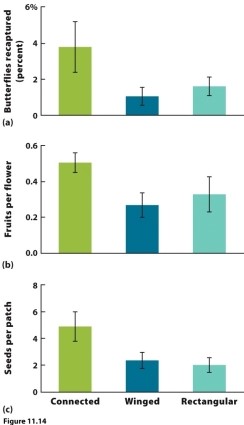
(Not Answered)
This question doesn't have any answer yet
The emerald ash borer (Agrilus planipennis) is an insect from eastern Asia that has invaded North America. The larvae of the emerald ash borer consume the cambium and phloem under the bark of American ash trees and eventually kill the trees. How can biologists predict the spread of this invasive pest? What might explain why the emerald ash borer is more of a problem in North America than in its native range?
(Essay)
4.8/5 (72)
(72) Which model specifically addresses the situation in which subpopulations in poor-quality habitats are maintained by immigration of individuals from other subpopulations that produce surplus individuals?
(Multiple Choice)
4.9/5 (78)
(78) Populations whose individuals _____ favor clustered dispersion.
(Multiple Choice)
4.8/5 (79)
(79) In the experiment in which stickleback fish (Gasterosteus aculeatus) were presented with high- and low-quality habitats, why would fish disperse from the high-food side of the aquarium to the low-food side?
(Multiple Choice)
4.8/5 (73)
(73) A researcher who counts the number of individuals of a tree species between two fixed points is making a(n) _____ survey.
(Multiple Choice)
4.9/5 (91)
(91) In the example of the Ozark Mountain collard lizard, what would the glades be considered?
(Multiple Choice)
4.8/5 (82)
(82) Sugar maple (Acer saccharum) is a tree species that is found throughout the northeastern United States in higher-elevation sites without sandy soils. What can you conclude about the distribution of sugar maples in terms of their geographic range and realized niche?
(Essay)
5.0/5 (75)
(75) Which of the following does NOT explain why an ideal free distribution might not be achieved in nature?
(Multiple Choice)
4.7/5 (73)
(73) If one were looking at the characteristic related to how an individual in a population interacts with others of its species in a given area, one would likely be looking at what?
(Multiple Choice)
4.8/5 (67)
(67) 
Filters
- Essay(0)
- Multiple Choice(0)
- Short Answer(0)
- True False(0)
- Matching(0)