



 Chat with AI
Exam 28: Diagnostic Parasitology

Exam 1: Bacterial Cell Structure, Physiology, Metabolism, and Genetics47 Questions
Exam 2: Hostparasite Interaction39 Questions
Exam 3: The Laboratory Role in Infection Control29 Questions
Exam 4: Control of Microorganisms56 Questions
Exam 5: Performance Improvement in the Microbiology Laboratory38 Questions
Exam 6: Specimen Collection and Processing57 Questions
Exam 7: Microscopic Examination of Materials From Infected Sites24 Questions
Exam 8: Use of Colony Morphology for the Presumptive Identification of Microorganisms30 Questions
Exam 9: Biochemical Identification of Gram-Negative Bacteria50 Questions
Exam 10: Immunodiagnosis of Infectious Diseases44 Questions
Exam 11: Applications of Molecular Diagnostics49 Questions
Exam 12: Antimicrobial Agent Mechanisms of Action and Resistance Mechanisms43 Questions
Exam 13: Antimicrobial Susceptibility Testing83 Questions
Exam 14: Staphylococci35 Questions
Exam 15: Streptococcus, Enterococcus, and Other Catalase-Negative, Gram-Positive Cocci40 Questions
Exam 16: Aerobic Gram-Positive Bacilli44 Questions
Exam 17: Neisseria Species and Moraxella Catarrhalis31 Questions
Exam 18: Haemophilus, Hacek, Legionella, and Other Fastidious Gram-Negative Bacilli33 Questions
Exam 19: Enterobacteriaceae33 Questions
Exam 20: Vibrio, Aeromonas, and Campylobacter Species27 Questions
Exam 21: Nonfermenting and Miscellaneous Gram-Negative Bacilli28 Questions
Exam 22: Anaerobes of Clinical Importance37 Questions
Exam 23: The Spirochetes26 Questions
Exam 24: Chlamydia, Rickettsia, and Similar Organisms24 Questions
Exam 25: Mycoplasma and Ureaplasma20 Questions
Exam 26: Mycobacterium Tuberculosis and Nontuberculous Mycobacteria34 Questions
Exam 27: Medically Significant Fungi26 Questions
Exam 28: Diagnostic Parasitology21 Questions
Exam 29: Clinical Virology48 Questions
Exam 30: Agents of Bioterror and Forensic Microbiology27 Questions
Exam 31: Biofilms: Architects of Disease27 Questions
Exam 32: Upper and Lower Respiratory Tract Infections32 Questions
Exam 33: Skin and Soft Tissue Infections30 Questions
Exam 34: Gastrointestinal Infections and Food Poisoning34 Questions
Exam 35: Infections of the Central Nervous System26 Questions
Exam 36: Bacteremia and Sepsis32 Questions
Exam 37: Urinary Tract Infections30 Questions
Exam 38: Genital Infections and Sexually Transmitted Infections26 Questions
Exam 39: Infections in Special Populations20 Questions
Exam 40: Zoonotic Diseases22 Questions
Exam 41: Ocular Infections23 Questions
Select questions type


A patient who has traveled to Puerto Rico comes to a clinic with a history of diarrhea for the past 2 weeks. A fecal sample collected for O&P shows the following parasite at 400 . This organism is most likely 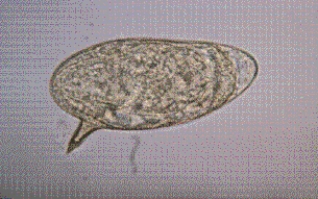

Free
(Multiple Choice)
4.9/5  (91)
(91) Correct Answer: Verified
A
A housewife from the Great Lakes area presents to her family physician with fatigue and malaise. Blood tests show that she has enlarged but pale RBCs (megaloblastic anemia) along with a vitamin B12 deficiency. Her history includes a dietary habit of making pickled fish, a family favorite. Because of this, an ova and parasites examination is also requested and reveals the following at 400 . What is the identity of this parasite? 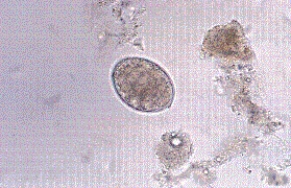
Free
(Multiple Choice)
4.7/5 (68)
(68) Correct Answer:Verified
VerifiedC
A patient comes to the emergency department stating that he has fever and chills every 48 hours. The patient has a history of travel to Central America in the past month and did not take any preventative measures against malaria. A complete blood count shows the following RBC inclusions at 1000 . This organism is most likely 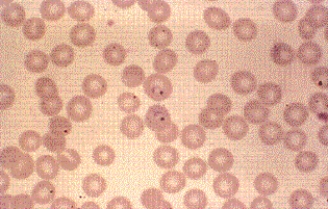
Free
(Multiple Choice)
4.9/5 (93)
(93) Correct Answer:Verified
VerifiedD
The following organism was found at 1000 in the fecal sample of a patient with fever and diarrhea. This organism is most likely: 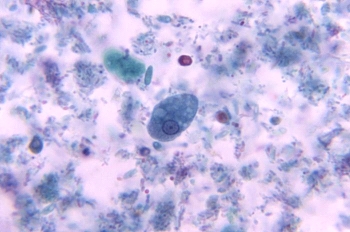
(Multiple Choice)
4.8/5 (90)
(90) A farmer who raises sheep and cattle shows signs of jaundice. Along with elevated liver enzymes, he also has an elevated eosinophil count. A fecal sample for ova and parasites shows the parasite form seen below at 400 . The organism causing this infection is 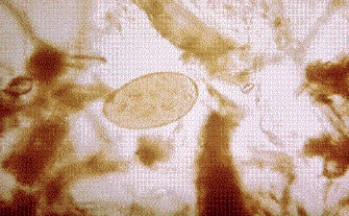
(Multiple Choice)
4.8/5 (77)
(77) A patient with recent history of travel to the Philippines has bloody diarrhea. An ova and parasites examination of the stool shows the following at 400 . 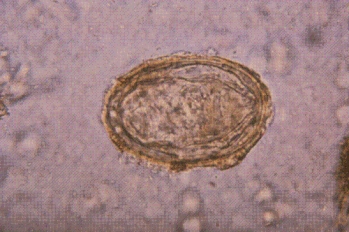
(Multiple Choice)
4.9/5 (81)
(81) A woman who just returned from a trip to Southeast Asia has signs of biliary obstruction, which is confirmed by CT scan. Due to her recent travel history, the physician orders an ova and parasites examination before considering surgical intervention. The following element is found in her fecal sample at 400 . The most likely identity of this organism is 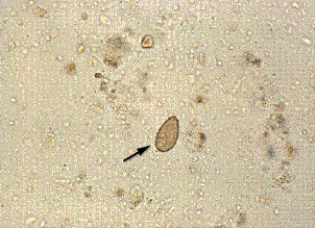
(Multiple Choice)
4.8/5 (82)
(82) A 15-year-old boy spent most of the summer at the northern Minnesota family cabin on a lake in a densely wooded area. After returning to school in the fall, he was frequently tired and listless with periods of fever and chills. A blood sample revealed the following organism at 1000 . The most likely identification is 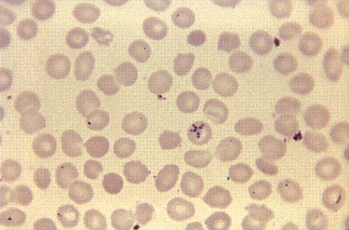
(Multiple Choice)
4.9/5 (79)
(79) A recent emigrant from Somalia develops high fever, chills, and severe headache. Blood work on admission to the hospital reveals the following in his blood smear at 1000 . This patient is most likely infected with 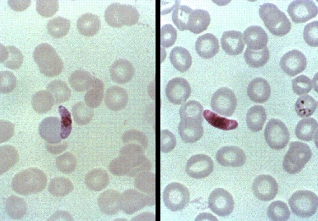
(Multiple Choice)
4.8/5 (73)
(73) A patient finds a small ribbonlike object in his stool and reports this to his physician. The physician orders a fecal ova and parasite analysis that reveals the following egg in the sample at 400 . The most likely identity of this parasite is 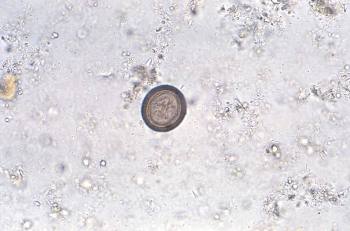
(Multiple Choice)
4.9/5 (82)
(82) A young man from rural Brazil is visiting family in the United States when he becomes ill with muscle pains, high fever, and hepatosplenomegaly. A blood sample taken in the emergency department reveals the following organism at 1000 . The most likely identification of this organism is 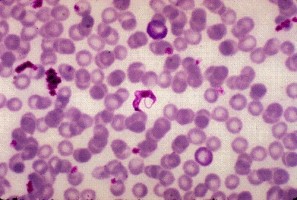
(Multiple Choice)
4.7/5 (76)
(76) Identify the organism found in a peripheral blood thick smear at 1000 : 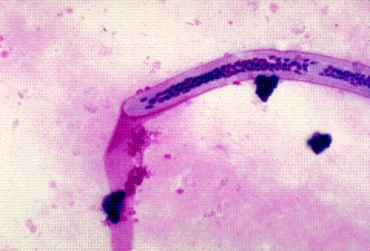
(Multiple Choice)
4.9/5 (77)
(77) Five members of a family develop a sudden onset of watery diarrhea, nausea, vomiting, headache, and cramps. The family physician orders fecal cultures and complete ova and parasites analysis. Each sample reveals the presence of organisms seen below at 1000 . The most likely cause of the infection is 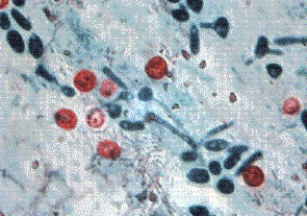
(Multiple Choice)
4.8/5 (85)
(85) A young man who returned a week ago from a family vacation to Kenya develops a high fever and delirium. Although he was compliant with his antimalarial medications, a blood sample is taken to rule out malaria. The laboratory scientist sees the following on the blood smear at 1000 . This organism is most likely 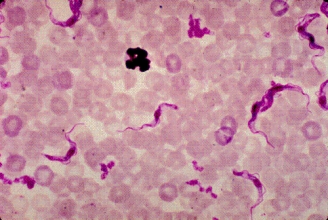
(Multiple Choice)
4.9/5 (70)
(70) A patient with a history of eating wild game comes to the physician with a history of diarrhea over the past 3 weeks. In addition, he complains of fever, muscular pain and tenderness, headache, and general weakness. The patient also has a significant eosinophilia. A biopsy of a nodular area on his forearm is seen in the image below. This is consistent with a diagnosis of infection caused by 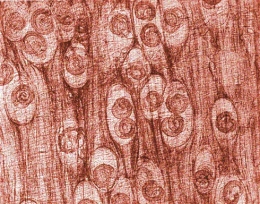
(Multiple Choice)
4.9/5 (76)
(76) Some pathogens will not grow in culture and are usually unsuspected. This pathogen can be seen in the sputum and bronchoalveolar fluid of patients with a hyperinfestation syndrome. The name of this pathogen is
(Multiple Choice)
4.8/5 (81)
(81) Several children at a daycare center are having trouble sleeping and are showing increasing signs of restlessness. Because one child was recently diagnosed with an intestinal parasite, the parents are informed that other children should be tested. The organism below is found at 400 during examination. This organism is 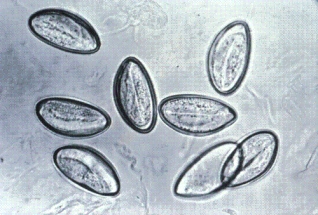
(Multiple Choice)
4.9/5 (80)
(80) A woman patient with history of travel to tropical Africa was noncompliant with her antimalarial medications. She now has a cyclical fever and paroxysm every 72 hours. The following organism is seen in her peripheral blood smear at 1000 is consistent with an infection caused by 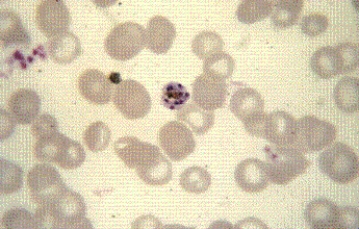
(Multiple Choice)
4.8/5 (76)
(76) A 4-year-old child has been complaining of a stomachache and has had intermittent episodes of diarrhea. Physical examination reveals an apparently healthy child with a mildly distended abdomen. Because of the diarrhea, a fecal sample is sent for culture and for ova and parasites examination. What is the identity of that found at 400 in the child's fecal sample? 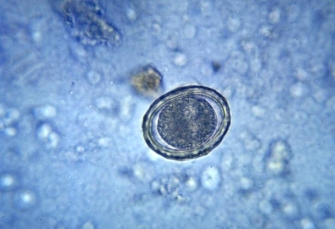
(Multiple Choice)
4.9/5 (82)
(82) An international male student from Egypt comes to the campus clinic complaining of blood in his urine. A urinalysis reveals the parasite seen below at 400 . This organism is 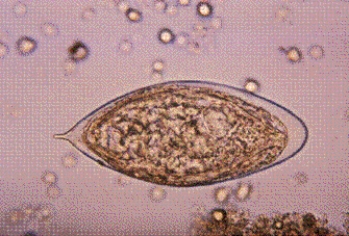
(Multiple Choice)
4.8/5 (63)
(63) 
Filters
- Essay(0)
- Multiple Choice(0)
- Short Answer(0)
- True False(0)
- Matching(0)