



 Chat with AI
Exam 8: Reactions of Alkenes and Alkynes

Exam 1: Structure and Bonding29 Questions
Exam 2: Polar Covalent Bonds; Acids and Bases41 Questions
Exam 3: Organic Compounds: Alkanes and Their Stereochemistry32 Questions
Exam 4: Organic Compounds: Cycloalkanes and Their Stereochemistry29 Questions
Exam 5: Stereochemistry at Tetrahedral Centers40 Questions
Exam 6: An Overview of Organic Reactions39 Questions
Exam 7: Alkenes and Alkynes36 Questions
Exam 8: Reactions of Alkenes and Alkynes38 Questions
Exam 9: Aromatic Compounds37 Questions
Exam 10: Structure Determination: Mass Spectrometry, Infrared Spectroscopy, and Ultraviolet Spectroscopy42 Questions
Exam 10: Structure Determination: Mass Spectrometry, Infrared Spectroscopy, and Ultraviolet Spectroscopy43 Questions
Exam 11: Structure Determination: Nuclear Magnetic Resonance Spectroscopy41 Questions
Exam 12: Organohalides: Nucleophilic Substitutions and Eliminations43 Questions
Exam 13: Alcohols, Phenols, and Thiols; Ethers and Sulfides38 Questions
Exam 14: Aldehydes and Ketones: Nucleophilic Addition Reactions36 Questions
Exam 15: Carboxylic Acids and Nitriles36 Questions
Exam 16: Carboxylic Acid Derivatives: Nucleophilic Acyl Substitution Reactions46 Questions
Exam 17: Carbonyl Alpha-Substitution and Condensation Reactions46 Questions
Exam 18: Amines and Heterocycles36 Questions
Exam 19: Biomolecules: Amino Acids, Peptides, and Proteins52 Questions
Exam 20: Amino Acid Metabolism32 Questions
Exam 21: Biomolecules: Carbohydrates49 Questions
Exam 22: Carbohydrate Metabolism45 Questions
Exam 23: Biomolecules: Lipids and Their Metabolism42 Questions
Exam 24: Biomolecules: Nucleic Acids and Their Metabolism34 Questions
Exam 26: Orbitals and Organic Chemistry: Pericyclic Reactionse44 Questions
Exam 27: Synthetic Polymerse35 Questions
Select questions type


What is the major organic product obtained from the following reaction? 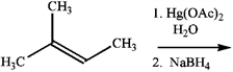
(Essay)
4.8/5  (83)
(83) What is the major organic product obtained from the following reaction? 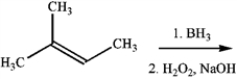
(Essay)
4.9/5 (74)
(74) What type of reactive intermediate is formed in the reaction of an alkene with HBr to give a bromoalkane?
(Multiple Choice)
4.9/5 (85)
(85) For each reaction below, suggest structures for alkenes that give the indicated reaction products. There may be more than one answer.
-Suggest structure(s): 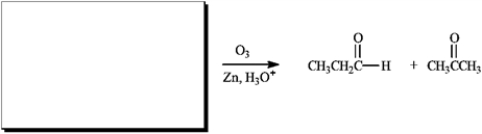
(Essay)
4.9/5 (87)
(87) Predict the products of each reaction below. Indicate regiochemistry and stereochemistry when relevant.
-Predict and indicate: 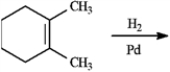
(Essay)
4.9/5 (77)
(77) How many isomeric products would be formed when the following compound undergoes dehydration? 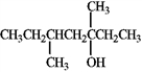
(Multiple Choice)
4.8/5 (74)
(74) What type of reaction mechanism accounts for the reaction of an alkene with HBr to give an alkyl bromide?
(Multiple Choice)
4.7/5 (84)
(84) Draw the structure of the monomer used to prepare the polymer shown below. 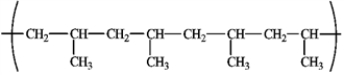
(Essay)
4.8/5 (84)
(84) On the structures provided, draw arrows showing the electron flow in the reaction mechanism for the electrophilic addition of hydrogen bromide to hex-1-yne. 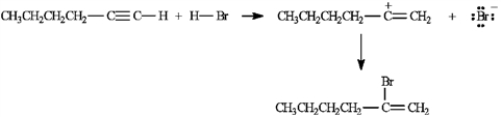
(Essay)
4.9/5 (70)
(70) Consider the reaction below to answer the following question(s).
Alkenes may be hydrated by the hydroboration/oxidation procedure shown.  -Refer to instructions. The regiochemistry of hydroboration/oxidation of alkenes is:
 (Multiple Choice)
4.9/5 (93)
(93) What type of reaction mechanism is involved in the reaction of an alcohol with aqueous acid to give an alkene?
(Multiple Choice)
4.8/5 (67)
(67) Draw all the isomeric products formed from the addition of HCl to the following compound. 
(Essay)
4.9/5 (81)
(81) 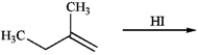
What is the best choice of reagents to perform the following transformation? 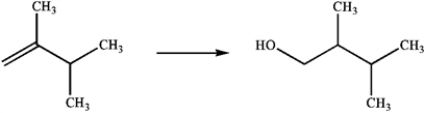
(Multiple Choice)
4.9/5 (90)
(90) What is the major organic product obtained from the following reaction? 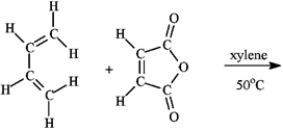
(Essay)
4.8/5 (76)
(76) Consider the reaction sequence below to answer the following question.  -Refer to instructions. Write the complete reaction mechanism for the first step of this reaction sequence. Show all electron flow with arrows and show all intermediate structures.
 (Essay)
5.0/5 (82)
(82) What type of reactive intermediate is involved in both of the following general reaction types? 1)
Reaction of an alkene with Br2 in the presence of water to give a bromohydrin
2)
Two-step hydroxylation of an alkene
(Multiple Choice)
4.9/5 (73)
(73) Predict the products of each reaction below. Indicate regiochemistry and stereochemistry when relevant.
-Predict and indicate:
a) 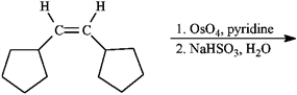 b)If the product of the above reaction were subsequently treated with periodic acid (HIO4), write the formula for the product formed.
 (Essay)
4.9/5 (85)
(85) 
Filters
- Essay(0)
- Multiple Choice(0)
- Short Answer(0)
- True False(0)
- Matching(0)