



 Chat with AI
Exam 6: An Overview of Organic Reactions

Exam 1: Structure and Bonding29 Questions
Exam 2: Polar Covalent Bonds; Acids and Bases41 Questions
Exam 3: Organic Compounds: Alkanes and Their Stereochemistry32 Questions
Exam 4: Organic Compounds: Cycloalkanes and Their Stereochemistry29 Questions
Exam 5: Stereochemistry at Tetrahedral Centers40 Questions
Exam 6: An Overview of Organic Reactions39 Questions
Exam 7: Alkenes and Alkynes36 Questions
Exam 8: Reactions of Alkenes and Alkynes38 Questions
Exam 9: Aromatic Compounds37 Questions
Exam 10: Structure Determination: Mass Spectrometry, Infrared Spectroscopy, and Ultraviolet Spectroscopy42 Questions
Exam 10: Structure Determination: Mass Spectrometry, Infrared Spectroscopy, and Ultraviolet Spectroscopy43 Questions
Exam 11: Structure Determination: Nuclear Magnetic Resonance Spectroscopy41 Questions
Exam 12: Organohalides: Nucleophilic Substitutions and Eliminations43 Questions
Exam 13: Alcohols, Phenols, and Thiols; Ethers and Sulfides38 Questions
Exam 14: Aldehydes and Ketones: Nucleophilic Addition Reactions36 Questions
Exam 15: Carboxylic Acids and Nitriles36 Questions
Exam 16: Carboxylic Acid Derivatives: Nucleophilic Acyl Substitution Reactions46 Questions
Exam 17: Carbonyl Alpha-Substitution and Condensation Reactions46 Questions
Exam 18: Amines and Heterocycles36 Questions
Exam 19: Biomolecules: Amino Acids, Peptides, and Proteins52 Questions
Exam 20: Amino Acid Metabolism32 Questions
Exam 21: Biomolecules: Carbohydrates49 Questions
Exam 22: Carbohydrate Metabolism45 Questions
Exam 23: Biomolecules: Lipids and Their Metabolism42 Questions
Exam 24: Biomolecules: Nucleic Acids and Their Metabolism34 Questions
Exam 26: Orbitals and Organic Chemistry: Pericyclic Reactionse44 Questions
Exam 27: Synthetic Polymerse35 Questions
Select questions type


Match each definition to one of the terms below.
-ΔG° = −RT ln Keq

Free
(Multiple Choice)
4.7/5  (84)
(84) Correct Answer: Verified
D
Use the reaction energy diagram below to answer the following question(s). 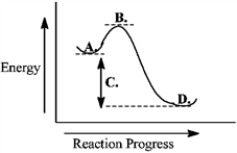 -The products are found at _____ on the diagram.
Free
(Multiple Choice)
4.8/5 (77)
(77) Correct Answer:Verified
VerifiedD
Identify and label the nucleophile and electrophile in each reaction below.
-Identify and label: 
Free
(Essay)
4.8/5 (76)
(76) Correct Answer:Verified
Verified
Match each definition to one of the terms below.
-A species that lies at an energy maximum during an individual step in a reaction.
(Multiple Choice)
4.8/5 (81)
(81) In an organic reaction, which of the following is most likely to function as only a nucleophile?
(Multiple Choice)
4.9/5 (91)
(91) Use the first step of the reaction of 2-bromo-2-methylpropane with water, shown below, to answer the following question(s). 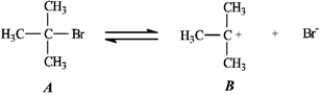 -In the following generic reaction between a halogen (X) and an alkane (R), which of the following steps occurs slowly due to low concentration of reactants?
 (Multiple Choice)
4.9/5 (68)
(68) How many monochlorosubstitution products are possible for 2,3-dimethylbutane?
(Multiple Choice)
4.8/5 (86)
(86) In theory, upon reaction with water in the presence of a strong acid, which of the following will produce more than one isomeric product?
(Multiple Choice)
4.9/5 (81)
(81) In the reaction below:
a)Label the nucleophile (Nu) and the electrophile (E).
b)Draw arrows on the structures showing electron flow in the reaction.
-Predict the two alcohol addition products obtained by reaction of the following alkene with aqueous acid. 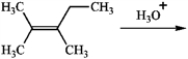
(Essay)
4.9/5 (72)
(72) Use the reaction energy diagram below to answer the following question(s).
-The reactants are found at _____ on the diagram.
-The reactants are found at _____ on the diagram. (Multiple Choice)
4.8/5 (81)
(81) Use the reaction energy diagram below to answer the following question(s).
-The free-energy change for the reaction is indicated at _____ on the diagram.
-The free-energy change for the reaction is indicated at _____ on the diagram. (Multiple Choice)
4.8/5 (83)
(83) Identify the functional groups present in each compound below, and predict the direction of polarity in each.
-Identify and predict:
amphetamine 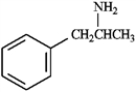
(Essay)
4.9/5 (76)
(76) Add curved arrows to the following reaction(s) to indicate the flow of electrons in each.
-Indicate flow: 
(Essay)
4.9/5 (73)
(73) Add curved arrows to the following reaction(s) to indicate the flow of electrons in each.
-Consider the following reaction:  a)Assuming that the first step is the slow step, draw and label a qualitative energy diagram for the reaction.
b)If the second step of the reaction were the slow step, briefly explain how the values of ΔG‡1, ΔG‡2, and ΔG° would change.
a)Assuming that the first step is the slow step, draw and label a qualitative energy diagram for the reaction.
b)If the second step of the reaction were the slow step, briefly explain how the values of ΔG‡1, ΔG‡2, and ΔG° would change. (Essay)
4.8/5 (62)
(62) The reaction below is commonly used as a laboratory preparation of cyclohexene. Use this reaction to answer the following question(s). 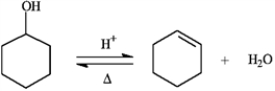 -Refer to instructions. The forward and reverse reactions are classified, respectively, as:
 (Multiple Choice)
4.8/5 (94)
(94) Use the first step of the reaction of 2-bromo-2-methylpropane with water, shown below, to answer the following question(s).
-Refer to instructions. Species B is:
-Refer to instructions. Species B is: (Multiple Choice)
4.8/5 (67)
(67) Identify and label the nucleophile and electrophile in each reaction below.
-Identify and label: 
(Essay)
4.8/5 (78)
(78) Classify each structure below as a nucleophile or electrophile, and briefly explain your choice.
-Classify and explain:
phenol 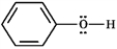
(Essay)
4.8/5 (78)
(78) Match each definition to one of the terms below.
-Another term used for a Lewis acid.
(Multiple Choice)
4.9/5 (77)
(77) Which of the following is a characteristic of a polar reaction?
(Multiple Choice)
4.8/5 (70)
(70) 
Filters
- Essay(0)
- Multiple Choice(0)
- Short Answer(0)
- True False(0)
- Matching(0)