



 Chat with AI
Exam 19: Biomolecules: Amino Acids, Peptides, and Proteins

Exam 1: Structure and Bonding29 Questions
Exam 2: Polar Covalent Bonds; Acids and Bases41 Questions
Exam 3: Organic Compounds: Alkanes and Their Stereochemistry32 Questions
Exam 4: Organic Compounds: Cycloalkanes and Their Stereochemistry29 Questions
Exam 5: Stereochemistry at Tetrahedral Centers40 Questions
Exam 6: An Overview of Organic Reactions39 Questions
Exam 7: Alkenes and Alkynes36 Questions
Exam 8: Reactions of Alkenes and Alkynes38 Questions
Exam 9: Aromatic Compounds37 Questions
Exam 10: Structure Determination: Mass Spectrometry, Infrared Spectroscopy, and Ultraviolet Spectroscopy42 Questions
Exam 10: Structure Determination: Mass Spectrometry, Infrared Spectroscopy, and Ultraviolet Spectroscopy43 Questions
Exam 11: Structure Determination: Nuclear Magnetic Resonance Spectroscopy41 Questions
Exam 12: Organohalides: Nucleophilic Substitutions and Eliminations43 Questions
Exam 13: Alcohols, Phenols, and Thiols; Ethers and Sulfides38 Questions
Exam 14: Aldehydes and Ketones: Nucleophilic Addition Reactions36 Questions
Exam 15: Carboxylic Acids and Nitriles36 Questions
Exam 16: Carboxylic Acid Derivatives: Nucleophilic Acyl Substitution Reactions46 Questions
Exam 17: Carbonyl Alpha-Substitution and Condensation Reactions46 Questions
Exam 18: Amines and Heterocycles36 Questions
Exam 19: Biomolecules: Amino Acids, Peptides, and Proteins52 Questions
Exam 20: Amino Acid Metabolism32 Questions
Exam 21: Biomolecules: Carbohydrates49 Questions
Exam 22: Carbohydrate Metabolism45 Questions
Exam 23: Biomolecules: Lipids and Their Metabolism42 Questions
Exam 24: Biomolecules: Nucleic Acids and Their Metabolism34 Questions
Exam 26: Orbitals and Organic Chemistry: Pericyclic Reactionse44 Questions
Exam 27: Synthetic Polymerse35 Questions
Select questions type


Refer to the data below to answer the following question(s).
Leucine is an essential amino acid with the systematic name 2-amino-3-methylpentanoic acid. It has pKa1 = 2.36 and pKa2 = 9.60.
-Refer to instructions. Leucine is described as an essential amino acid. What does this mean?

Free
(Essay)
4.8/5  (73)
(73) Correct Answer: Verified
Humans are able to synthesize only 10 of the 20 amino acids necessary for protein synthesis. The remaining 10 are called essential amino acids since they must be obtained from dietary sources. Failure to include an adequate dietary supply of these essential amino acids can lead to severe deficiency diseases.
Which amino acid results from the following sequence of transformations? 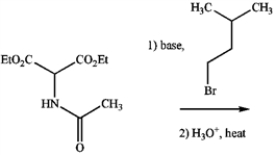
Free
(Short Answer)
4.7/5 (84)
(84) Correct Answer:Verified
Verifiedleucine, in racemic form.
Consider the following structure. Based on this structure answer the following question(s).  -Refer to instructions. Circle the peptide bonds.
Free
(Essay)
4.9/5 (86)
(86) Correct Answer:Verified
Verified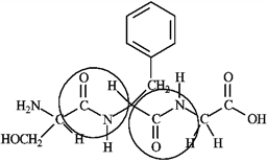
Match a structure from the list below to each of the following terms.
-The product of an Edman degradation.
(Multiple Choice)
4.8/5 (86)
(86) To what structural feature does the term "primary structure" refer?
(Multiple Choice)
4.8/5 (88)
(88) Match a structure from the list below to each of the following terms.
-A peptide coupling reagent.
(Multiple Choice)
5.0/5 (96)
(96) To what structural feature does the term "tertiary structure" refer?
(Multiple Choice)
5.0/5 (75)
(75) Consider the following structure. Based on this structure answer the following question(s).
-Refer to instructions. Identify the C-terminal amino acid and the N-terminal amino acid.
-Refer to instructions. Identify the C-terminal amino acid and the N-terminal amino acid. (Essay)
4.9/5 (86)
(86) Refer to the data below to answer the following question(s).
Leucine is an essential amino acid with the systematic name 2-amino-3-methylpentanoic acid. It has pKa1 = 2.36 and pKa2 = 9.60.
-Refer to instructions. How many possible stereoisomers of leucine are there?
(Essay)
4.9/5 (68)
(68) Which of the following amino acids migrates to the positive electrode on paper electrophoresis at a pH of 7.0?
(Multiple Choice)
4.8/5 (89)
(89) Consider the following structure. Based on this structure answer the following question(s).
-Write the equation for the reaction, using methanol (CH3OH), that would render the carboxyl group of alanine unreactive.
-Write the equation for the reaction, using methanol (CH3OH), that would render the carboxyl group of alanine unreactive. (Essay)
4.9/5 (69)
(69) Match a structure from the list below to each of the following terms.
-Source from which many coenzymes are derived.
(Multiple Choice)
4.9/5 (86)
(86) Refer to the data below to answer the following question(s).
Leucine is an essential amino acid with the systematic name 2-amino-3-methylpentanoic acid. It has pKa1 = 2.36 and pKa2 = 9.60.
-Refer to instructions. Draw the structure of the predominant form of leucine at pH = 1.50.
(Essay)
4.8/5 (79)
(79) How does phenyl isothiocyanate, Ph−N=C=S, react with a peptide in the Edman degradation?
(Multiple Choice)
4.9/5 (74)
(74) Which of the following amino acids contains two stereocenters?
(Multiple Choice)
4.9/5 (82)
(82) Refer to the data below to answer the following question(s).
Porcine dynorphin is a neuropeptide having 17 amino acid residues. Its structure is shown below.
Tyr−Gly−Gly−Phe−Leu−Arg−Arg−Ile−Arg−Pro−Lys−Leu−Lys−Trp−Asp−Asn−Gln
-Refer to instructions. What fragments would result if dynorphin were cleaved by trypsin?
(Essay)
4.8/5 (83)
(83) Match a structure from the list below to each of the following terms.
-An amino acid in its zwitterionic form.
(Multiple Choice)
4.8/5 (84)
(84) Which of the following amino acids migrates to the negative electrode on paper electrophoresis at a pH of 7.0?
(Multiple Choice)
4.8/5 (87)
(87) 
Filters
- Essay(0)
- Multiple Choice(0)
- Short Answer(0)
- True False(0)
- Matching(0)