



 Chat with AI
Exam 3: Organic Compounds: Alkanes and Their Stereochemistry

Exam 1: Structure and Bonding29 Questions
Exam 2: Polar Covalent Bonds; Acids and Bases41 Questions
Exam 3: Organic Compounds: Alkanes and Their Stereochemistry32 Questions
Exam 4: Organic Compounds: Cycloalkanes and Their Stereochemistry29 Questions
Exam 5: Stereochemistry at Tetrahedral Centers40 Questions
Exam 6: An Overview of Organic Reactions39 Questions
Exam 7: Alkenes and Alkynes36 Questions
Exam 8: Reactions of Alkenes and Alkynes38 Questions
Exam 9: Aromatic Compounds37 Questions
Exam 10: Structure Determination: Mass Spectrometry, Infrared Spectroscopy, and Ultraviolet Spectroscopy42 Questions
Exam 10: Structure Determination: Mass Spectrometry, Infrared Spectroscopy, and Ultraviolet Spectroscopy43 Questions
Exam 11: Structure Determination: Nuclear Magnetic Resonance Spectroscopy41 Questions
Exam 12: Organohalides: Nucleophilic Substitutions and Eliminations43 Questions
Exam 13: Alcohols, Phenols, and Thiols; Ethers and Sulfides38 Questions
Exam 14: Aldehydes and Ketones: Nucleophilic Addition Reactions36 Questions
Exam 15: Carboxylic Acids and Nitriles36 Questions
Exam 16: Carboxylic Acid Derivatives: Nucleophilic Acyl Substitution Reactions46 Questions
Exam 17: Carbonyl Alpha-Substitution and Condensation Reactions46 Questions
Exam 18: Amines and Heterocycles36 Questions
Exam 19: Biomolecules: Amino Acids, Peptides, and Proteins52 Questions
Exam 20: Amino Acid Metabolism32 Questions
Exam 21: Biomolecules: Carbohydrates49 Questions
Exam 22: Carbohydrate Metabolism45 Questions
Exam 23: Biomolecules: Lipids and Their Metabolism42 Questions
Exam 24: Biomolecules: Nucleic Acids and Their Metabolism34 Questions
Exam 26: Orbitals and Organic Chemistry: Pericyclic Reactionse44 Questions
Exam 27: Synthetic Polymerse35 Questions
Select questions type


How many constitutional isomers are there with the molecular formula C6H14?

Free
(Multiple Choice)
4.8/5  (88)
(88) Correct Answer: Verified
C
Experiments have shown that for 1,2-dichloroethane, ClCH2CH2Cl, in tetrachloromethane solution at 25° C, 70% of the molecules are in the anti and 30% are in the gauche conformation. Use this information to answer the following question(s).
-Refer to instructions. Draw a Newman projection of the gauche conformation of 1,2-dichloroethane.
Free
(Essay)
4.7/5 (76)
(76) Correct Answer:Verified
Verified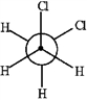
4-ethyl-3,3,4-trimethylheptane contains:
Free
(Multiple Choice)
4.7/5 (83)
(83) Correct Answer:Verified
VerifiedD
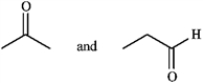
One of the functional group classifications is characterized by the presence of an sp2 hybridized carbon atom. This functional group could be:
(Multiple Choice)
4.8/5 (84)
(84) 
Provide the line bond structure for 4-(2,2-dibromoethyl)-3,5-dichloroheptane.
(Essay)
4.7/5 (81)
(81) Experiments have shown that for 1,2-dichloroethane, ClCH2CH2Cl, in tetrachloromethane solution at 25° C, 70% of the molecules are in the anti and 30% are in the gauche conformation. Use this information to answer the following question(s).
-Refer to instructions. Draw a Newman projection of the anti conformation of 1,2-dichloroethane.
(Essay)
4.8/5 (85)
(85) Circle and name each functional group in the following structure. 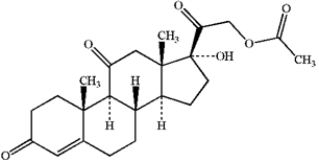 cortisone acetate (active ingredient in steroid skin cream)
 (Essay)
4.9/5 (71)
(71) The carbon atoms within the functional group of the following classifications are: alkene ester carboxylic acid amide
(Multiple Choice)
4.8/5 (65)
(65) Designate each carbon as primary, secondary, tertiary, or quaternary. 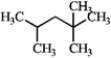
(Essay)
4.8/5 (76)
(76) Which of the following Newman projections represents the most stable conformation of 2,3-dimethylbutane?
A  B
 C
 D

B C D (Multiple Choice)
4.7/5 (85)
(85) Among the following structures, how many different compounds are represented? 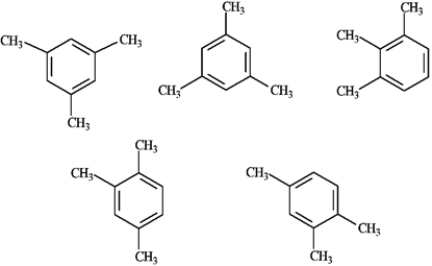
(Multiple Choice)
4.9/5 (79)
(79) Draw the structure of a five carbon ketone containing one tertiary carbon atom.
(Essay)
4.9/5 (87)
(87) Which hydrogen atom(s) in the following compound is (are) classified as tertiary? 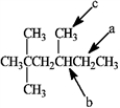
(Multiple Choice)
4.8/5 (77)
(77) Name these groups (left to right). 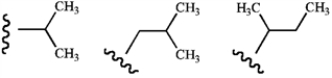 where
 represents the parent chain.
where represents the parent chain. (Multiple Choice)
4.9/5 (74)
(74) Pick the set of terms that correctly classifies the compound. 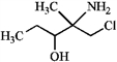
(Multiple Choice)
4.9/5 (81)
(81) Which of the following alkanes is the most likely to be a liquid at room temperature?
(Multiple Choice)
4.9/5 (80)
(80) Which of the following functional group classifications do not contain oxygen?
(Multiple Choice)
4.9/5 (67)
(67) Which of the following Newman projections does not represent 2-methylhexane?
A 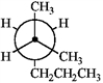 B
 C
 D
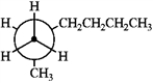
B C D
(Multiple Choice)
4.8/5 (88)
(88) 
Filters
- Essay(0)
- Multiple Choice(0)
- Short Answer(0)
- True False(0)
- Matching(0)