



 Chat with AI
Exam 21: Biomolecules: Carbohydrates

Exam 1: Structure and Bonding29 Questions
Exam 2: Polar Covalent Bonds; Acids and Bases41 Questions
Exam 3: Organic Compounds: Alkanes and Their Stereochemistry32 Questions
Exam 4: Organic Compounds: Cycloalkanes and Their Stereochemistry29 Questions
Exam 5: Stereochemistry at Tetrahedral Centers40 Questions
Exam 6: An Overview of Organic Reactions39 Questions
Exam 7: Alkenes and Alkynes36 Questions
Exam 8: Reactions of Alkenes and Alkynes38 Questions
Exam 9: Aromatic Compounds37 Questions
Exam 10: Structure Determination: Mass Spectrometry, Infrared Spectroscopy, and Ultraviolet Spectroscopy42 Questions
Exam 10: Structure Determination: Mass Spectrometry, Infrared Spectroscopy, and Ultraviolet Spectroscopy43 Questions
Exam 11: Structure Determination: Nuclear Magnetic Resonance Spectroscopy41 Questions
Exam 12: Organohalides: Nucleophilic Substitutions and Eliminations43 Questions
Exam 13: Alcohols, Phenols, and Thiols; Ethers and Sulfides38 Questions
Exam 14: Aldehydes and Ketones: Nucleophilic Addition Reactions36 Questions
Exam 15: Carboxylic Acids and Nitriles36 Questions
Exam 16: Carboxylic Acid Derivatives: Nucleophilic Acyl Substitution Reactions46 Questions
Exam 17: Carbonyl Alpha-Substitution and Condensation Reactions46 Questions
Exam 18: Amines and Heterocycles36 Questions
Exam 19: Biomolecules: Amino Acids, Peptides, and Proteins52 Questions
Exam 20: Amino Acid Metabolism32 Questions
Exam 21: Biomolecules: Carbohydrates49 Questions
Exam 22: Carbohydrate Metabolism45 Questions
Exam 23: Biomolecules: Lipids and Their Metabolism42 Questions
Exam 24: Biomolecules: Nucleic Acids and Their Metabolism34 Questions
Exam 26: Orbitals and Organic Chemistry: Pericyclic Reactionse44 Questions
Exam 27: Synthetic Polymerse35 Questions
Select questions type


Consider the reaction below to answer the following question(s).  -Refer to instructions. Which anomer is the LEAST stable?
Q or Z
-Refer to instructions. Which anomer is the LEAST stable?
Q or Z
Free
(Short Answer)
4.8/5  (83)
(83) Correct Answer: Verified
Z
Which of the following could not form a pyranose?
Free
(Multiple Choice)
4.8/5 (89)
(89) Correct Answer:Verified
VerifiedA
Convert the Fischer projections into tetrahedral representations, and assign R or S stereochemistry to each.
-Convert and assign: 
Free
(Essay)
4.8/5 (71)
(71) Correct Answer:Verified
Verified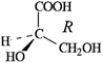
Draw structures for the products you would expect to obtain from reaction of β-D-galactopyranose with the listed reagents. Be sure to include all relevant stereochemistry.  β-D-galactopyranose
-Draw:
Ch3I, Ag2O
β-D-galactopyranose
-Draw:
Ch3I, Ag2O (Essay)
4.9/5 (88)
(88) The brick-red color observed when Benedict's test is applied to D-mannose is due to
(Multiple Choice)
4.7/5 (78)
(78) Which reagent would be best suited for the transformation shown? 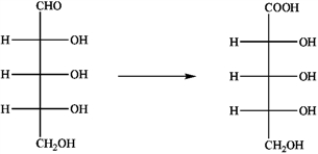
(Multiple Choice)
4.8/5 (72)
(72) Refer to the monosaccharides below to answer the following question(s).
a. Sorbose  b. Rhamnose
 c. Erythrulose
 d. Xylulose
 -Convert the following Fisher projections into tetrahedral representations.
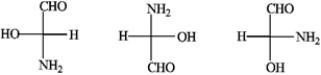
b. Rhamnose c. Erythrulose d. Xylulose
-Convert the following Fisher projections into tetrahedral representations. (Essay)
4.9/5 (74)
(74) Refer to the sugars below to answer the following question(s). Choose the sugar that best fits each description. There is only one correct answer for each question, but sugars may be used more than once. Indicate each answer by the corresponding letter.
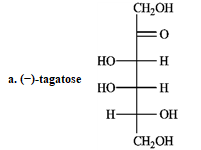
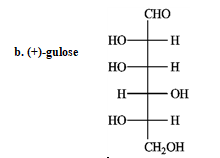
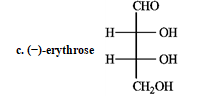
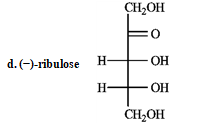 -Draw the structure of the product of the following reaction.
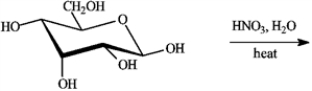
-Draw the structure of the product of the following reaction. (Essay)
4.7/5 (81)
(81) Refer to the sugars below to answer the following question(s). Choose the sugar that best fits each description. There is only one correct answer for each question, but sugars may be used more than once. Indicate each answer by the corresponding letter.
-Refer to instructions. _____ a ketose and _____ an aldose with two chirality centers
-Refer to instructions. _____ a ketose and _____ an aldose with two chirality centers (Multiple Choice)
4.8/5 (79)
(79) What is the relationship between D-erythrose and D-threose? 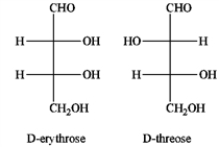
(Multiple Choice)
4.9/5 (84)
(84) Convert the Fischer projections into tetrahedral representations, and assign R or S stereochemistry to each.
-Describe the fundamental difference between the following classifications of carbohydrates.
a.
monosaccharide, disaccharide, polysaccharide
b.
simple sugar, complex sugar
c.
ketose, aldose
d.
furanose, pyranose
(Essay)
4.8/5 (88)
(88) Consider the reaction below to answer the following question(s).
-Refer to instructions. Q and Z are cyclic examples of:
-Refer to instructions. Q and Z are cyclic examples of: (Multiple Choice)
4.8/5 (79)
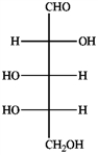
(79) Refer to the monosaccharides below to answer the following question(s). Classify each sugar by type; for example, glucose is an aldohexose.a. Sorbose  b. Rhamnose
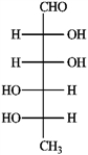 c. Erythrulose
 d. Xylulose
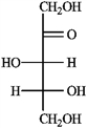 -Refer to instructions. Erythrulose is ____________________.
b. Rhamnose c. Erythrulose d. Xylulose
-Refer to instructions. Erythrulose is ____________________. (Short Answer)
4.9/5 (73)
(73) Choose a structure from the list provided below that best fits the description given. There is only one correct answer for each question.
-A non-reducing disaccharide
(Multiple Choice)
4.7/5 (76)
(76) Consider the reaction below to answer the following question(s).
-Refer to instructions. Compound Z is:
-Refer to instructions. Compound Z is: (Multiple Choice)
4.8/5 (71)
(71) Refer to the equilibrium below to answer the following question(s).  -Refer to instructions. Classify ribose by carbonyl type and number of carbons.
 (Short Answer)
4.8/5 (82)
(82) Refer to the equilibrium below to answer the following question(s).
-Refer to instructions. Which enantiomer of ribose is drawn, D or L, and is it the α or β anomer?
-Refer to instructions. Which enantiomer of ribose is drawn, D or L, and is it the α or β anomer? (Short Answer)
5.0/5 (79)
(79) Choose a structure from the list provided below that best fits the description given. There is only one correct answer for each question.
-A 1,4' β-glycoside
(Multiple Choice)
4.9/5 (81)
(81) Aldohexoses may exist as furanoses or pyranoses. Aldopentoses also may exist as furanoses or pyranoses.
a)Draw Haworth projections for a furanose and a pyranose obtained from D-ribose.
b)Each product can exist in two anomeric forms. What is the structural difference between these forms?
(Essay)
5.0/5 (73)
(73) 

Filters
- Essay(0)
- Multiple Choice(0)
- Short Answer(0)
- True False(0)
- Matching(0)