



 Chat with AI
Exam 4: Organic Compounds: Cycloalkanes and Their Stereochemistry

Exam 1: Structure and Bonding29 Questions
Exam 2: Polar Covalent Bonds; Acids and Bases41 Questions
Exam 3: Organic Compounds: Alkanes and Their Stereochemistry32 Questions
Exam 4: Organic Compounds: Cycloalkanes and Their Stereochemistry29 Questions
Exam 5: Stereochemistry at Tetrahedral Centers40 Questions
Exam 6: An Overview of Organic Reactions39 Questions
Exam 7: Alkenes and Alkynes36 Questions
Exam 8: Reactions of Alkenes and Alkynes38 Questions
Exam 9: Aromatic Compounds37 Questions
Exam 10: Structure Determination: Mass Spectrometry, Infrared Spectroscopy, and Ultraviolet Spectroscopy42 Questions
Exam 10: Structure Determination: Mass Spectrometry, Infrared Spectroscopy, and Ultraviolet Spectroscopy43 Questions
Exam 11: Structure Determination: Nuclear Magnetic Resonance Spectroscopy41 Questions
Exam 12: Organohalides: Nucleophilic Substitutions and Eliminations43 Questions
Exam 13: Alcohols, Phenols, and Thiols; Ethers and Sulfides38 Questions
Exam 14: Aldehydes and Ketones: Nucleophilic Addition Reactions36 Questions
Exam 15: Carboxylic Acids and Nitriles36 Questions
Exam 16: Carboxylic Acid Derivatives: Nucleophilic Acyl Substitution Reactions46 Questions
Exam 17: Carbonyl Alpha-Substitution and Condensation Reactions46 Questions
Exam 18: Amines and Heterocycles36 Questions
Exam 19: Biomolecules: Amino Acids, Peptides, and Proteins52 Questions
Exam 20: Amino Acid Metabolism32 Questions
Exam 21: Biomolecules: Carbohydrates49 Questions
Exam 22: Carbohydrate Metabolism45 Questions
Exam 23: Biomolecules: Lipids and Their Metabolism42 Questions
Exam 24: Biomolecules: Nucleic Acids and Their Metabolism34 Questions
Exam 26: Orbitals and Organic Chemistry: Pericyclic Reactionse44 Questions
Exam 27: Synthetic Polymerse35 Questions
Select questions type


For each disubstituted cyclohexane below, draw its ring-flip isomer. Circle the most stable conformation and label the substituent groups as axial or equatorial.
-Draw and label: 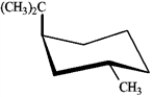

Free
(Essay)
5.0/5  (76)
(76) Correct Answer: Verified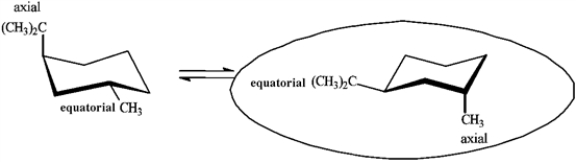
Label each pair of compounds below as:
-Label:  and

and Free
(Multiple Choice)
4.9/5 (87)
(87) Correct Answer:Verified
VerifiedA
In which of the following compounds would the carbon−carbon bond angle diverge the greatest from 109°?
Free
(Multiple Choice)
4.9/5 (64)
(64) Correct Answer:Verified
VerifiedD
In cycloheptane, which of the following factors contributes the least to the stability of the ring conformation?
(Multiple Choice)
4.9/5 (76)
(76) If the 1,3-diaxial strain for an ethyl group is 4.0 kJ/mol, what is the energy difference between the axial and equatorial conformations of ethylcyclohexane?
(Multiple Choice)
4.7/5 (89)
(89) D-Pinitol is an interesting hexahydroxycyclohexane, whose structure is shown below. 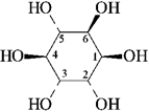 On the templates provided, draw the two chair conformations that are in equilibrium for D-pinitol. Circle the most stable conformation.

On the templates provided, draw the two chair conformations that are in equilibrium for D-pinitol. Circle the most stable conformation. (Essay)
4.8/5 (93)
(93) Which of the following is the most stable conformation of trans-1-ethyl-3-methylcyclohexane?
(Multiple Choice)
4.9/5 (82)
(82) Which one of the following structures represents a different compound from the other three?
(Multiple Choice)
4.8/5 (71)
(71) Refer to the structure below to answer the following question(s).  -Refer to instructions. Which of the labeled groups in the structure are equatorial?
 (Short Answer)
4.8/5 (71)
(71) Which of the following structures represents trans-1,3-dimethylcyclohexane?
(Multiple Choice)
4.7/5 (90)
(90) Which one of the following structures represents a different compound from the other three?
(Multiple Choice)
4.9/5 (84)
(84) The following is an incorrect name according to IUPAC nomenclature rules. Correct it such that it is a proper IUPAC name.
3-methylhexylcyclopentane
(Short Answer)
4.9/5 (84)
(84) Which of the following statements is not true regarding the conformation of substituted cyclohexanes?
(Multiple Choice)
4.9/5 (66)
(66) 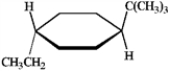
Which of the following compounds can adopt a chair conformation in which there are no axial methyl groups?
(Multiple Choice)
4.8/5 (77)
(77) Which of the following structures represents trans-1,2-dimethylcyclohexane?
(Multiple Choice)
4.8/5 (82)
(82) Which of the following cycloalkanes has the most ring strain?
(Multiple Choice)
4.8/5 (70)
(70) Refer to the structure below to answer the following question(s).
-Refer to instructions. Which of the labeled groups is trans to b?
-Refer to instructions. Which of the labeled groups is trans to b? (Short Answer)
4.8/5 (79)
(79) If cyclohexane were planar, how much torsional strain would be present in the planar molecule? Assume that the energy cost for each H↔H eclipsing interaction is 4.0 kcal/mol.
(Multiple Choice)
4.8/5 (71)
(71) Which of the following is the most stable conformation of cis-1-isopropyl-3-methylcyclohexane?
(Multiple Choice)
4.9/5 (87)
(87) 
Filters
- Essay(0)
- Multiple Choice(0)
- Short Answer(0)
- True False(0)
- Matching(0)