



 Chat with AI
Exam 11: Structure Determination: Nuclear Magnetic Resonance Spectroscopy

Exam 1: Structure and Bonding29 Questions
Exam 2: Polar Covalent Bonds; Acids and Bases41 Questions
Exam 3: Organic Compounds: Alkanes and Their Stereochemistry32 Questions
Exam 4: Organic Compounds: Cycloalkanes and Their Stereochemistry29 Questions
Exam 5: Stereochemistry at Tetrahedral Centers40 Questions
Exam 6: An Overview of Organic Reactions39 Questions
Exam 7: Alkenes and Alkynes36 Questions
Exam 8: Reactions of Alkenes and Alkynes38 Questions
Exam 9: Aromatic Compounds37 Questions
Exam 10: Structure Determination: Mass Spectrometry, Infrared Spectroscopy, and Ultraviolet Spectroscopy42 Questions
Exam 10: Structure Determination: Mass Spectrometry, Infrared Spectroscopy, and Ultraviolet Spectroscopy43 Questions
Exam 11: Structure Determination: Nuclear Magnetic Resonance Spectroscopy41 Questions
Exam 12: Organohalides: Nucleophilic Substitutions and Eliminations43 Questions
Exam 13: Alcohols, Phenols, and Thiols; Ethers and Sulfides38 Questions
Exam 14: Aldehydes and Ketones: Nucleophilic Addition Reactions36 Questions
Exam 15: Carboxylic Acids and Nitriles36 Questions
Exam 16: Carboxylic Acid Derivatives: Nucleophilic Acyl Substitution Reactions46 Questions
Exam 17: Carbonyl Alpha-Substitution and Condensation Reactions46 Questions
Exam 18: Amines and Heterocycles36 Questions
Exam 19: Biomolecules: Amino Acids, Peptides, and Proteins52 Questions
Exam 20: Amino Acid Metabolism32 Questions
Exam 21: Biomolecules: Carbohydrates49 Questions
Exam 22: Carbohydrate Metabolism45 Questions
Exam 23: Biomolecules: Lipids and Their Metabolism42 Questions
Exam 24: Biomolecules: Nucleic Acids and Their Metabolism34 Questions
Exam 26: Orbitals and Organic Chemistry: Pericyclic Reactionse44 Questions
Exam 27: Synthetic Polymerse35 Questions
Select questions type


Explain why all protons in a molecule do not absorb rf energy at the same frequency.

Free
(Essay)
4.8/5  (78)
(78) Correct Answer: Verified
All nuclei in molecules are surrounded by electron clouds. When a uniform external magnetic field is applied to a molecule, the circulating electron clouds set up tiny local magnetic fields of their own. These local magnetic fields act in opposition to the applied field, so that the effective field actually felt by a nucleus is a bit smaller than the applied field.
Beffective = Bapplied − Blocal
This effect is termed shielding. Each nucleus is shielded to a slightly different extent, so each unique kind of proton in a molecule resonates at a slightly different frequency and gives rise to a unique NMR signal.
The following questions pertain to the display of NMR spectra. Match a term to each description below.
-The calibration standard for 1H and 13C NMR is _____.
Free
(Multiple Choice)
4.9/5 (80)
(80) Correct Answer:Verified
VerifiedA
If the proton attached to C2 in 1,1,2-tribromopropane is coupled with the protons on C1 (J = 3.5 Hz) and C3 (J = 6.8), draw the tree diagram of the C2 proton and predict the splitting pattern. 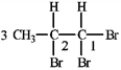
Free
(Essay)
4.8/5 (73)
(73) Correct Answer:Verified
Verified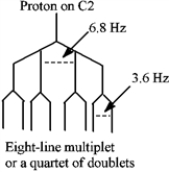
Refer to the structure of 3-methylbutan-2-one below to answer the following question(s). 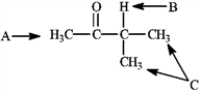 -A compound with the molecular formula C6H4ClBr produces only two doublets in the 1H NMR spectrum.
a)Propose a structure for this compound.
b)How many signals would be present in the 13CNMR for this structure?
-A compound with the molecular formula C6H4ClBr produces only two doublets in the 1H NMR spectrum.
a)Propose a structure for this compound.
b)How many signals would be present in the 13CNMR for this structure? (Essay)
4.9/5 (72)
(72) To answer the following questions, consider the data and 1H NMR spectrum below.
The mass spectrum of this compound shows a molecular ion at m/z = 113, the IR spectrum has characteristic absorptions at 2270 and 1735 cm−1, and the 13C NMR spectrum has five signals. 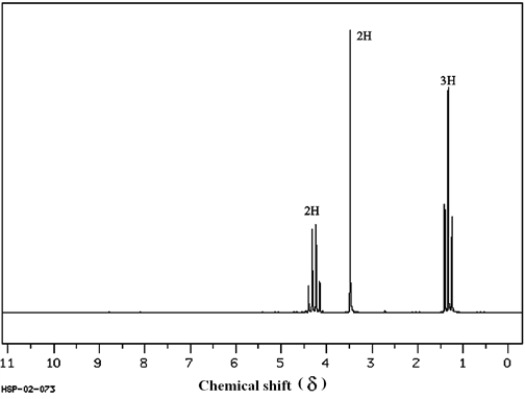 (Spectrum obtained from: SDBSWeb: http://www.aist.go.jp/RIODB/SDBS/)
-Refer to instructions. How many types of nonequivalent protons are there in this molecule?
(Spectrum obtained from: SDBSWeb: http://www.aist.go.jp/RIODB/SDBS/)
-Refer to instructions. How many types of nonequivalent protons are there in this molecule? (Short Answer)
4.8/5 (93)
(93) How many positive and negative peaks appear in the DEPT-135 and in the DEPT-90 spectrum of 2-methylpentane?
(Multiple Choice)
4.9/5 (62)
(62) The following questions pertain to the display of NMR spectra. Match a term to each description below.
-When looking at an NMR spectrum the right-hand part of the chart is the _____.
(Multiple Choice)
5.0/5 (80)
(80) Refer to the structure of 3-methylbutan-2-one below to answer the following question(s).
-Treatment of tert-butyl alcohol with hydrogen chloride yields a mixture of tert-butyl chloride and 2-methylpropene.  a)After chromatographic separation, how would you use 1H NMR to help you decide which was which?
b)How would the 13C NMR for the two compounds differ?
-Treatment of tert-butyl alcohol with hydrogen chloride yields a mixture of tert-butyl chloride and 2-methylpropene. a)After chromatographic separation, how would you use 1H NMR to help you decide which was which?
b)How would the 13C NMR for the two compounds differ? (Essay)
4.8/5 (74)
(74) To answer the following questions, consider the data and 1H NMR spectrum below.
The mass spectrum of this compound shows a molecular ion at m/z = 113, the IR spectrum has characteristic absorptions at 2270 and 1735 cm−1, and the 13C NMR spectrum has five signals. (Spectrum obtained from: SDBSWeb: http://www.aist.go.jp/RIODB/SDBS/)
-Refer to instructions. Based on the mass spectral data and the IR data, what functional groups are present in this compound?
(Spectrum obtained from: SDBSWeb: http://www.aist.go.jp/RIODB/SDBS/)
-Refer to instructions. Based on the mass spectral data and the IR data, what functional groups are present in this compound? (Essay)
4.9/5 (75)
(75) Which feature in the 1H NMR spectrum provides information about the electronic environment of the protons in a compound?
(Multiple Choice)
4.9/5 (77)
(77) For each of the compounds below tell how many signals you would expect the molecule to have in its normal, broadband decoupled 13C NMR spectra.
-Number of signals: 
(Essay)
4.8/5 (81)
(81) The following questions pertain to the display of NMR spectra. Match a term to each description below.
-The NMR spectrum are calibrated using an arbitrary scale that is divided into _____ units.
(Multiple Choice)
4.9/5 (90)
(90) Which of the following would not produce nuclear magnetic resonance?
(Multiple Choice)
4.9/5 (79)
(79) For each of the compounds below tell how many signals you would expect the molecule to have in its normal, broadband decoupled 13C NMR spectra.
-Number of signals: 
(Essay)
4.9/5 (76)
(76) Refer to the structure of 3-methylbutan-2-one below to answer the following question(s).
-Refer to instructions. What is the ratio of peak areas upon integration of the spectrum for A, B, and C respectively?
-Refer to instructions. What is the ratio of peak areas upon integration of the spectrum for A, B, and C respectively? (Multiple Choice)
4.8/5 (84)
(84) Which of the following compounds gives a 1H NMR spectrum consisting of only a singlet and two signals in the 13C NMR?
(Multiple Choice)
4.9/5 (79)
(79) For each of the compounds below tell how many signals you would expect the molecule to have in its normal, broadband decoupled 13C NMR spectra.
-Number of signals: 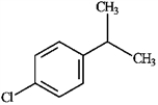
(Essay)
4.8/5 (73)
(73) Which structure of molecular formula C4H8Cl2 fits the 1H NMR and 13C NMR spectra shown below? 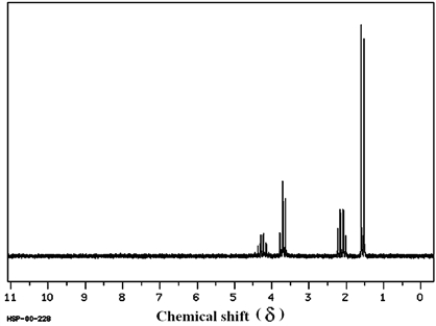
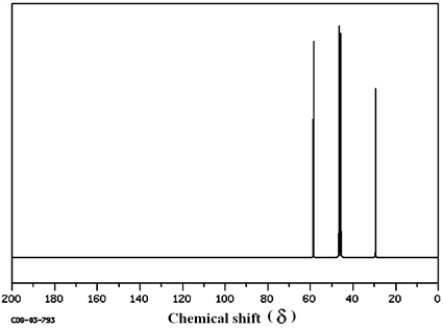 (Spectrum obtained from: SDBSWeb: http://www.aist.go.jp/RIODB/SDBS/)
 (Multiple Choice)
4.8/5 (81)
(81) Which feature in the 1H NMR spectrum provides information about the relative numbers of hydrogen atoms of each type found in a compound?
(Multiple Choice)
4.7/5 (96)
(96) Which feature in the 1H NMR spectrum provides information about the number of neighboring protons of each proton in the compound?
(Multiple Choice)
4.9/5 (75)
(75) 
Filters
- Essay(0)
- Multiple Choice(0)
- Short Answer(0)
- True False(0)
- Matching(0)