



 Chat with AI
Exam 20: Amino Acid Metabolism

Exam 1: Structure and Bonding29 Questions
Exam 2: Polar Covalent Bonds; Acids and Bases41 Questions
Exam 3: Organic Compounds: Alkanes and Their Stereochemistry32 Questions
Exam 4: Organic Compounds: Cycloalkanes and Their Stereochemistry29 Questions
Exam 5: Stereochemistry at Tetrahedral Centers40 Questions
Exam 6: An Overview of Organic Reactions39 Questions
Exam 7: Alkenes and Alkynes36 Questions
Exam 8: Reactions of Alkenes and Alkynes38 Questions
Exam 9: Aromatic Compounds37 Questions
Exam 10: Structure Determination: Mass Spectrometry, Infrared Spectroscopy, and Ultraviolet Spectroscopy42 Questions
Exam 10: Structure Determination: Mass Spectrometry, Infrared Spectroscopy, and Ultraviolet Spectroscopy43 Questions
Exam 11: Structure Determination: Nuclear Magnetic Resonance Spectroscopy41 Questions
Exam 12: Organohalides: Nucleophilic Substitutions and Eliminations43 Questions
Exam 13: Alcohols, Phenols, and Thiols; Ethers and Sulfides38 Questions
Exam 14: Aldehydes and Ketones: Nucleophilic Addition Reactions36 Questions
Exam 15: Carboxylic Acids and Nitriles36 Questions
Exam 16: Carboxylic Acid Derivatives: Nucleophilic Acyl Substitution Reactions46 Questions
Exam 17: Carbonyl Alpha-Substitution and Condensation Reactions46 Questions
Exam 18: Amines and Heterocycles36 Questions
Exam 19: Biomolecules: Amino Acids, Peptides, and Proteins52 Questions
Exam 20: Amino Acid Metabolism32 Questions
Exam 21: Biomolecules: Carbohydrates49 Questions
Exam 22: Carbohydrate Metabolism45 Questions
Exam 23: Biomolecules: Lipids and Their Metabolism42 Questions
Exam 24: Biomolecules: Nucleic Acids and Their Metabolism34 Questions
Exam 26: Orbitals and Organic Chemistry: Pericyclic Reactionse44 Questions
Exam 27: Synthetic Polymerse35 Questions
Select questions type


Suppose that the formation of a dipeptide is endergonic by +14.7 kJ/mol. If this reaction is coupled with the hydrolysis of ATP, will the net reaction be spontaneous or nonspontaneous? Explain your answer.

Free
(Essay)
4.9/5  (76)
(76) Correct Answer: Verified
The net reaction will be spontaneous since the ΔGnet value is −15.8 kJ/mol. This is based on coupling the endergonic reaction with a ΔG of +14.7 kJ/mol with the exergonic hydrolysis of ATP with a ΔG value of −30.5 kJ/mol. ΔGnet = −30.5 kJ/mol +14.7 kJ/mol = −15.8 kJ/mol.
This many ATP equivalents are required to produce one molecule of urea from ammonia:
Free
(Multiple Choice)
4.8/5 (78)
(78) Correct Answer:Verified
VerifiedC
Write a mechanism for the nonenzymatic transformation of glutamate semialdehyde into 1-pyrroline-5-carboxylate. Which amino acid is synthesized from 1-pyrroline-5-carboxylate in vivo? 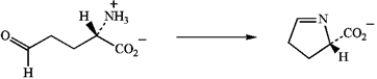
Free
(Essay)
4.9/5 (79)
(79) Correct Answer:Verified
Verified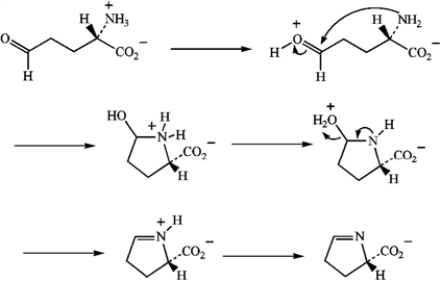 proline is synthesized from 1-pyrroline-5-carboxylate.
3-Phosphoglycerate contains the carbon skeleton used to make
(Multiple Choice)
5.0/5 (95)
(95) The reaction, 2 NH4+ + α-ketoglutarate + NADPH + ATP → glutamine + NADP+ + ADP + Pi + H2O, is the combined result of what two enzymes?
(Multiple Choice)
4.8/5 (81)
(81) The coenzyme pyridoxal phosphate (PLP) in its active form has all the following characteristics except:
(Multiple Choice)
4.8/5 (69)
(69) Consider the deamination of serine to answer the following questions.
a)Draw the structure of the α-keto acid produced by the deamination of serine.
b)What is the fate of the amino group in serine when this conversion occurs in a mammalian system?
(Essay)
4.8/5 (71)
(71) 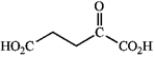
Ornithine serves three metabolically important roles but is not found in proteins. Which of the following statements about ornithine is not true?
(Multiple Choice)
4.8/5 (77)
(77) Amino acids biosynthesized from aspartate include all except:
(Multiple Choice)
4.8/5 (72)
(72) Which of the following is not an intermediate in the urea cycle?
(Multiple Choice)
4.9/5 (89)
(89) What product would be obtained from enzymatic transamination of 3-hydroxy-2-ketopropanoic acid? 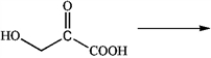
(Essay)
4.8/5 (82)
(82) Draw the structure of the product formed when the substance shown below undergoes amide formation. 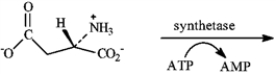
(Essay)
4.8/5 (87)
(87) The key functional group in the PLP-dependent transamination of an α-amino acid is an activated
(Multiple Choice)
4.8/5 (84)
(84) In the process of amino acid biosynthesis, how are glutamic acid, glutamine, proline, and arginine all related?
(Multiple Choice)
5.0/5 (82)
(82) Glucogenic amino acids include all of the following, except:
(Multiple Choice)
4.9/5 (81)
(81) The following shows a part of the biosynthetic pathway of amino acids. If possible, draw an arrow to match the amino acid with its precursor. 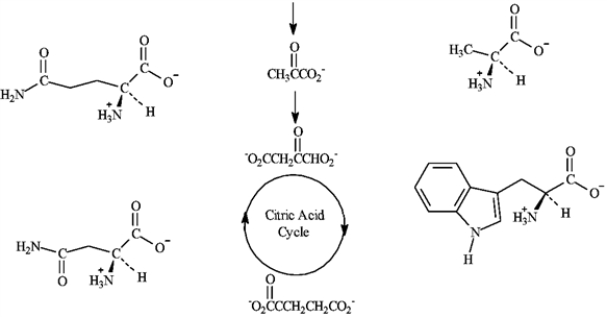
(Essay)
4.8/5 (78)
(78) 
Filters
- Essay(0)
- Multiple Choice(0)
- Short Answer(0)
- True False(0)
- Matching(0)