



 Chat with AI
Exam 21: Biomolecules: Carbohydrates

Exam 1: Structure and Bonding29 Questions
Exam 2: Polar Covalent Bonds; Acids and Bases41 Questions
Exam 3: Organic Compounds: Alkanes and Their Stereochemistry32 Questions
Exam 4: Organic Compounds: Cycloalkanes and Their Stereochemistry29 Questions
Exam 5: Stereochemistry at Tetrahedral Centers40 Questions
Exam 6: An Overview of Organic Reactions39 Questions
Exam 7: Alkenes and Alkynes36 Questions
Exam 8: Reactions of Alkenes and Alkynes38 Questions
Exam 9: Aromatic Compounds37 Questions
Exam 10: Structure Determination: Mass Spectrometry, Infrared Spectroscopy, and Ultraviolet Spectroscopy42 Questions
Exam 10: Structure Determination: Mass Spectrometry, Infrared Spectroscopy, and Ultraviolet Spectroscopy43 Questions
Exam 11: Structure Determination: Nuclear Magnetic Resonance Spectroscopy41 Questions
Exam 12: Organohalides: Nucleophilic Substitutions and Eliminations43 Questions
Exam 13: Alcohols, Phenols, and Thiols; Ethers and Sulfides38 Questions
Exam 14: Aldehydes and Ketones: Nucleophilic Addition Reactions36 Questions
Exam 15: Carboxylic Acids and Nitriles36 Questions
Exam 16: Carboxylic Acid Derivatives: Nucleophilic Acyl Substitution Reactions46 Questions
Exam 17: Carbonyl Alpha-Substitution and Condensation Reactions46 Questions
Exam 18: Amines and Heterocycles36 Questions
Exam 19: Biomolecules: Amino Acids, Peptides, and Proteins52 Questions
Exam 20: Amino Acid Metabolism32 Questions
Exam 21: Biomolecules: Carbohydrates49 Questions
Exam 22: Carbohydrate Metabolism45 Questions
Exam 23: Biomolecules: Lipids and Their Metabolism42 Questions
Exam 24: Biomolecules: Nucleic Acids and Their Metabolism34 Questions
Exam 26: Orbitals and Organic Chemistry: Pericyclic Reactionse44 Questions
Exam 27: Synthetic Polymerse35 Questions
Select questions type


Refer to the sugars below to answer the following question(s). Choose the sugar that best fits each description. There is only one correct answer for each question, but sugars may be used more than once. Indicate each answer by the corresponding letter.
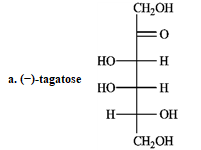
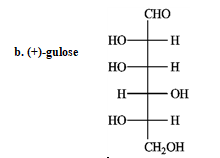
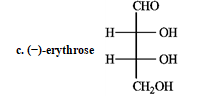
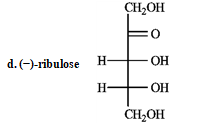 -Refer to instructions. _____ oxidizes to an optically inactive aldaric acid.
 (Multiple Choice)
4.9/5  (81)
(81) Refer to the sugars below to answer the following question(s). Choose the sugar that best fits each description. There is only one correct answer for each question, but sugars may be used more than once. Indicate each answer by the corresponding letter.
-Using the following structure of D-talose as a guide, draw the structure for α-D-talopyranose. Label each ring substituent as axial or equatorial. 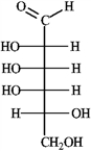
-Using the following structure of D-talose as a guide, draw the structure for α-D-talopyranose. Label each ring substituent as axial or equatorial. (Essay)
4.8/5 (87)
(87) If the following compound undergoes oxidation in the presence of the appropriate enzyme, draw the structure of the likely product. 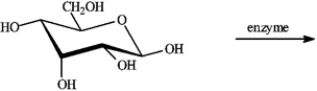
(Essay)
4.9/5 (67)
(67) Refer to the monosaccharides below to answer the following question(s).
a. Sorbose  b. Rhamnose
 c. Erythrulose
 d. Xylulose
 -Refer to instructions. Draw both chair conformations of the α-anomer of rhamnose in its pyranose form. Circle the more stable conformation.
b. Rhamnose c. Erythrulose d. Xylulose
-Refer to instructions. Draw both chair conformations of the α-anomer of rhamnose in its pyranose form. Circle the more stable conformation. (Essay)
4.9/5 (81)
(81) Refer to the equilibrium below to answer the following question(s).  -Refer to instructions. The correct name for the cyclic structure is____.
 (Multiple Choice)
4.9/5 (74)
(74) Refer to the carbohydrate below to answer the following questions. 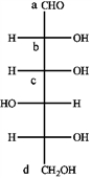 a)Which carbon in the carbohydrate is the anomeric carbon?
b)What would be observed on the addition of Tollen's reagent to a solution of this sugar?
a)Which carbon in the carbohydrate is the anomeric carbon?
b)What would be observed on the addition of Tollen's reagent to a solution of this sugar? (Essay)
4.9/5 (76)
(76) Refer to the monosaccharides below to answer the following question(s).
a. Sorbose b. Rhamnose c. Erythrulose d. Xylulose
-Refer to instructions. Assign R or S configuration to each chirality center in sorbose.
b. Rhamnose c. Erythrulose d. Xylulose
-Refer to instructions. Assign R or S configuration to each chirality center in sorbose. (Essay)
4.9/5 (87)
(87) Convert the Fischer projections into tetrahedral representations, and assign R or S stereochemistry to each.
-Convert and assign: 
(Essay)
4.8/5 (69)
(69) 
Filters
- Essay(0)
- Multiple Choice(0)
- Short Answer(0)
- True False(0)
- Matching(0)