



 Chat with AI
Exam 10: Structure Determination: Mass Spectrometry, Infrared Spectroscopy, and Ultraviolet Spectroscopy

Exam 1: Structure and Bonding29 Questions
Exam 2: Polar Covalent Bonds; Acids and Bases41 Questions
Exam 3: Organic Compounds: Alkanes and Their Stereochemistry32 Questions
Exam 4: Organic Compounds: Cycloalkanes and Their Stereochemistry29 Questions
Exam 5: Stereochemistry at Tetrahedral Centers40 Questions
Exam 6: An Overview of Organic Reactions39 Questions
Exam 7: Alkenes and Alkynes36 Questions
Exam 8: Reactions of Alkenes and Alkynes38 Questions
Exam 9: Aromatic Compounds37 Questions
Exam 10: Structure Determination: Mass Spectrometry, Infrared Spectroscopy, and Ultraviolet Spectroscopy42 Questions
Exam 10: Structure Determination: Mass Spectrometry, Infrared Spectroscopy, and Ultraviolet Spectroscopy43 Questions
Exam 11: Structure Determination: Nuclear Magnetic Resonance Spectroscopy41 Questions
Exam 12: Organohalides: Nucleophilic Substitutions and Eliminations43 Questions
Exam 13: Alcohols, Phenols, and Thiols; Ethers and Sulfides38 Questions
Exam 14: Aldehydes and Ketones: Nucleophilic Addition Reactions36 Questions
Exam 15: Carboxylic Acids and Nitriles36 Questions
Exam 16: Carboxylic Acid Derivatives: Nucleophilic Acyl Substitution Reactions46 Questions
Exam 17: Carbonyl Alpha-Substitution and Condensation Reactions46 Questions
Exam 18: Amines and Heterocycles36 Questions
Exam 19: Biomolecules: Amino Acids, Peptides, and Proteins52 Questions
Exam 20: Amino Acid Metabolism32 Questions
Exam 21: Biomolecules: Carbohydrates49 Questions
Exam 22: Carbohydrate Metabolism45 Questions
Exam 23: Biomolecules: Lipids and Their Metabolism42 Questions
Exam 24: Biomolecules: Nucleic Acids and Their Metabolism34 Questions
Exam 26: Orbitals and Organic Chemistry: Pericyclic Reactionse44 Questions
Exam 27: Synthetic Polymerse35 Questions
Select questions type


Which type of spectroscopy (IR, UV, or MS) will best distinguish between the pair of compounds below? Give a brief reason. 
(Essay)
4.8/5  (80)
(80) What region of the IR spectrum would be the most useful in distinguishing between the following two compounds? 
(Multiple Choice)
4.9/5 (70)
(70) Match each of the following groups of bond-types to the region of the infrared spectrum in which their absorptions occur.
-C−C, C−O, C−N, and C−X single-bond vibrations.
(Multiple Choice)
4.8/5 (80)
(80) Which of the following compounds gives an infrared spectrum with a peak at ˜1750 cm−1, but no significant peaks at 3000−3500 cm−1 or 1050−1250 cm−1?
(Multiple Choice)
4.9/5 (64)
(64) Refer to the mass spectrum of 2-methylbutane shown below to answer the following question(s). 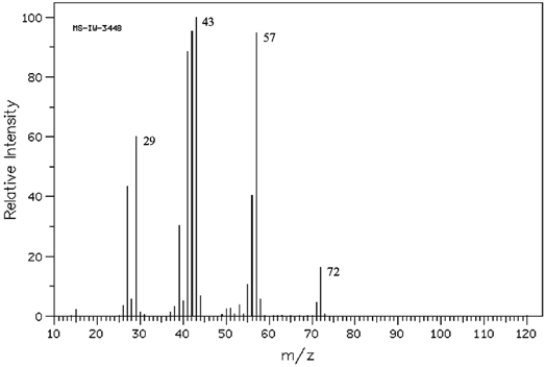 (Spectrum obtained from: SDBSWeb: http://www.aist.go.jp/RIODB/SDBS/)
-Refer to instructions. What peak represents the base peak?
(Spectrum obtained from: SDBSWeb: http://www.aist.go.jp/RIODB/SDBS/)
-Refer to instructions. What peak represents the base peak? (Short Answer)
4.9/5 (83)
(83) Arrange the following in order of increasing energy.
A. 3842 nm B. 2870 cm−1 C. 2.91 × 10¹⁶ Hz D. 1.99 × 10⁻¹⁸ J
(Short Answer)
4.7/5 (75)
(75) A 3.42 × 10⁻⁵ M solution of dibenzalacetone in ethanol produced an absorbance of 0.753 in a 1.00 cm cell. Based on this data, what is ε for this compound?
(Multiple Choice)
4.7/5 (69)
(69) Which of the following regions in the electromagnetic spectrum corresponds to the radiation with the highest energy?
(Multiple Choice)
4.9/5 (64)
(64) The amount of energy in electromagnetic radiation is related to the frequency and wavelength of the radiation. High energy radiation, like gamma rays, is of:
(Multiple Choice)
4.8/5 (75)
(75) Which of the following compounds gives an infrared spectrum with no significant peaks at ˜3300 cm−1 or 1600−1680 cm−1?
(Multiple Choice)
4.9/5 (71)
(71) Which of the following bonds gives rise to a strong absorbance near 1700 cm−1 in the infrared spectrum?
(Multiple Choice)
4.8/5 (85)
(85) What are the masses of the charged fragments produced by alpha cleavage of the following? 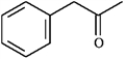
(Essay)
4.9/5 (87)
(87) Circle any of the following compounds that would be a candidate to produce a UV absorption spectrum. 
(Essay)
4.7/5 (94)
(94) Which of the following does not involve the interaction of molecules with electromagnetic energy?
(Multiple Choice)
4.8/5 (71)
(71) Which of the following statements best describes the base peak in a mass spectrum?
(Multiple Choice)
4.9/5 (60)
(60) Loratidine is the active ingredient in the antihistamine Claritin. Mass spectral analysis of loratidine shows M+ at m/z = 382. Loratidine is known to contain nitrogen. What is the minimum number of nitrogens in loratidine?
(Essay)
4.9/5 (69)
(69) The source of absorbance of light at a wavelength of 6600 nm would be:
(Multiple Choice)
4.7/5 (83)
(83) Which of the following peaks is not prominent in the mass spectrum of 2-methylbutan-2-ol?
(Multiple Choice)
4.9/5 (86)
(86) 
Filters
- Essay(0)
- Multiple Choice(0)
- Short Answer(0)
- True False(0)
- Matching(0)