



 Chat with AI
Exam 10: Structure Determination: Mass Spectrometry, Infrared Spectroscopy, and Ultraviolet Spectroscopy

Exam 1: Structure and Bonding29 Questions
Exam 2: Polar Covalent Bonds; Acids and Bases41 Questions
Exam 3: Organic Compounds: Alkanes and Their Stereochemistry32 Questions
Exam 4: Organic Compounds: Cycloalkanes and Their Stereochemistry29 Questions
Exam 5: Stereochemistry at Tetrahedral Centers40 Questions
Exam 6: An Overview of Organic Reactions39 Questions
Exam 7: Alkenes and Alkynes36 Questions
Exam 8: Reactions of Alkenes and Alkynes38 Questions
Exam 9: Aromatic Compounds37 Questions
Exam 10: Structure Determination: Mass Spectrometry, Infrared Spectroscopy, and Ultraviolet Spectroscopy42 Questions
Exam 10: Structure Determination: Mass Spectrometry, Infrared Spectroscopy, and Ultraviolet Spectroscopy43 Questions
Exam 11: Structure Determination: Nuclear Magnetic Resonance Spectroscopy41 Questions
Exam 12: Organohalides: Nucleophilic Substitutions and Eliminations43 Questions
Exam 13: Alcohols, Phenols, and Thiols; Ethers and Sulfides38 Questions
Exam 14: Aldehydes and Ketones: Nucleophilic Addition Reactions36 Questions
Exam 15: Carboxylic Acids and Nitriles36 Questions
Exam 16: Carboxylic Acid Derivatives: Nucleophilic Acyl Substitution Reactions46 Questions
Exam 17: Carbonyl Alpha-Substitution and Condensation Reactions46 Questions
Exam 18: Amines and Heterocycles36 Questions
Exam 19: Biomolecules: Amino Acids, Peptides, and Proteins52 Questions
Exam 20: Amino Acid Metabolism32 Questions
Exam 21: Biomolecules: Carbohydrates49 Questions
Exam 22: Carbohydrate Metabolism45 Questions
Exam 23: Biomolecules: Lipids and Their Metabolism42 Questions
Exam 24: Biomolecules: Nucleic Acids and Their Metabolism34 Questions
Exam 26: Orbitals and Organic Chemistry: Pericyclic Reactionse44 Questions
Exam 27: Synthetic Polymerse35 Questions
Select questions type


The amount of energy in electromagnetic radiation is related to the frequency and wavelength of the radiation. High energy radiation, like gamma rays, is of:
(Multiple Choice)
4.9/5  (79)
(79) Match each of the following groups of bond-types to the region of the infrared spectrum in which their absorptions occur.
-triple bond stretching vibrations.
(Multiple Choice)
4.8/5 (82)
(82) Which of the following bonds undergoes stretching at the highest frequency?
(Multiple Choice)
4.7/5 (79)
(79) Which of the following regions in the electromagnetic spectrum corresponds to the radiation with the highest energy?
(Multiple Choice)
4.8/5 (71)
(71) Examining the infrared spectrum of a compound allows us to:
(Multiple Choice)
4.9/5 (71)
(71) Refer to the mass spectrum of 2-methylbutane shown below to answer the following question(s). 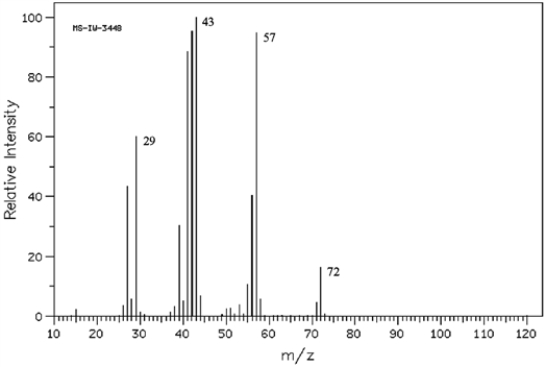 (Spectrum obtained from: SDBSWeb: http://www.aist.go.jp/RIODB/SDBS/)
-Refer to instructions. What peak represents M+?
(Spectrum obtained from: SDBSWeb: http://www.aist.go.jp/RIODB/SDBS/)
-Refer to instructions. What peak represents M+? (Essay)
4.9/5 (92)
(92) The source of absorbance of light at a wavelength of 6600 nm would be:
(Multiple Choice)
4.9/5 (82)
(82) Which of the following compounds gives an infrared spectrum with a peak at ˜1750 cm−1, but no significant peaks at 3000−3500 cm−1 or 1050−1250 cm−1?
(Multiple Choice)
4.8/5 (83)
(83) A 3.42 × 10⁻⁵ M solution of dibenzalacetone in ethanol produced an absorbance of 0.753 in a 1.00 cm cell. Based on this data, what is ε for this compound?
(Multiple Choice)
5.0/5 (75)
(75) Which of the following compounds gives an infrared spectrum with peaks at 3000−3500 cm−1 and ˜1750 cm−1?
(Multiple Choice)
4.8/5 (80)
(80) Circle any of the following compounds that would be a candidate to produce a UV absorption spectrum. 
(Essay)
4.9/5 (93)
(93) Match each of the following groups of bond-types to the region of the infrared spectrum in which their absorptions occur.
-C=O, C=N, and C=C bond absorptions.
(Multiple Choice)
4.9/5 (79)
(79) Which of the following compounds gives an infrared spectrum with no significant peaks at ˜3300 cm−1 or 1600−1680 cm−1?
(Multiple Choice)
4.7/5 (74)
(74) Assume you are carrying out the conversion of 1-bromobutane to butan-1-ol. How could you use IR spectroscopy to determine when the reaction is complete? 
(Essay)
4.8/5 (79)
(79) What are the masses of the charged fragments produced by alpha cleavage of the following? 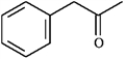
(Essay)
4.8/5 (86)
(86) Select the most reasonable formula for the compounds with the following mass spectral data.
-Refer to instructions. M+ at m/z = 101
(Multiple Choice)
4.7/5 (82)
(82) Match each of the following groups of bond-types to the region of the infrared spectrum in which their absorptions occur.
-C−C, C−O, C−N, and C−X single-bond vibrations.
(Multiple Choice)
4.8/5 (72)
(72) Which of the following compounds gives an infrared spectrum with a peak at strong 1730 cm−1?
(Multiple Choice)
4.9/5 (76)
(76) Which of the following bonds gives rise to a strong absorbance near 1700 cm−1 in the infrared spectrum?
(Multiple Choice)
4.7/5 (83)
(83) 
Filters
- Essay(0)
- Multiple Choice(0)
- Short Answer(0)
- True False(0)
- Matching(0)