



 Chat with AI
Exam 14: Aldehydes and Ketones: Nucleophilic Addition Reactions

Exam 1: Structure and Bonding29 Questions
Exam 2: Polar Covalent Bonds; Acids and Bases41 Questions
Exam 3: Organic Compounds: Alkanes and Their Stereochemistry32 Questions
Exam 4: Organic Compounds: Cycloalkanes and Their Stereochemistry29 Questions
Exam 5: Stereochemistry at Tetrahedral Centers40 Questions
Exam 6: An Overview of Organic Reactions39 Questions
Exam 7: Alkenes and Alkynes36 Questions
Exam 8: Reactions of Alkenes and Alkynes38 Questions
Exam 9: Aromatic Compounds37 Questions
Exam 10: Structure Determination: Mass Spectrometry, Infrared Spectroscopy, and Ultraviolet Spectroscopy42 Questions
Exam 10: Structure Determination: Mass Spectrometry, Infrared Spectroscopy, and Ultraviolet Spectroscopy43 Questions
Exam 11: Structure Determination: Nuclear Magnetic Resonance Spectroscopy41 Questions
Exam 12: Organohalides: Nucleophilic Substitutions and Eliminations43 Questions
Exam 13: Alcohols, Phenols, and Thiols; Ethers and Sulfides38 Questions
Exam 14: Aldehydes and Ketones: Nucleophilic Addition Reactions36 Questions
Exam 15: Carboxylic Acids and Nitriles36 Questions
Exam 16: Carboxylic Acid Derivatives: Nucleophilic Acyl Substitution Reactions46 Questions
Exam 17: Carbonyl Alpha-Substitution and Condensation Reactions46 Questions
Exam 18: Amines and Heterocycles36 Questions
Exam 19: Biomolecules: Amino Acids, Peptides, and Proteins52 Questions
Exam 20: Amino Acid Metabolism32 Questions
Exam 21: Biomolecules: Carbohydrates49 Questions
Exam 22: Carbohydrate Metabolism45 Questions
Exam 23: Biomolecules: Lipids and Their Metabolism42 Questions
Exam 24: Biomolecules: Nucleic Acids and Their Metabolism34 Questions
Exam 26: Orbitals and Organic Chemistry: Pericyclic Reactionse44 Questions
Exam 27: Synthetic Polymerse35 Questions
Select questions type


Consider the data below to answer the following question(s).
Cyanohydrins are important intermediates in the synthesis of α-hydroxycarboxylic acids from ketones and aldehydes. The nitrile functional group can be hydrolyzed by aqueous acid to yield a carboxylic acid. Nitriles can also be hydrolyzed to carboxylic acids using aqueous base. When a cyanohydrin is treated with aqueous base, however, the original carbonyl compound is isolated. 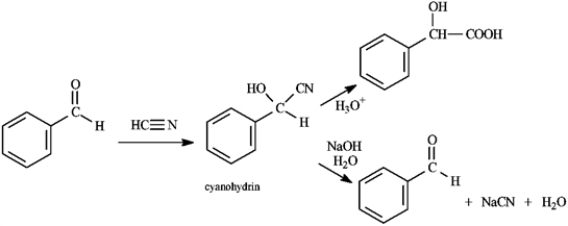 -Refer to instructions. Identify the electrophile and nucloephile in the reaction of benzaldehyde with hydrogen cyanide.
 (Essay)
4.9/5  (61)
(61) Which of the following would correctly describe the respective 13C NMR and 1H NMR spectra for the indicated atoms for the compound shown below? 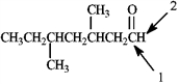
(Multiple Choice)
4.7/5 (81)
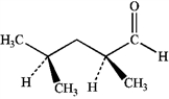
(81) 
What is the correct assignment of the functional groups in each of the following compounds? 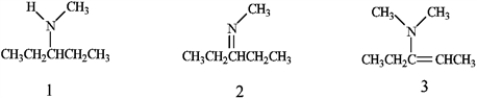
(Multiple Choice)
4.9/5 (87)
(87) Draw structures corresponding to each of the following names.
-Draw:
cyclohexen-2-one
(Essay)
4.8/5 (81)
(81) Predict the products from the information given for the following question(s).
-Predict: 
(Essay)
4.9/5 (73)
(73) Draw structures corresponding to each of the following names.
-Draw:
benzophenone
(Essay)
4.8/5 (79)
(79) Synthesize the following alkene through the Wittig reaction of a carbonyl compound and a phosphorus ylide. 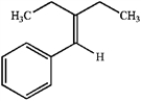
(Essay)
4.7/5 (76)
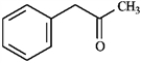
(76) 
α,β-Unsaturated aldehydes and ketones can undergo reaction with nucleophiles at the β carbon, as shown below. Use this information to answer the following question(s). 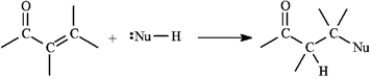 -Refer to instructions. This reaction is called a(n) _____ reaction.
 (Multiple Choice)
4.9/5 (80)
(80) In the box, what is the name of the reactant used in the following reaction? 
(Multiple Choice)
4.9/5 (88)
(88) Predict whether the following reactions of the depicted carbonyl containing compounds and amines will result in the formation of an enamine or an imine.
A 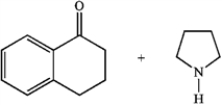 B
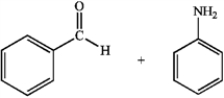 C
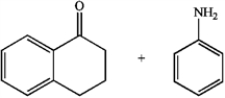
B C (Essay)
4.9/5 (77)
(77) Consider the data below to answer the following question(s).
C7H14O
IR:
1715 cm−1
MS:
M+ at m/z = 114, α-cleavage fragment at m/z = 71.
McLafferty rearrangement fragment at m/z = 86.
1H NMR:
0.92 δ (6 H, triplet), 1.59 δ (4 H, multiplet), 2.36 δ (4 H, triplet)
-Refer to instructions. Interpret the 1H NMR data.
(Essay)
4.9/5 (80)
(80) Consider the data below to answer the following question(s).
Cyanohydrins are important intermediates in the synthesis of α-hydroxycarboxylic acids from ketones and aldehydes. The nitrile functional group can be hydrolyzed by aqueous acid to yield a carboxylic acid. Nitriles can also be hydrolyzed to carboxylic acids using aqueous base. When a cyanohydrin is treated with aqueous base, however, the original carbonyl compound is isolated.
-Refer to instructions. The reaction of an aldehyde with hydrogen cyanide is an example of _____ reaction.
-Refer to instructions. The reaction of an aldehyde with hydrogen cyanide is an example of _____ reaction. (Multiple Choice)
4.9/5 (84)
(84) Consider the data below to answer the following question(s).
C7H14O
IR:
1715 cm−1
MS:
M+ at m/z = 114, α-cleavage fragment at m/z = 71.
McLafferty rearrangement fragment at m/z = 86.
1H NMR:
0.92 δ (6 H, triplet), 1.59 δ (4 H, multiplet), 2.36 δ (4 H, triplet)
-Refer to instructions. Interpret the mass spectral data.
(Essay)
4.9/5 (81)
(81) The nucleophillic addition of water to an aldehyde or ketone
(Multiple Choice)
4.7/5 (72)
(72) 
Filters
- Essay(0)
- Multiple Choice(0)
- Short Answer(0)
- True False(0)
- Matching(0)