



 Chat with AI
Exam 26: Orbitals and Organic Chemistry: Pericyclic Reactionse

Exam 1: Structure and Bonding29 Questions
Exam 2: Polar Covalent Bonds; Acids and Bases41 Questions
Exam 3: Organic Compounds: Alkanes and Their Stereochemistry32 Questions
Exam 4: Organic Compounds: Cycloalkanes and Their Stereochemistry29 Questions
Exam 5: Stereochemistry at Tetrahedral Centers40 Questions
Exam 6: An Overview of Organic Reactions39 Questions
Exam 7: Alkenes and Alkynes36 Questions
Exam 8: Reactions of Alkenes and Alkynes38 Questions
Exam 9: Aromatic Compounds37 Questions
Exam 10: Structure Determination: Mass Spectrometry, Infrared Spectroscopy, and Ultraviolet Spectroscopy42 Questions
Exam 10: Structure Determination: Mass Spectrometry, Infrared Spectroscopy, and Ultraviolet Spectroscopy43 Questions
Exam 11: Structure Determination: Nuclear Magnetic Resonance Spectroscopy41 Questions
Exam 12: Organohalides: Nucleophilic Substitutions and Eliminations43 Questions
Exam 13: Alcohols, Phenols, and Thiols; Ethers and Sulfides38 Questions
Exam 14: Aldehydes and Ketones: Nucleophilic Addition Reactions36 Questions
Exam 15: Carboxylic Acids and Nitriles36 Questions
Exam 16: Carboxylic Acid Derivatives: Nucleophilic Acyl Substitution Reactions46 Questions
Exam 17: Carbonyl Alpha-Substitution and Condensation Reactions46 Questions
Exam 18: Amines and Heterocycles36 Questions
Exam 19: Biomolecules: Amino Acids, Peptides, and Proteins52 Questions
Exam 20: Amino Acid Metabolism32 Questions
Exam 21: Biomolecules: Carbohydrates49 Questions
Exam 22: Carbohydrate Metabolism45 Questions
Exam 23: Biomolecules: Lipids and Their Metabolism42 Questions
Exam 24: Biomolecules: Nucleic Acids and Their Metabolism34 Questions
Exam 26: Orbitals and Organic Chemistry: Pericyclic Reactionse44 Questions
Exam 27: Synthetic Polymerse35 Questions
Select questions type




Exhibit 30-8
Classify each of the following sigmatropic reactions by order [x, y].
26.  ANSWER:
[3, 3]
 POINTS:
1
27.
 ANSWER:
[1, 7]
 POINTS:
1
28.
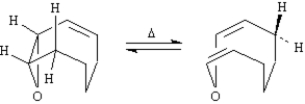 ANSWER:
[1, 5]
 POINTS:
1
Exhibit 30-9
Vitamin D3, cholecalciferol, is synthesized under the skin by the photochemical pericyclic process shown below. Answer the following question(s) about these reactions.
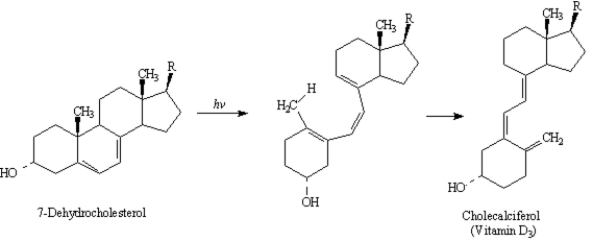 -Refer to Exhibit 30-9. The first step in this process is a(n):
ANSWER:
[3, 3] POINTS:
1
27. ANSWER:
[1, 7] POINTS:
1
28. ANSWER:
[1, 5] POINTS:
1
Exhibit 30-9
Vitamin D3, cholecalciferol, is synthesized under the skin by the photochemical pericyclic process shown below. Answer the following question(s) about these reactions.
-Refer to Exhibit 30-9. The first step in this process is a(n): (Multiple Choice)
4.8/5  (81)
(81) Exhibit 30-3
To answer the following question(s), consider the reaction below:  -Refer to Exhibit 30-3. Two pericyclic reactions are involved in this synthesis of compound Y. Draw the structure of intermediate X and name it using IUPAC nomenclature.
 (Essay)
4.8/5 (70)
(70) Exhibit 30-6
Consider the reaction sequence below to answer the following question(s):  -Refer to Exhibit 30-6. Step 1 is an example of:
 (Multiple Choice)
4.9/5 (72)
(72) Exhibit 30-7
Consider the Sommelet-Hauser rearrangement below to answer the following question(s): 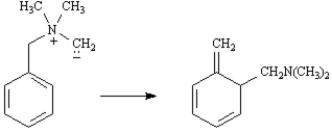 -Refer to Exhibit 30-7. The Sommelet-Hauser rearrangement is an example of a [2, 3] sigmatropic rearrangement. How many pairs of electrons are involved in this reaction?
 (Multiple Choice)
4.9/5 (90)
(90) Exhibit 30-4
Consider the reaction below to answer the following question(s):  -Refer to Exhibit 30-4. Explain the stereochemistry of this reaction.
 (Essay)
4.8/5 (89)
(89) Under photochemical conditions, the following substance will undergo: 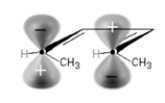
(Multiple Choice)
4.9/5 (67)
(67) To answer the following question(s), consider the π molecular orbitals of a conjugated diene shown below:  -Draw the product(s) you would expect to obtain from photochemical cyclization of (2Z, 4E)-hexadiene.

-Draw the product(s) you would expect to obtain from photochemical cyclization of (2Z, 4E)-hexadiene. (Essay)
4.9/5 (77)
(77) Exhibit 30-5
To answer the following question(s), consider the reaction below:  -Refer to Exhibit 30-5. Propose a mechanism for the reaction that fully accounts for the formation of both products.
 (Essay)
4.7/5 (75)
(75) 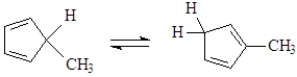
Exhibit 30-5
To answer the following question(s), consider the reaction below:
-Refer to Exhibit 30-5. What type of pericyclic reaction is involved in this transformation?
-Refer to Exhibit 30-5. What type of pericyclic reaction is involved in this transformation? (Multiple Choice)
4.7/5 (84)
(84) Exhibit 30-2
Consider the reaction below to answer the following question(s):  -Refer to Exhibit 30-2. Has this reaction taken place in a conrotatory manner or in a disrotatory manner?
 (Essay)
4.9/5 (65)
(65) To answer the following question(s), consider the π molecular orbitals of a conjugated diene shown below:
-Refer to Exhibit 30-1. Which molecular orbital of a conjugated diene contains two nodes between nuclei?
-Refer to Exhibit 30-1. Which molecular orbital of a conjugated diene contains two nodes between nuclei? (Multiple Choice)
4.9/5 (80)
(80) For an odd number of electron pairs (double bonds), for cycloadditions reactions which of the following rules is correct?:
(Multiple Choice)
4.8/5 (67)
(67) Exhibit 30-7
Consider the Sommelet-Hauser rearrangement below to answer the following question(s):
-Refer to Exhibit 30-7. Would you expect the Sommelet-Hauser rearrangement to be antarafacial or suprafacial? Explain.
-Refer to Exhibit 30-7. Would you expect the Sommelet-Hauser rearrangement to be antarafacial or suprafacial? Explain. (Essay)
4.8/5 (94)
(94) Exhibit 30-6
Consider the reaction sequence below to answer the following question(s):
-Refer to Exhibit 30-6. Explain the stereochemistry of product C.
-Refer to Exhibit 30-6. Explain the stereochemistry of product C. (Essay)
4.7/5 (87)
(87) Exhibit 30-6
Consider the reaction sequence below to answer the following question(s):
-Refer to Exhibit 30-6. Show how C is formed from B.
-Refer to Exhibit 30-6. Show how C is formed from B. (Essay)
4.9/5 (69)
(69) Exhibit 30-6
Consider the reaction sequence below to answer the following question(s):
-Refer to Exhibit 30-6. Explain the stereochemistry of product B.
-Refer to Exhibit 30-6. Explain the stereochemistry of product B. (Essay)
4.9/5 (63)
(63) 
Filters
- Essay(0)
- Multiple Choice(0)
- Short Answer(0)
- True False(0)
- Matching(0)