



 Chat with AI
Exam 27: Bioenergetics: How the Body Converts Food to Energy

Exam 1: Matter, Energy, and Measurement143 Questions
Exam 2: Atoms133 Questions
Exam 3: Chemical Bonds140 Questions
Exam 4: Chemical Reactions140 Questions
Exam 5: Gases, Liquids, and Solids132 Questions
Exam 6: Solutions and Colloids153 Questions
Exam 7: Reaction Rates and Chemical Equilibrium103 Questions
Exam 8: Acids and Bases197 Questions
Exam 9: Nuclear Chemistry155 Questions
Exam 10: Organic Chemistry70 Questions
Exam 11: Alkanes142 Questions
Exam 12: Alkenes and Alkynes123 Questions
Exam 13: Benzene and Its Derivatives60 Questions
Exam 14: Alcohols, Ethers, and Thiols122 Questions
Exam 15: Chirality: the Handedness of Molecules92 Questions
Exam 16: Amines89 Questions
Exam 17: Aldehydes and Ketones101 Questions
Exam 18: Carboxylic Acids115 Questions
Exam 19: Carboxylic Anhydrides, Esters, and Amides117 Questions
Exam 20: Carbohydrates103 Questions
Exam 21: Lipids132 Questions
Exam 22: Proteins128 Questions
Exam 23: Enzymes62 Questions
Exam 24: Chemical Communications: Neurotransmitters and Hormones89 Questions
Exam 25: Nucleotides, Nucleic Acids, and Heredity121 Questions
Exam 26: Gene Expression and Protein Synthesis129 Questions
Exam 27: Bioenergetics: How the Body Converts Food to Energy140 Questions
Exam 28: Specific Catabolic Pathways: Carbohydrate, Lipid, and Protein Metabolism104 Questions
Exam 29: Biosynthetic Pathways67 Questions
Exam 30: Nutrition73 Questions
Exam 31: Immunochemistry142 Questions
Exam 32: Body Fluids72 Questions
Select questions type


In AMP, ADP and ATP the phosphate is linked to ribose through which carbon atom?
(Multiple Choice)
4.9/5  (89)
(89) How many molecules of NADH are produced by one pass through the citric acid cycle?
(Multiple Choice)
4.8/5 (69)
(69) What type of reaction occurs when isocitrate is converted to oxalosuccinate in step 3 of the citric acid cycle?
(Multiple Choice)
4.8/5 (70)
(70) Examine the following figure.  -Examine the structures of following two compounds. Each shows the biologically operative part of the molecule.
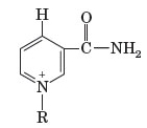
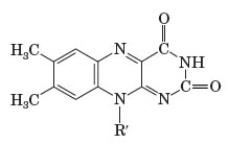 Which of the following does not correctly characterizes both compounds
-Examine the structures of following two compounds. Each shows the biologically operative part of the molecule. Which of the following does not correctly characterizes both compounds (Multiple Choice)
4.8/5 (79)
(79) How many molecules of FADH2 are obtained for each C2 fragment which enters the common catabolic pathway?
(Multiple Choice)
4.8/5 (77)
(77) How many protons are required for the conversion of ADP to ATP?
(Multiple Choice)
4.7/5 (71)
(71) Which portions of the citric acid cycle produce most of the energy generated by the cycle?
(Multiple Choice)
4.9/5 (70)
(70) How many subunits make up complex III of the electron and H+ transport chain?
(Multiple Choice)
4.7/5 (67)
(67) In AMP, ADP and ATP, what type of linkage connects the phosphate to the sugar?
(Multiple Choice)
4.9/5 (78)
(78) How many molecules of ATP are obtained for each C2 fragment which enters the common catabolic pathway?
(Multiple Choice)
4.8/5 (79)
(79) The catabolism of carbohydrates or lipids produces smaller species which then enter the citric acid cycle. How many carbon atoms are in these smaller species?
(Multiple Choice)
4.8/5 (81)
(81) Approximately how much energy is released by the hydrolysis of one mole of ATP to AMP?
(Multiple Choice)
4.9/5 (67)
(67) Which of the following is the oxidizing agent in the reaction which converts succinate to fumarate?
(Multiple Choice)
4.9/5 (67)
(67) Complex I of the electron and H+ transport chain contains a number of clusters made up of a metal and a nonmetal. Which atoms are found in these clusters?
(Multiple Choice)
4.7/5 (80)
(80) Which metal is found in complex II of the electron and H+ transport chain?
(Multiple Choice)
5.0/5 (84)
(84) In AMP, ADP and ATP the adenine is linked to ribose through which carbon atom?
(Multiple Choice)
4.9/5 (66)
(66) Which of the following is true of the catabolic pathways for carbohydrates, lipids and proteins?
(Multiple Choice)
4.8/5 (74)
(74) Where are the enzymes which promote the reaction 4H+ + 4e− + O2 → 2H2O located?
(Multiple Choice)
4.9/5 (86)
(86) 
Filters
- Essay(0)
- Multiple Choice(0)
- Short Answer(0)
- True False(0)
- Matching(0)