



 Chat with AI
Exam 28: Specific Catabolic Pathways: Carbohydrate, Lipid, and Protein Metabolism

Exam 1: Matter, Energy, and Measurement143 Questions
Exam 2: Atoms133 Questions
Exam 3: Chemical Bonds140 Questions
Exam 4: Chemical Reactions140 Questions
Exam 5: Gases, Liquids, and Solids132 Questions
Exam 6: Solutions and Colloids153 Questions
Exam 7: Reaction Rates and Chemical Equilibrium103 Questions
Exam 8: Acids and Bases197 Questions
Exam 9: Nuclear Chemistry155 Questions
Exam 10: Organic Chemistry70 Questions
Exam 11: Alkanes142 Questions
Exam 12: Alkenes and Alkynes123 Questions
Exam 13: Benzene and Its Derivatives60 Questions
Exam 14: Alcohols, Ethers, and Thiols122 Questions
Exam 15: Chirality: the Handedness of Molecules92 Questions
Exam 16: Amines89 Questions
Exam 17: Aldehydes and Ketones101 Questions
Exam 18: Carboxylic Acids115 Questions
Exam 19: Carboxylic Anhydrides, Esters, and Amides117 Questions
Exam 20: Carbohydrates103 Questions
Exam 21: Lipids132 Questions
Exam 22: Proteins128 Questions
Exam 23: Enzymes62 Questions
Exam 24: Chemical Communications: Neurotransmitters and Hormones89 Questions
Exam 25: Nucleotides, Nucleic Acids, and Heredity121 Questions
Exam 26: Gene Expression and Protein Synthesis129 Questions
Exam 27: Bioenergetics: How the Body Converts Food to Energy140 Questions
Exam 28: Specific Catabolic Pathways: Carbohydrate, Lipid, and Protein Metabolism104 Questions
Exam 29: Biosynthetic Pathways67 Questions
Exam 30: Nutrition73 Questions
Exam 31: Immunochemistry142 Questions
Exam 32: Body Fluids72 Questions
Select questions type


Consider the following reaction sequence.  -Which of the following is(are) involved in the breaking down of di- and polysaccharides to monosaccharides?
 (Multiple Choice)
4.8/5  (93)
(93) In the transport mechanism which operates in the heart and liver, how many ATP molecules are produced for each NADH + H+?
(Multiple Choice)
4.8/5 (78)
(78) The enzyme phosphoglycerate mutase promotes which of the following?
(Multiple Choice)
4.7/5 (70)
(70) Carbamoyl phosphate is formed in which region(s) of the cell?
(Multiple Choice)
4.8/5 (66)
(66) Which of the following gases is produced during the conversion of pyruvate of acetyl coenzyme A?
(Multiple Choice)
4.9/5 (74)
(74) Which of the following is not involved in the hydrolysis of proteins?
(Multiple Choice)
4.8/5 (67)
(67) Since naturally occurring fatty acids contain an even number of carbon atoms, the number of carbon atoms in such compounds can be expressed as 2n. How many turns of the β-oxidation cycle occur during the breakdown of a fatty acid which contains 2n carbon atoms?
(Multiple Choice)
4.8/5 (70)
(70) Which of the following is the main agent used to keep hemoglobin in its reduced form?
(Multiple Choice)
4.7/5 (91)
(91) The following fatty acid undergoes two loops of the β-oxidation spiral. 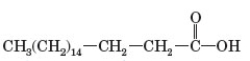 What is the value of n in the formula of the product shown below at this point?
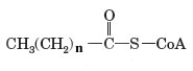
What is the value of n in the formula of the product shown below at this point? (Multiple Choice)
4.9/5 (82)
(82) The conversion of 1,3-bisphosphoglycerate to 3-phosphoglycerate produces which of the following?
(Multiple Choice)
4.7/5 (79)
(79) Complete metabolism of which of the following fatty acids will yield the most ATP molecules per carbon atom?
(Multiple Choice)
4.7/5 (79)
(79) When one molecule of glucose undergoes glycolysis, two molecules of 1,3-bisphosphoglycerate are produced; these are then dephosphorylated to yield two pyruvates. How many molecules of ATP are produced by the dephosphorylation of two molecules of 1,3-bisphosphoglycerate to yield two pyruvates?
(Multiple Choice)
4.9/5 (79)
(79) Which of the following cannot be converted to a form which can enter the glycolysis pathway?
(Multiple Choice)
4.8/5 (82)
(82) 
Filters
- Essay(0)
- Multiple Choice(0)
- Short Answer(0)
- True False(0)
- Matching(0)