



 Chat with AI
Exam 24: Carbohydrate, Lipid, and Protein Metabolism

Exam 1: Matter and Measurement89 Questions
Exam 2: Atoms and the Periodic Table90 Questions
Exam 3: Ionic Compounds90 Questions
Exam 4: Covalent Compounds90 Questions
Exam 5: Chemical Reactions89 Questions
Exam 6: Energy Changes, Reaction Rates, and Equilibrium88 Questions
Exam 7: Gases, Liquids, and Solids79 Questions
Exam 8: Solutions90 Questions
Exam 9: Acids and Bases90 Questions
Exam 10: Nuclear Chemistry85 Questions
Exam 11: Introduction to Organic Molecules and Functional Groups103 Questions
Exam 12: Alkanes106 Questions
Exam 13: Unsaturated Hydrocarbons101 Questions
Exam 14: Organic Compounds That Contain Oxygen, Halogen, or Sulfur111 Questions
Exam 15: The Three-Dimensional Shape of Molecules100 Questions
Exam 16: Aldehydes and Ketones103 Questions
Exam 17: Carboxylic Acids, Esters, and Amides81 Questions
Exam 18: Amines and Neurotransmitters105 Questions
Exam 19: Lipids105 Questions
Exam 20: Carbohydrates92 Questions
Exam 21: Amino Acids, Proteins, and Enzymes88 Questions
Exam 22: Nucleic Acids and Protein Synthesis89 Questions
Exam 23: Digestion and the Conversion of Food Into Energy92 Questions
Exam 24: Carbohydrate, Lipid, and Protein Metabolism91 Questions
Select questions type


Catabolism of a fatty acid produces more than twice the energy per gram as glucose (in terms of moles of ATP generated).
(True/False)
4.8/5  (74)
(74) How many molecules of ATP are formed per carbon atom in the fatty acid during the complete catabolism of a saturated fatty acid with the chemical formula CH3(CH2)24CO2H?
(Multiple Choice)
4.7/5 (95)
(95) Gluconeogenesis is an anabolic process that synthesizes glucose from pyruvate.
(True/False)
4.9/5 (83)
(83) The first step in gluconeogenesis is the oxidation of lactic acid. What product is formed when lactic acid is oxidized? 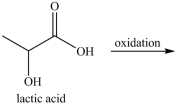
(Multiple Choice)
4.8/5 (92)
(92) The first step in gluconeogenesis is the oxidation of lactic acid. What product is formed when lactic acid is oxidized? 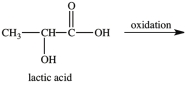
(Multiple Choice)
4.8/5 (84)
(84) Under some circumstances, when glucose is unavailable or cannot pass into a cell for use as fuel, ketone bodies accumulate, a condition called _____.
(Short Answer)
4.9/5 (74)
(74) Gluconeogenesis is not a commonly used metabolic pathway when carbohydrate intake is high.
(True/False)
4.8/5 (80)
(80) Which statement best describes the energy requirement for the conversion of a fatty acid to a thioester with coenzyme A in the -oxidation of a fatty acid?
(Multiple Choice)
4.9/5 (67)
(67) In oxidative deamination, glutamate is re-converted to -ketoglutarate, which can undergo transamination with another molecule of an amino acid and the cycle repeats.
(True/False)
5.0/5 (68)
(68) Which condition does not lead to increased levels of ketone bodies?
(Multiple Choice)
5.0/5 (67)
(67) The hydrolysis of ATP to ADP releases 7.3 kcal/mol of energy. If the coupled reaction below releases 3.4 kcal/mol of energy, then the amount of energy required for the phosphorylation of fructose 6-phosphate is _____ kcal/mol. 
(Short Answer)
4.9/5 (84)
(84) 
Filters
- Essay(0)
- Multiple Choice(0)
- Short Answer(0)
- True False(0)
- Matching(0)