



 Chat with AI
Exam 20: Carbohydrates

Exam 1: Matter and Measurement89 Questions
Exam 2: Atoms and the Periodic Table90 Questions
Exam 3: Ionic Compounds90 Questions
Exam 4: Covalent Compounds90 Questions
Exam 5: Chemical Reactions89 Questions
Exam 6: Energy Changes, Reaction Rates, and Equilibrium88 Questions
Exam 7: Gases, Liquids, and Solids79 Questions
Exam 8: Solutions90 Questions
Exam 9: Acids and Bases90 Questions
Exam 10: Nuclear Chemistry85 Questions
Exam 11: Introduction to Organic Molecules and Functional Groups103 Questions
Exam 12: Alkanes106 Questions
Exam 13: Unsaturated Hydrocarbons101 Questions
Exam 14: Organic Compounds That Contain Oxygen, Halogen, or Sulfur111 Questions
Exam 15: The Three-Dimensional Shape of Molecules100 Questions
Exam 16: Aldehydes and Ketones103 Questions
Exam 17: Carboxylic Acids, Esters, and Amides81 Questions
Exam 18: Amines and Neurotransmitters105 Questions
Exam 19: Lipids105 Questions
Exam 20: Carbohydrates92 Questions
Exam 21: Amino Acids, Proteins, and Enzymes88 Questions
Exam 22: Nucleic Acids and Protein Synthesis89 Questions
Exam 23: Digestion and the Conversion of Food Into Energy92 Questions
Exam 24: Carbohydrate, Lipid, and Protein Metabolism91 Questions
Select questions type


Which naturally-occurring monosaccharide forms the Haworth structure shown? 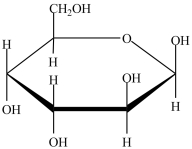

Free
(Multiple Choice)
4.8/5  (65)
(65) Correct Answer: Verified
B
Why are humans not able to digest cellulose?
Free
(Multiple Choice)
4.7/5 (88)
(88) Correct Answer:Verified
VerifiedB
Modern glucose meters are electronic devices that measure the amount of oxidizing agent that reacts with the glucose in a known amount of blood.
Free
(True/False)
5.0/5 (86)
(86) Correct Answer:Verified
VerifiedTrue
Individuals with type AB blood are called universal recipients because their blood contains no antibodies to blood types A, B, or O. Individuals with type AB blood can receive blood of any type.
(True/False)
4.8/5 (77)
(77) The structure shown has four (4)chirality centers and is a D monosaccharide. 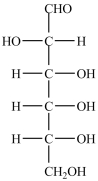
(True/False)
4.9/5 (94)
(94) When converting a Fischer projection to a Haworth projection, where are all of the substituents on the right side of the carbon skeleton drawn in the Haworth projection?
(Multiple Choice)
4.9/5 (64)
(64) In aldohexoses, it is the -OH group on C5 that reacts with the aldehyde carbonyl to form two cyclic hemiacetals called anomers.
(True/False)
4.8/5 (83)
(83) Which carbohydrates cannot be converted to simpler compounds by hydrolysis?
(Multiple Choice)
4.8/5 (74)
(74) What product forms when the compound below is treated with Benedict's reagent? 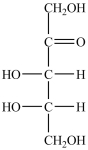
(Multiple Choice)
4.9/5 (74)
(74) The carbonyl group of an aldose is reduced to a secondary alcohol using hydrogen (H2)in the presence of palladium (Pd)metal.
(True/False)
4.8/5 (70)
(70) Which labeled carbon atom in the structure below is the anomeric carbon? 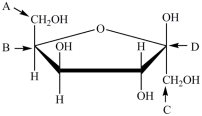
(Multiple Choice)
4.8/5 (86)
(86) Certain monosaccharides-notably aldopentoses and ketohexoses-form five-membered rings, not six-membered rings, in solution.
(True/False)
4.9/5 (74)
(74) 
When a monosaccharide forms a cyclic hemiacetal, the carbon atom that is part of the hemiacetal is a new chirality center, called the anomeric carbon.
(True/False)
4.9/5 (74)
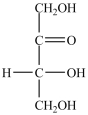
(74) Dihydroxyacetone, shown below, is the simplest ketose. Does the structure shown represent D-dihydroxyacetone or L-dihydroxyacetone? 
(Multiple Choice)
4.8/5 (73)
(73) Salicin is a naturally occurring, carbohydrate-containing pain reliever. Which statement concerning the functional groups present in salicin is incorrect? 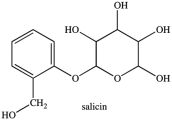
(Multiple Choice)
4.8/5 (96)
(96) In addition to the three monosaccharides that occur in all blood types, type A blood contains the monosaccharide N-acetyl-D-galactosamine, and type B blood contains an additional D-galactose unit.
(True/False)
4.9/5 (74)
(74) 
Filters
- Essay(0)
- Multiple Choice(0)
- Short Answer(0)
- True False(0)
- Matching(0)