



 Chat with AI
Exam 21: Amino Acids, Proteins, and Enzymes

Exam 1: Matter and Measurement89 Questions
Exam 2: Atoms and the Periodic Table90 Questions
Exam 3: Ionic Compounds90 Questions
Exam 4: Covalent Compounds90 Questions
Exam 5: Chemical Reactions89 Questions
Exam 6: Energy Changes, Reaction Rates, and Equilibrium88 Questions
Exam 7: Gases, Liquids, and Solids79 Questions
Exam 8: Solutions90 Questions
Exam 9: Acids and Bases90 Questions
Exam 10: Nuclear Chemistry85 Questions
Exam 11: Introduction to Organic Molecules and Functional Groups103 Questions
Exam 12: Alkanes106 Questions
Exam 13: Unsaturated Hydrocarbons101 Questions
Exam 14: Organic Compounds That Contain Oxygen, Halogen, or Sulfur111 Questions
Exam 15: The Three-Dimensional Shape of Molecules100 Questions
Exam 16: Aldehydes and Ketones103 Questions
Exam 17: Carboxylic Acids, Esters, and Amides81 Questions
Exam 18: Amines and Neurotransmitters105 Questions
Exam 19: Lipids105 Questions
Exam 20: Carbohydrates92 Questions
Exam 21: Amino Acids, Proteins, and Enzymes88 Questions
Exam 22: Nucleic Acids and Protein Synthesis89 Questions
Exam 23: Digestion and the Conversion of Food Into Energy92 Questions
Exam 24: Carbohydrate, Lipid, and Protein Metabolism91 Questions
Select questions type


Which Fischer projections represent naturally-occurring amino acids? 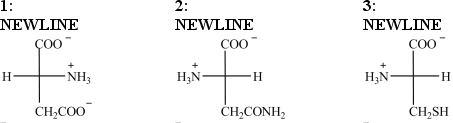

Free
(Multiple Choice)
4.9/5  (87)
(87) Correct Answer: Verified
D
The pH at which an amino acid exists primarily in its neutral form is called its _____ point.
Free
(Short Answer)
4.9/5 (76)
(76) Correct Answer:Verified
Verifiedisoelectric
Denaturation of a protein results in the loss of its native conformation and its biological activity. Which statement best describes what happens to a protein when it is denatured?
Free
(Multiple Choice)
4.8/5 (94)
(94) Correct Answer:Verified
VerifiedC
_____ bonds between cysteine residues are the only covalent bonds that stabilize the tertiary structure of a protein.
(Short Answer)
5.0/5 (78)
(78) _____ proteins are composed of long linear polypeptide chains that are bundled together to form rods or sheets that are insoluble in water and serve structural roles.
(Short Answer)
5.0/5 (83)
(83) Trypsin is a digestive enzyme that hydrolyzes peptide bonds only when the carbonyl group in the amide bond comes from Lys or Arg. What fragments result when the peptide Gly-Lys-Arg-Ala-Ala-Arg is hydrolyzed by trypsin?
(Multiple Choice)
4.9/5 (73)
(73) What is the strongest type of interaction between two cysteine amino acid side chains in a protein?
(Multiple Choice)
4.8/5 (78)
(78) Which conditions are commonly diagnosed by measuring the levels of specific enzymes in the blood?
(Multiple Choice)
4.7/5 (78)
(78) Secretion of vasopressin by the pituitary gland causes the kidneys to retain fluid, resulting in decreased urine output.
(True/False)
4.8/5 (95)
(95) What is the C-terminal amino acid in the tetrapeptide glycylalanyisoleucylmethionine?
(Multiple Choice)
4.8/5 (89)
(89) Insulin is a small protein consisting of two polypeptide chains held together by hydrogen bonds.
(True/False)
4.9/5 (77)
(77) HIV protease inhibitors are used to treat HIV by binding to an enzyme needed by the virus to replicate itself.
(True/False)
4.7/5 (77)
(77) D-Amino acids have the -NH3+ group on the left side in the Fischer projection.
(True/False)
4.8/5 (88)
(88) How many chirality centers are in leu-enkephalin (structure shown)? 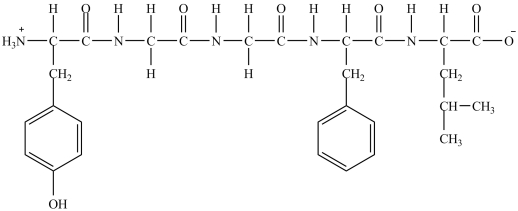
(Multiple Choice)
4.8/5 (53)
(53) When the peptide below is hydrolyzed with water, the products are the amino acids proline, cysteine, and glutamine. 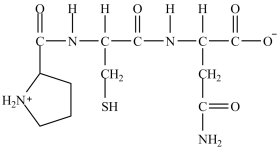
(True/False)
4.7/5 (78)
(78) Since amino acids contain a base (NH2 group)and an acid (COOH), proton transfer from the acid to the base forms a salt called a/an _____, which contains both a positive and a negative charge.
(Short Answer)
4.8/5 (82)
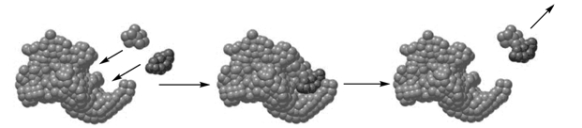
(82) 

Filters
- Essay(0)
- Multiple Choice(0)
- Short Answer(0)
- True False(0)
- Matching(0)