



 Chat with AI
Exam 21: Amino Acids, Proteins, and Enzymes

Exam 1: Matter and Measurement89 Questions
Exam 2: Atoms and the Periodic Table90 Questions
Exam 3: Ionic Compounds90 Questions
Exam 4: Covalent Compounds90 Questions
Exam 5: Chemical Reactions89 Questions
Exam 6: Energy Changes, Reaction Rates, and Equilibrium88 Questions
Exam 7: Gases, Liquids, and Solids79 Questions
Exam 8: Solutions90 Questions
Exam 9: Acids and Bases90 Questions
Exam 10: Nuclear Chemistry85 Questions
Exam 11: Introduction to Organic Molecules and Functional Groups103 Questions
Exam 12: Alkanes106 Questions
Exam 13: Unsaturated Hydrocarbons101 Questions
Exam 14: Organic Compounds That Contain Oxygen, Halogen, or Sulfur111 Questions
Exam 15: The Three-Dimensional Shape of Molecules100 Questions
Exam 16: Aldehydes and Ketones103 Questions
Exam 17: Carboxylic Acids, Esters, and Amides81 Questions
Exam 18: Amines and Neurotransmitters105 Questions
Exam 19: Lipids105 Questions
Exam 20: Carbohydrates92 Questions
Exam 21: Amino Acids, Proteins, and Enzymes88 Questions
Exam 22: Nucleic Acids and Protein Synthesis89 Questions
Exam 23: Digestion and the Conversion of Food Into Energy92 Questions
Exam 24: Carbohydrate, Lipid, and Protein Metabolism91 Questions
Select questions type


By convention, the C-terminal amino acid is always written at the right end of the peptide chain and the N-terminal amino acid at the left.
(True/False)
4.9/5  (83)
(83) No one plant source has sufficient amounts of all of the essential amino acids.
(True/False)
4.9/5 (83)
(83) The lock-and-key model is often used to explain why some enzymes catalyze a wide variety of substrate reactions.
(True/False)
4.8/5 (75)
(75) The enzyme in the ribbon diagram shown is composed primarily of -pleated sheets. 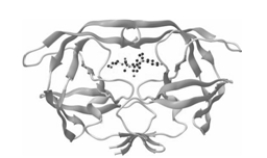
(True/False)
4.9/5 (72)
(72) Hemoglobin, collagen, and myoglobin are all examples of conjugated proteins.
(True/False)
4.8/5 (84)
(84) Amino acids are the building blocks of the body's proteins. Which statement concerning amino acids is false? 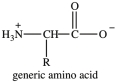
(Multiple Choice)
4.8/5 (85)
(85) Amino acids with an additional COOH group in the side chain are classified as acidic amino acids.
(True/False)
4.9/5 (79)
(79) 
Filters
- Essay(0)
- Multiple Choice(0)
- Short Answer(0)
- True False(0)
- Matching(0)