



 Chat with AI
Exam 21: Amino Acids, Proteins, and Enzymes

Exam 1: Matter and Measurement89 Questions
Exam 2: Atoms and the Periodic Table90 Questions
Exam 3: Ionic Compounds90 Questions
Exam 4: Covalent Compounds90 Questions
Exam 5: Chemical Reactions89 Questions
Exam 6: Energy Changes, Reaction Rates, and Equilibrium88 Questions
Exam 7: Gases, Liquids, and Solids79 Questions
Exam 8: Solutions90 Questions
Exam 9: Acids and Bases90 Questions
Exam 10: Nuclear Chemistry85 Questions
Exam 11: Introduction to Organic Molecules and Functional Groups103 Questions
Exam 12: Alkanes106 Questions
Exam 13: Unsaturated Hydrocarbons101 Questions
Exam 14: Organic Compounds That Contain Oxygen, Halogen, or Sulfur111 Questions
Exam 15: The Three-Dimensional Shape of Molecules100 Questions
Exam 16: Aldehydes and Ketones103 Questions
Exam 17: Carboxylic Acids, Esters, and Amides81 Questions
Exam 18: Amines and Neurotransmitters105 Questions
Exam 19: Lipids105 Questions
Exam 20: Carbohydrates92 Questions
Exam 21: Amino Acids, Proteins, and Enzymes88 Questions
Exam 22: Nucleic Acids and Protein Synthesis89 Questions
Exam 23: Digestion and the Conversion of Food Into Energy92 Questions
Exam 24: Carbohydrate, Lipid, and Protein Metabolism91 Questions
Select questions type


Fibrin and thrombin, two proteins involved in blood clotting, are first synthesized as the zymogens fibrinogen and prothrombin, respectively.
(True/False)
4.8/5  (73)
(73) The Fischer projection below represents a naturally occurring amino acid. 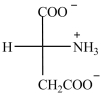
(True/False)
4.8/5 (89)
(89) Amino acids typically exist in nature as neutral molecules with all uncharged atoms.
(True/False)
4.9/5 (71)
(71) What type of inhibitor binds to the enzyme but does not bind at the active site?
(Multiple Choice)
4.9/5 (83)
(83) Both the myosin and the -keratin are proteins composed almost entirely of -pleated sheets.
(True/False)
4.8/5 (88)
(88) In hydrolysis of a peptide or protein, the addition of water breaks the hydrogen bonds that hold the amino acids together in the peptide chain.
(True/False)
4.9/5 (82)
(82) The amino acids aspartic acid and glutamic acid have a +1 net charge at low pH, and a -2 net charge at high pH.
(True/False)
4.9/5 (90)
(90) It is possible for two different proteins to contain the same number and type of amino acids.
(True/False)
5.0/5 (82)
(82) What is the process of altering the shape of a protein without breaking the amide bonds that form the primary structure?
(Multiple Choice)
4.8/5 (79)
(79) Globular proteins are coiled into compact shapes with hydrophilic outer surfaces that make them water soluble.
(True/False)
4.8/5 (96)
(96) The -pleated sheet forms when two or more peptide chains, called strands, line up side-by-side with the C=O and N-H bonds in the plane of the sheets.
(True/False)
4.8/5 (85)
(85) 
What is the N-terminal amino acid in the tetrapeptide glycylalanyisoleucylmethionine?
(Multiple Choice)
4.9/5 (84)
(84) Molecules that cause an enzyme to lose its activity are called _____.
(Short Answer)
4.8/5 (67)
(67) The difference between normal hemoglobin and sickle cell hemoglobin is that a single amino acid of both subunits is changed from glutamic acid to _____.
(Short Answer)
4.9/5 (64)
(64) A _____ is a peptide that contains four amino acids joined together by three peptide bonds.
(Short Answer)
4.7/5 (82)
(82) Amino acids are the building blocks of the body's proteins. Which statement concerning amino acids is false? 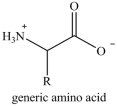
(Multiple Choice)
4.9/5 (93)
(93) The _____ of an enzyme is the region where substrate binding and catalysis occur.
(Short Answer)
4.9/5 (69)
(69) The hydrolysis of the amide bonds in a protein forms the individual amino acids that comprise the primary structure.
(True/False)
4.8/5 (69)
(69) 
Filters
- Essay(0)
- Multiple Choice(0)
- Short Answer(0)
- True False(0)
- Matching(0)