



 Chat with AI
Exam 20: Carbohydrates

Exam 1: Matter and Measurement89 Questions
Exam 2: Atoms and the Periodic Table90 Questions
Exam 3: Ionic Compounds90 Questions
Exam 4: Covalent Compounds90 Questions
Exam 5: Chemical Reactions89 Questions
Exam 6: Energy Changes, Reaction Rates, and Equilibrium88 Questions
Exam 7: Gases, Liquids, and Solids79 Questions
Exam 8: Solutions90 Questions
Exam 9: Acids and Bases90 Questions
Exam 10: Nuclear Chemistry85 Questions
Exam 11: Introduction to Organic Molecules and Functional Groups103 Questions
Exam 12: Alkanes106 Questions
Exam 13: Unsaturated Hydrocarbons101 Questions
Exam 14: Organic Compounds That Contain Oxygen, Halogen, or Sulfur111 Questions
Exam 15: The Three-Dimensional Shape of Molecules100 Questions
Exam 16: Aldehydes and Ketones103 Questions
Exam 17: Carboxylic Acids, Esters, and Amides81 Questions
Exam 18: Amines and Neurotransmitters105 Questions
Exam 19: Lipids105 Questions
Exam 20: Carbohydrates92 Questions
Exam 21: Amino Acids, Proteins, and Enzymes88 Questions
Exam 22: Nucleic Acids and Protein Synthesis89 Questions
Exam 23: Digestion and the Conversion of Food Into Energy92 Questions
Exam 24: Carbohydrate, Lipid, and Protein Metabolism91 Questions
Select questions type


A hemiacetal is a compound that contains a hydroxyl group (-OH)and an alkoxy group (-OR)on adjacent carbon atoms.
(True/False)
4.7/5  (72)
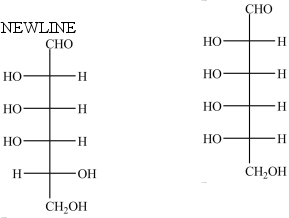
(72) The structures of galactose (left)and glucose (right)are shown below. How are the two monosaccharides related? 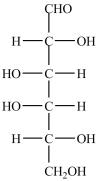
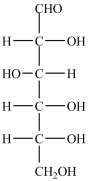
(Multiple Choice)
4.8/5 (66)
(66) When the monosaccharide below is oxidized by Benedict's reagent, the indicated product results. 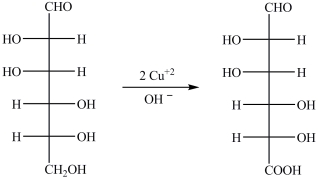
(True/False)
4.8/5 (96)
(96) What is the difference between the disaccharides lactose and maltose?
(Multiple Choice)
4.9/5 (82)
(82) Humans store glucose for short term energy requirements in the polysaccharide _____.
(Short Answer)
4.9/5 (70)
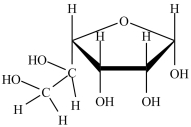
(70) 
Cellulose is a highly branched polymer composed of repeating glucose units joined in a 1 4- -glycosidic linkage.
(True/False)
5.0/5 (78)
(78) Carbohydrates are structurally defined as polyhydroxyaldehydes and polyhydroxyketones, or compounds that can be hydrolyzed to them.
(True/False)
4.9/5 (68)
(68) What is the polysaccharide form in which glucose is stored in animals?
(Multiple Choice)
4.8/5 (71)
(71) 
Disaccharides and polysaccharides contain monosaccharide units joined together by which of the following?
(Multiple Choice)
4.8/5 (70)
(70) The conversion of D-ribose to L-ribose is an example of mutarotation.
(True/False)
4.8/5 (78)
(78) Which of the following is not a term that would properly describe glucose as it is shown below? 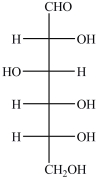
(Multiple Choice)
4.7/5 (81)
(81) Hydrolysis of the disaccharide below yields the indicated products. 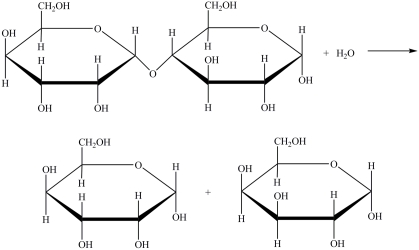
(True/False)
5.0/5 (91)
(91) Carbohydrates that are oxidized with Benedict's reagent are called reducing sugars, because they reduce the Cu2+ in Benedict's reagent to Cu+ during the reaction.
(True/False)
4.8/5 (73)
(73) Carbohydrates are chiral biomolecules. The term chiral indicates that carbohydrates can be both synthesized and digested by the human body.
(True/False)
4.7/5 (68)
(68) The simplest aldose is commonly called glyceraldehyde, although its IUPAC name is 2, 3-dihydroxypropanal. What is the structure of this compound?
(Multiple Choice)
4.9/5 (92)
(92) Gentobiose, a rare disaccharide found in saffron, produces two identical monosaccharides when it undergoes hydrolysis. What is the identity of the hydrolysis product? 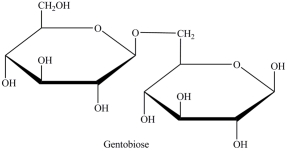
(Multiple Choice)
4.9/5 (94)
(94) What monosaccharide is found in cellulose, starch, and glycogen?
(Multiple Choice)
4.9/5 (90)
(90) 
Filters
- Essay(0)
- Multiple Choice(0)
- Short Answer(0)
- True False(0)
- Matching(0)