



 Chat with AI
Exam 24: Carbohydrate, Lipid, and Protein Metabolism

Exam 1: Matter and Measurement89 Questions
Exam 2: Atoms and the Periodic Table90 Questions
Exam 3: Ionic Compounds90 Questions
Exam 4: Covalent Compounds90 Questions
Exam 5: Chemical Reactions89 Questions
Exam 6: Energy Changes, Reaction Rates, and Equilibrium88 Questions
Exam 7: Gases, Liquids, and Solids79 Questions
Exam 8: Solutions90 Questions
Exam 9: Acids and Bases90 Questions
Exam 10: Nuclear Chemistry85 Questions
Exam 11: Introduction to Organic Molecules and Functional Groups103 Questions
Exam 12: Alkanes106 Questions
Exam 13: Unsaturated Hydrocarbons101 Questions
Exam 14: Organic Compounds That Contain Oxygen, Halogen, or Sulfur111 Questions
Exam 15: The Three-Dimensional Shape of Molecules100 Questions
Exam 16: Aldehydes and Ketones103 Questions
Exam 17: Carboxylic Acids, Esters, and Amides81 Questions
Exam 18: Amines and Neurotransmitters105 Questions
Exam 19: Lipids105 Questions
Exam 20: Carbohydrates92 Questions
Exam 21: Amino Acids, Proteins, and Enzymes88 Questions
Exam 22: Nucleic Acids and Protein Synthesis89 Questions
Exam 23: Digestion and the Conversion of Food Into Energy92 Questions
Exam 24: Carbohydrate, Lipid, and Protein Metabolism91 Questions
Select questions type


Which class(es)of compounds generates pyruvate as it is metabolized to acetyl CoA?
(Multiple Choice)
4.9/5  (79)
(79) _____ is the synthesis of glucose from noncarbohydrate sources-lactate, amino acids, or glycerol.
(Short Answer)
4.9/5 (76)
(76) The complete catabolism of glucose forms _____ CO2 molecules and _____ ATP molecules.
(Short Answer)
4.8/5 (83)
(83) Many cancerous tumors depend largely on glycolysis to supply their energy needs.
(True/False)
5.0/5 (74)
(74) Conceptually, gluconeogenesis is the reverse of glycolysis; that is, two molecules of pyruvate are converted to glucose by a stepwise pathway that passes through all of the same intermediates encountered in glycolysis.
(True/False)
4.8/5 (85)
(85) How many moles of ATP per gram of fatty acid are formed during the complete catabolism of a saturated fatty acid with the chemical formula CH3(CH2)24CO2H (molar mass 397 g/mol)?
(Multiple Choice)
4.9/5 (86)
(86) The overall result of transamination and oxidative deamination is to remove an amino group from an amino acid and form an ammonium ion, NH4+.
(True/False)
4.9/5 (92)
(92) _____ is the main source of energy for cells and the only source of energy used by the brain.
(Short Answer)
4.7/5 (83)
(83) The first three steps of glycolysis add three phosphate groups to glucose.
(True/False)
4.9/5 (81)
(81) What are the products formed in the transamination reaction shown? 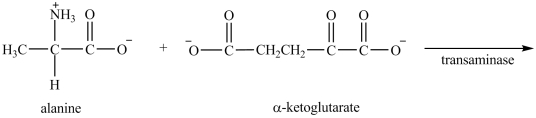
(Multiple Choice)
4.8/5 (91)
(91) Which compound can rise to dangerously high levels in individuals with galactosemia?
(Multiple Choice)
4.8/5 (80)
(80) Step [7] of glycolysis is shown below. Which statement concerning this step is true? 
(Multiple Choice)
4.7/5 (85)
(85) How is the amino group of an amino acid lost as a result of transamination and oxidative deamination?
(Multiple Choice)
4.9/5 (89)
(89) What is the starting material in step [1] in gluconeogenesis?
(Multiple Choice)
4.9/5 (91)
(91) Which food product does not rely on fermentation for its production?
(Multiple Choice)
4.8/5 (83)
(83) The reduction of acetaldehyde, shown below, is the last step in the fermentation process. What is the product of the reduction of acetaldehyde? 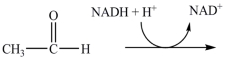
(Multiple Choice)
4.9/5 (85)
(85) 
Filters
- Essay(0)
- Multiple Choice(0)
- Short Answer(0)
- True False(0)
- Matching(0)