



 Chat with AI
Exam 5: Chemical Reactions

Exam 1: Matter and Measurement89 Questions
Exam 2: Atoms and the Periodic Table90 Questions
Exam 3: Ionic Compounds90 Questions
Exam 4: Covalent Compounds90 Questions
Exam 5: Chemical Reactions89 Questions
Exam 6: Energy Changes, Reaction Rates, and Equilibrium88 Questions
Exam 7: Gases, Liquids, and Solids79 Questions
Exam 8: Solutions90 Questions
Exam 9: Acids and Bases90 Questions
Exam 10: Nuclear Chemistry85 Questions
Exam 11: Introduction to Organic Molecules and Functional Groups103 Questions
Exam 12: Alkanes106 Questions
Exam 13: Unsaturated Hydrocarbons101 Questions
Exam 14: Organic Compounds That Contain Oxygen, Halogen, or Sulfur111 Questions
Exam 15: The Three-Dimensional Shape of Molecules100 Questions
Exam 16: Aldehydes and Ketones103 Questions
Exam 17: Carboxylic Acids, Esters, and Amides81 Questions
Exam 18: Amines and Neurotransmitters105 Questions
Exam 19: Lipids105 Questions
Exam 20: Carbohydrates92 Questions
Exam 21: Amino Acids, Proteins, and Enzymes88 Questions
Exam 22: Nucleic Acids and Protein Synthesis89 Questions
Exam 23: Digestion and the Conversion of Food Into Energy92 Questions
Exam 24: Carbohydrate, Lipid, and Protein Metabolism91 Questions
Select questions type


A compound that gains electrons in a redox reaction while causing another compound to be oxidized is called a(n)_____ agent.
(Short Answer)
4.7/5  (85)
(85) In the balanced redox reaction: 2 Cu(s)+ S(s) Cu2S(s), how many electrons are gained or lost by each copper atom?
(Multiple Choice)
4.8/5 (94)
(94) When the mass of a substance produced in a reaction must be calculated, first its number of moles is determined using mole ratios, and then Avogadro's number is used to convert moles to grams.
(True/False)
5.0/5 (78)
(78) Consider the balanced reaction: 4 NO2 + O2 + 2 H2O 4 HNO3. If 100. g of NO2 is placed in a reaction vessel the theoretical yield of nitric acid (HNO3)collected will be 137 g.
(True/False)
4.9/5 (87)
(87) The conversion factor shown below was obtained from the balanced chemical equation: 4 KO2(s)+ 2 CO2(g) 2 K2CO3(s)+ 3 O2(g). This conversion factor would be used to calculate which of the following? 
(Multiple Choice)
4.9/5 (68)
(68) The Greek letter delta ( )may be written over the reaction arrow in a chemical equation to indicate that
(Multiple Choice)
4.8/5 (87)
(87) Consider the oxidation of sodium metal to sodium oxide described by the balanced equation: 4 Na + O2 2 Na2O. If 2.55 mol of sodium reacts, and 75.0 g of Na2O is produced, what is the percent yield?
(Multiple Choice)
4.9/5 (72)
(72) To determine the overall percent yield in a synthesis that has more than one step, subtract the percent yield for each step from 100% yield.
(True/False)
4.9/5 (90)
(90) How many moles of sodium chloride (table salt, NaCl, molar mass 58.44 g/mol)are contained in a 1.00 lb box of table salt?
(Multiple Choice)
4.7/5 (82)
(82) How many moles of sulfur trioxide are formed from 3 moles of oxygen using the given balanced equation? 2 SO2 + O2 2 SO3
(Multiple Choice)
4.9/5 (82)
(82) Beaker A contains 1 mole of iron atoms, and Beaker B contains 1 mole of lead atoms. Which statement concerning these two samples is known with certainty? 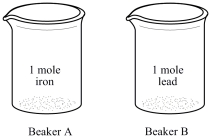
(Multiple Choice)
4.8/5 (76)
(76) Write a balanced chemical equation for the reaction of acetone (C3H6O)with oxygen (O2)to form carbon dioxide (CO2)and water (H2O).
(Multiple Choice)
4.8/5 (74)
(74) A chemical equation is an expression that uses chemical formulas and other symbols to illustrate what _____ constitute the starting materials in a reaction and what _____ are formed.
(Short Answer)
4.9/5 (81)
(81) In the chemical equation 2 Co(NO3)3 + 3 (NH4)2S Co2S3 + 6 NH4NO3 , how many nitrogen atoms are on each side of the equation?
(Multiple Choice)
4.7/5 (83)
(83) A 200.-mg ibuprofen (C13H18O2)tablet contains greater than one mole of ibuprofen molecules.
(True/False)
4.8/5 (83)
(83) The molar mass of dibromomethane (CH2Br2)is larger than the molar mass of dichloromethane (CH2Cl2).
(True/False)
4.9/5 (95)
(95) 
Filters
- Essay(0)
- Multiple Choice(0)
- Short Answer(0)
- True False(0)
- Matching(0)