



 Chat with AI
Exam 6: Energy Changes, Reaction Rates, and Equilibrium

Exam 1: Matter and Measurement89 Questions
Exam 2: Atoms and the Periodic Table90 Questions
Exam 3: Ionic Compounds90 Questions
Exam 4: Covalent Compounds90 Questions
Exam 5: Chemical Reactions89 Questions
Exam 6: Energy Changes, Reaction Rates, and Equilibrium88 Questions
Exam 7: Gases, Liquids, and Solids79 Questions
Exam 8: Solutions90 Questions
Exam 9: Acids and Bases90 Questions
Exam 10: Nuclear Chemistry85 Questions
Exam 11: Introduction to Organic Molecules and Functional Groups103 Questions
Exam 12: Alkanes106 Questions
Exam 13: Unsaturated Hydrocarbons101 Questions
Exam 14: Organic Compounds That Contain Oxygen, Halogen, or Sulfur111 Questions
Exam 15: The Three-Dimensional Shape of Molecules100 Questions
Exam 16: Aldehydes and Ketones103 Questions
Exam 17: Carboxylic Acids, Esters, and Amides81 Questions
Exam 18: Amines and Neurotransmitters105 Questions
Exam 19: Lipids105 Questions
Exam 20: Carbohydrates92 Questions
Exam 21: Amino Acids, Proteins, and Enzymes88 Questions
Exam 22: Nucleic Acids and Protein Synthesis89 Questions
Exam 23: Digestion and the Conversion of Food Into Energy92 Questions
Exam 24: Carbohydrate, Lipid, and Protein Metabolism91 Questions
Select questions type


The difference in energy between the reactants and the transition state is called the energy of activation, symbolized by Ea.
(True/False)
4.7/5  (84)
(84) Chemical reactions are considered favorable if the products have a higher energy than the reactants.
(True/False)
4.9/5 (83)
(83) When the equilibrium constant for a reaction is much less than one (K < 1), the concentration of the products is larger than the concentration of the reactants.
(True/False)
4.9/5 (86)
(86) In the energy diagram shown below, the H of the reaction is labeled by D. 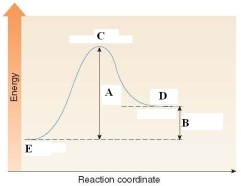
(True/False)
4.9/5 (63)
(63) Consider the reversible reaction: CO(g)+ Cl2(g)  COCl2(g). The reverse reaction is COCl2(g) CO(g)+ Cl2(g).
 (True/False)
4.9/5 (76)
(76) An enzyme contains a region called its _____ that binds a reactant, which then undergoes a very specific reaction with an enhanced rate.
(Short Answer)
4.9/5 (74)
(74) When the pressure of a reaction at equilibrium decreases, in which direction does the equilibrium shift?
(Multiple Choice)
4.9/5 (72)
(72) Consider the reaction, C2H4(g)+ H2(g) C2H6(g), where H = -137 kJ. How many kilojoules are released when 3.5 mol of C2H4 reacts?
(Multiple Choice)
4.8/5 (76)
(76) Which of the following energy quantities is equivalent to 11.9 kcal?
(Multiple Choice)
4.8/5 (88)
(88) A reversible reaction has reached equilibrium when which condition is established?
(Multiple Choice)
4.7/5 (67)
(67) Activation energy is the minimum amount of energy necessary for a reaction to occur.
(True/False)
4.8/5 (85)
(85) In the reaction: 2 C2H6(g)+ 7 O2(g) 4 CO2(g)+ 6 H2O(g), increasing the concentration of C2H6(g)will
(Multiple Choice)
4.9/5 (69)
(69) The molecular art depicts the following reversible reaction at equilibrium: CO(g)+ Cl2(g)  COCl2(g). What can be inferred about the equilibrium constant, K, for this reaction?
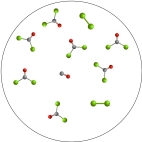
COCl2(g). What can be inferred about the equilibrium constant, K, for this reaction? (Multiple Choice)
4.8/5 (92)
(92) Consider the reversible reaction at equilibrium: N2(g)+ O2(g)  2 NO(g). What is the effect of removing some N2(g)from the equilibrium system?
 (Multiple Choice)
4.8/5 (75)
(75) A chemical reaction requires 31.39 kJ. How many kilocalories does this correspond to?
(Multiple Choice)
5.0/5 (65)
(65) As a general rule, a reaction rate _____ for each 10 °C the temperature is raised.
(Short Answer)
4.8/5 (72)
(72) Increasing the concentration of the reactants in a chemical reaction increases the number of collisions, and the reaction rate increases.
(True/False)
4.9/5 (64)
(64) When H is negative, the bonds formed in the products are _____ than the bonds broken in the reactants.
(Short Answer)
4.8/5 (89)
(89) 
Filters
- Essay(0)
- Multiple Choice(0)
- Short Answer(0)
- True False(0)
- Matching(0)