



 Chat with AI
Exam 6: Energy Changes, Reaction Rates, and Equilibrium

Exam 1: Matter and Measurement89 Questions
Exam 2: Atoms and the Periodic Table90 Questions
Exam 3: Ionic Compounds90 Questions
Exam 4: Covalent Compounds90 Questions
Exam 5: Chemical Reactions89 Questions
Exam 6: Energy Changes, Reaction Rates, and Equilibrium88 Questions
Exam 7: Gases, Liquids, and Solids79 Questions
Exam 8: Solutions90 Questions
Exam 9: Acids and Bases90 Questions
Exam 10: Nuclear Chemistry85 Questions
Exam 11: Introduction to Organic Molecules and Functional Groups103 Questions
Exam 12: Alkanes106 Questions
Exam 13: Unsaturated Hydrocarbons101 Questions
Exam 14: Organic Compounds That Contain Oxygen, Halogen, or Sulfur111 Questions
Exam 15: The Three-Dimensional Shape of Molecules100 Questions
Exam 16: Aldehydes and Ketones103 Questions
Exam 17: Carboxylic Acids, Esters, and Amides81 Questions
Exam 18: Amines and Neurotransmitters105 Questions
Exam 19: Lipids105 Questions
Exam 20: Carbohydrates92 Questions
Exam 21: Amino Acids, Proteins, and Enzymes88 Questions
Exam 22: Nucleic Acids and Protein Synthesis89 Questions
Exam 23: Digestion and the Conversion of Food Into Energy92 Questions
Exam 24: Carbohydrate, Lipid, and Protein Metabolism91 Questions
Select questions type


Consider the reaction: PCl3(g)+ Cl2(g)  PCl5(g). If [PCl3] = 0.78 M, [Cl2] = 0.44 M, and [PCl5] = 0.88 at equilibrium, what is the value of K?
 (Multiple Choice)
4.8/5  (76)
(76) A reversible reaction in which K = 9.65 × 10⁻¹⁴ contains a negligible amount of reactants at equilibrium.
(True/False)
4.8/5 (78)
(78) Walking at a brisk pace burns off about 280 Cal/h. How long would you have to walk to burn off the Calories obtained from eating a candy bar that contained 3 g of protein, 12 g of fat, and 28 g of carbohydrates?
(Multiple Choice)
4.9/5 (82)
(82) Kinetic energy is the energy associated with movement; potential energy is the energy inherent in an object due to its position or composition.
(True/False)
4.8/5 (93)
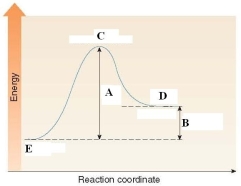
(93) 
The H for the reaction depicted by the energy diagram below is ____. 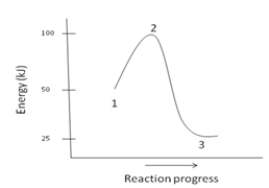
(Short Answer)
5.0/5 (81)
(81) One step in the metabolism of glucose is depicted below. Which statement best describes how the equilibrium system would respond if the amount of dihydroxyacetone phosphate is decreased? 
(Multiple Choice)
4.9/5 (82)
(82) Once equilibrium is reached in a chemical reaction, reactants stop forming products.
(True/False)
4.7/5 (78)
(78) Consider the reaction, C2H4(g)+ H2(g) C2H6(g), where H = -137 kJ. How many kilojoules are released when 55.3 g of C2H4 reacts?
(Multiple Choice)
4.8/5 (83)
(83) The expression for the equilibrium constant, K, for the general reaction: a A + b B  c C + d D is
 .
c C + d D is . (True/False)
4.7/5 (71)
(71) When heat is added to an exothermic equilibrium reaction, the reaction shifts to form more ____.
(Short Answer)
4.8/5 (80)
(80) Which term correctly describes a reaction in which the energy of the products is higher than the energy of the reactants?
(Multiple Choice)
4.8/5 (75)
(75) Which statement concerning the reversible reaction 2 NO2(g)  N2O4(g)is true?
 (Multiple Choice)
4.7/5 (94)
(94) An equilibrium constant with a value of 8.0 × 10⁶ indicates that at equilibrium
(Multiple Choice)
4.8/5 (69)
(69) Which of the following is NOT a reasonable assumption about the chemical reaction whose energy diagram is depicted below? 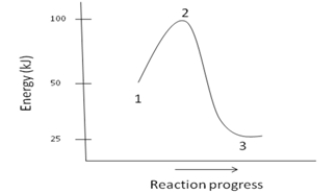
(Multiple Choice)
4.8/5 (70)
(70) Consider the reaction: N2(g)+ O2(g)  2 NO(g). If [N2] = 0.520 M, [O2] = 0.0662 M, and [NO] = 0.00956 at equilibrium, what is the value of K?
 (Multiple Choice)
4.8/5 (99)
(99) Increasing the temperature of a reaction mixture usually results in a decrease in the reaction rate.
(True/False)
4.8/5 (91)
(91) Le Châtelier's principle is a general rule used to explain the effect of a change in reaction conditions on equilibrium.
(True/False)
4.8/5 (81)
(81) Exothermic reactions involve the formation of products having lower energy than the reactants.
(True/False)
4.9/5 (68)
(68) 
Filters
- Essay(0)
- Multiple Choice(0)
- Short Answer(0)
- True False(0)
- Matching(0)