



 Chat with AI
Exam 22: Frontiers of Microeconomics

Exam 1: Ten Principles of Economics439 Questions
Exam 2: Thinking Like an Economist617 Questions
Exam 3: Interdependence and the Gains From Trade527 Questions
Exam 4: The Market Forces of Supply and Demand697 Questions
Exam 5: Elasticity and Its Application594 Questions
Exam 6: Supply, Demand, and Government Policies645 Questions
Exam 7: Consumers, Producers, and the Efficiency of Markets549 Questions
Exam 8: Application: the Costs of Taxation513 Questions
Exam 9: Application: International Trade492 Questions
Exam 10: Externalities524 Questions
Exam 11: Public Goods and Common Resources433 Questions
Exam 12: The Design of the Tax System549 Questions
Exam 13: The Costs of Production420 Questions
Exam 14: Firms in Competitive Markets543 Questions
Exam 15: Monopoly637 Questions
Exam 16: Monopolistic Competition580 Questions
Exam 17: Oligopoly488 Questions
Exam 18: The Markets for the Factors of Production564 Questions
Exam 19: Earnings and Discrimination490 Questions
Exam 20: Income Inequality and Poverty455 Questions
Exam 21: The Theory of Consumer Choice431 Questions
Exam 22: Frontiers of Microeconomics440 Questions
Exam 23: Measuring a Nations Income520 Questions
Exam 24: Measuring the Cost of Living529 Questions
Exam 25: Production and Growth505 Questions
Exam 26: Saving, Investment, and the Financial System564 Questions
Exam 27: The Basic Tools of Finance500 Questions
Exam 28: Unemployment678 Questions
Exam 29: The Monetary System515 Questions
Exam 30: Money Growth and Inflation481 Questions
Exam 31: Open-Economy Macroeconomics: Basic Concepts522 Questions
Exam 32: A Macroeconomic Theory of the Open Economy475 Questions
Exam 33: Aggregate Demand and Aggregate Supply562 Questions
Exam 34: The Influence of Monetary and Fiscal Policy on Aggregate Demand508 Questions
Exam 35: The Short-Run Trade-Off Between Inflation and Unemployment491 Questions
Exam 36: Six Debates Over Macroeconomic Policy372 Questions
Select questions type


Table 22-20
The table below shows the preferred city budget (in millions) for in the city of Springfield. 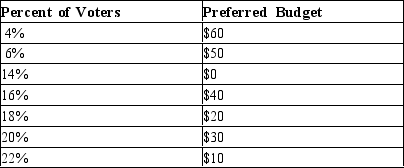 -Refer to Table 22-20. In an election, each voter will select the budget closest to his or her most preferred budget. In which of the following cases does a budget of $32 win?
 (Multiple Choice)
4.9/5  (72)
(72) Table 22-7
Suppose that residents of a town are asked to vote on the best way to improve the safety of an intersection. The three choices are: a stoplight, a 4-way stop, and a 2-way stop. The voters are divided into three groups based on their preferences.
Voter Type  -Refer to Table 22-7. If the vote were conducted according to a Borda count system where each person's first choice receives 3 points, second choice 2 points, and third choice 1 point, the result would be
 (Multiple Choice)
4.8/5 (69)
(69) The mathematical result showing that, under certain assumptions, there is no scheme for aggregating individual preferences into a valid set of social preferences is called
(Short Answer)
4.9/5 (80)
(80) An example of asymmetric information is when a seller of a house knows more than the buyer about the house's condition.
(True/False)
4.7/5 (67)
(67) Conventional economic theory suggests that in the ultimatum game, the player proposing a split of $50 will propose that she get $49 and that the other player get $1. By the same reasoning, if the amount to be split is $1000, the player proposing the split will propose that she gets
(Multiple Choice)
4.8/5 (87)
(87) Table 22-7
Suppose that residents of a town are asked to vote on the best way to improve the safety of an intersection. The three choices are: a stoplight, a 4-way stop, and a 2-way stop. The voters are divided into three groups based on their preferences.
Voter Type
-Refer to Table 22-7. If the first vote pits a 2-way stop against a 4-way stop and the second vote pits a stoplight against the winner of the first vote, then the outcome is as follows:
-Refer to Table 22-7. If the first vote pits a 2-way stop against a 4-way stop and the second vote pits a stoplight against the winner of the first vote, then the outcome is as follows: (Multiple Choice)
4.9/5 (70)
(70) Table 22-3
Three family members -- Seamus, Maeve, and Siobhan -- are deciding what type of movie to attend. The three choices are an action adventure, comedy, or horror. The first, second, and third choices for each person are as indicated in the table below.  -Refer to Table 22-3. Suppose the three decide to make the decision based on pairwise majority voting. If they first choose between Action and Horror and then choose between the winner of the first vote and Comedy, which movie alternative will win?
 (Multiple Choice)
4.7/5 (80)
(80) A brand of wine is priced at only $5 per bottle, far below the market price of most high quality wines. Before any reputation exists for the wine, consumers buy very little of this inexpensive wine because they interpret the low price to mean that the wine is of poor quality. The company decides to change the label on the wine to show that it has won awards for quality. This label change is an example of
(Multiple Choice)
4.7/5 (82)
(82) Table 22-18
The following table shows the preferences of four types of voters over four possible alternatives as well as the percentage of the electorate with the given preferences.  -Refer to Table 22-18. Suppose voters first choose in a majority vote between W and X. Second, voters choose in a majority vote between the winner of the first vote and Y. Third, voters choose in a majority vote between the winner of the second vote and Z. Which alternative will win?
 (Multiple Choice)
5.0/5 (75)
(75) In a dictator game, player A must divide $100 between player A and player B. In this game, player B does not have the opportunity to reject an offer - he or she goes home with whatever player A offers. Experiments have observed that when player A splits the $100, he or she consistently offers over $10 to player B. Which of the following comments fits best.
(Multiple Choice)
4.8/5 (83)
(83) Which of the following is an example of an adverse selection problem?
(Multiple Choice)
4.8/5 (62)
(62) Your city newspaper publishes a "Best of" poll that lists its readers' favorite restaurants. Mundo Bar and Grill is ranked as the best casual restaurant. Your best friend had dinner at Mundo Bar and Grill last week and commented that the food was mediocre and the service was slow. You decide not to have dinner at Mundo Bar and Grill based on your friend's experience. Your decision illustrates that people
(Multiple Choice)
4.8/5 (79)
(79) An implication of the median voter theorem is that, in a race between Republicans and Democrats,
(Multiple Choice)
4.8/5 (79)
(79) Table 22-8
The citizens of Mayville are having a severe budget shortage and are faced with eliminating athletics from the town high school. The town administrator has determined that the town can afford to maintain one sport. Exactly one of the three choices will prevail, and the choice will be made by way of pairwise voting, with the majority determining the outcome on each vote. The preferences of the voters are summarized in the table below.
Voter Type  -Refer to Table 22-8. The town administrator is a huge basketball fan. If he wants to ensure that basketball is the winning sport, how should he set up the voting?
 (Multiple Choice)
4.9/5 (79)
(79) Students of microeconomic principles often say they are going to study "tonight," because the only way to pass the exam is to study some every night. When "tonight" comes, some students choose to do something else. Come exam day, these students do not do well on their exam. This observation is an example of how people
(Multiple Choice)
5.0/5 (82)
(82) Table 22-19
The 600 voters of Appleton are deciding by majority rule how much to spend on a new library.  -Refer to Table 22-19. If an election were held between spending $2 million and $4 million, the median voter would vote for
 (Multiple Choice)
4.8/5 (91)
(91) 
Filters
- Essay(0)
- Multiple Choice(0)
- Short Answer(0)
- True False(0)
- Matching(0)