



 Chat with AI
Exam 22: Frontiers of Microeconomics

Exam 1: Ten Principles of Economics439 Questions
Exam 2: Thinking Like an Economist617 Questions
Exam 3: Interdependence and the Gains From Trade527 Questions
Exam 4: The Market Forces of Supply and Demand697 Questions
Exam 5: Elasticity and Its Application594 Questions
Exam 6: Supply, Demand, and Government Policies645 Questions
Exam 7: Consumers, Producers, and the Efficiency of Markets549 Questions
Exam 8: Application: the Costs of Taxation513 Questions
Exam 9: Application: International Trade492 Questions
Exam 10: Externalities524 Questions
Exam 11: Public Goods and Common Resources433 Questions
Exam 12: The Design of the Tax System549 Questions
Exam 13: The Costs of Production420 Questions
Exam 14: Firms in Competitive Markets543 Questions
Exam 15: Monopoly637 Questions
Exam 16: Monopolistic Competition580 Questions
Exam 17: Oligopoly488 Questions
Exam 18: The Markets for the Factors of Production564 Questions
Exam 19: Earnings and Discrimination490 Questions
Exam 20: Income Inequality and Poverty455 Questions
Exam 21: The Theory of Consumer Choice431 Questions
Exam 22: Frontiers of Microeconomics440 Questions
Exam 23: Measuring a Nations Income520 Questions
Exam 24: Measuring the Cost of Living529 Questions
Exam 25: Production and Growth505 Questions
Exam 26: Saving, Investment, and the Financial System564 Questions
Exam 27: The Basic Tools of Finance500 Questions
Exam 28: Unemployment678 Questions
Exam 29: The Monetary System515 Questions
Exam 30: Money Growth and Inflation481 Questions
Exam 31: Open-Economy Macroeconomics: Basic Concepts522 Questions
Exam 32: A Macroeconomic Theory of the Open Economy475 Questions
Exam 33: Aggregate Demand and Aggregate Supply562 Questions
Exam 34: The Influence of Monetary and Fiscal Policy on Aggregate Demand508 Questions
Exam 35: The Short-Run Trade-Off Between Inflation and Unemployment491 Questions
Exam 36: Six Debates Over Macroeconomic Policy372 Questions
Select questions type


Which of the following is a lesson from the Condorcet paradox?
(Multiple Choice)
4.9/5  (75)
(75) Table 22-5
The citizens of Anytown will decide whether to build a new library, a recreation center, or an arena. Exactly one of the three choices will prevail, and the choice will be made by way of pairwise voting, with the majority determining the outcome on each vote. The preferences of the voters are summarized in the table below.
Voter Type  -Refer to Table 22-5. Which of the following statements is correct?
 (Multiple Choice)
4.8/5 (73)
(73) If you are assigned the role of Player A in the Ultimatum game and you propose that player B gets $1 and you get $99
(Multiple Choice)
4.9/5 (72)
(72) Table 22-18
The following table shows the preferences of four types of voters over four possible alternatives as well as the percentage of the electorate with the given preferences.  -Refer to Table 22-18. Suppose before any voting takes place that alternative W is eliminated as an option. Based on this information, the median voter's first choice is
 (Multiple Choice)
5.0/5 (87)
(87) The moral-hazard problem and the desire of firms to lessen that problem serve as a plausible explanation for a firm paying above-equilibrium wages to its workers.
(True/False)
4.9/5 (68)
(68) Table 22-25
Sophie, Huan, and Santiago are lost with no map or GPS available. They come to an intersection at which they can turn left, turn right, or continue going straight. Their preferences are summarized in the table.  -Refer to Table 22-25. If the travelers decide to use a Borda count, what is the result?
 (Short Answer)
5.0/5 (83)
(83) You own an ice cream store and are concerned that an employee may be giving generous scoops to friends and relatives and smaller scoops to some other customers. This may be reducing sales. If you want your employee to stop giving larger scoops to friends and relatives, which of the following is not a good approach?
(Multiple Choice)
4.9/5 (90)
(90) Which of the following is not an example of a systematic mistake that people make?
(Multiple Choice)
4.9/5 (92)
(92) In a moral hazard problem, the agent is unable to perfectly monitor the principal's behavior so the principal applies less effort than the agent considers desirable.
(True/False)
4.8/5 (82)
(82) Lindsay and Tim are playing the ultimatum game starting with $100. Based on the coin toss, Lindsay is the player to propose a division of the $100. If Lindsay acts as economic theory assumes and Tim acts as experimental evidence shows, Tim will
(Essay)
4.8/5 (85)
(85) Pedro, who knows nothing about construction, paid Benito to remodel a room in his house. Two years later, one wall in the remodeled room crumbled because Benito used poor-quality materials. This illustrates which economic problem?
(Multiple Choice)
4.9/5 (83)
(83) Table 22-23
The town of Franklin is facing a severe budget shortage. The town administrator has proposed four options to balance the budget: increase property taxes (taxes), cut the school arts budget (arts), turn off half of the streetlights in the town (streetlights), reduce police patrols (police). Exactly one of the four choices will prevail, and the choice will be made by way of pairwise voting, with the majority determining the outcome on each vote. The preferences of the voters are summarized in the table below.
Voter Type 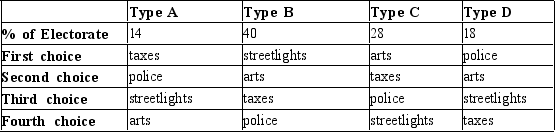 -Refer to Table 22-23. If the town administrator asks the people to first choose between cutting the arts program and turning off half of the streetlights, and then choose between the winner of the first election and reducing police patrols, and then choose between the winner of the second election and increasing taxes, which option will win each vote?
 (Short Answer)
4.8/5 (81)
(81) Suppose a community is debating how much money to spend on improvements to the high school. The members of the community who have children advocate spending $20 million to make improvements. The remaining 60% of the community thinks the high school is just fine and does not want to spend anything. What will the outcome be?
(Essay)
4.7/5 (81)
(81) Majority rule will produce the outcome most preferred by the median voter, as demonstrated by the
(Multiple Choice)
4.7/5 (90)
(90) Which of the following is not an example of a principal-agent relationship?
(Multiple Choice)
4.8/5 (72)
(72) The Condorcet voting paradox demonstrates that democratic outcomes do not always obey the property of
(Multiple Choice)
4.9/5 (83)
(83) 
Filters
- Essay(0)
- Multiple Choice(0)
- Short Answer(0)
- True False(0)
- Matching(0)