



 Chat with AI
Exam 22: Frontiers of Microeconomics

Exam 1: Ten Principles of Economics439 Questions
Exam 2: Thinking Like an Economist617 Questions
Exam 3: Interdependence and the Gains From Trade527 Questions
Exam 4: The Market Forces of Supply and Demand697 Questions
Exam 5: Elasticity and Its Application594 Questions
Exam 6: Supply, Demand, and Government Policies645 Questions
Exam 7: Consumers, Producers, and the Efficiency of Markets549 Questions
Exam 8: Application: the Costs of Taxation513 Questions
Exam 9: Application: International Trade492 Questions
Exam 10: Externalities524 Questions
Exam 11: Public Goods and Common Resources433 Questions
Exam 12: The Design of the Tax System549 Questions
Exam 13: The Costs of Production420 Questions
Exam 14: Firms in Competitive Markets543 Questions
Exam 15: Monopoly637 Questions
Exam 16: Monopolistic Competition580 Questions
Exam 17: Oligopoly488 Questions
Exam 18: The Markets for the Factors of Production564 Questions
Exam 19: Earnings and Discrimination490 Questions
Exam 20: Income Inequality and Poverty455 Questions
Exam 21: The Theory of Consumer Choice431 Questions
Exam 22: Frontiers of Microeconomics440 Questions
Exam 23: Measuring a Nations Income520 Questions
Exam 24: Measuring the Cost of Living529 Questions
Exam 25: Production and Growth505 Questions
Exam 26: Saving, Investment, and the Financial System564 Questions
Exam 27: The Basic Tools of Finance500 Questions
Exam 28: Unemployment678 Questions
Exam 29: The Monetary System515 Questions
Exam 30: Money Growth and Inflation481 Questions
Exam 31: Open-Economy Macroeconomics: Basic Concepts522 Questions
Exam 32: A Macroeconomic Theory of the Open Economy475 Questions
Exam 33: Aggregate Demand and Aggregate Supply562 Questions
Exam 34: The Influence of Monetary and Fiscal Policy on Aggregate Demand508 Questions
Exam 35: The Short-Run Trade-Off Between Inflation and Unemployment491 Questions
Exam 36: Six Debates Over Macroeconomic Policy372 Questions
Select questions type


Which of the following relationships involves asymmetric information?
(Multiple Choice)
4.9/5  (89)
(89) One way that employers respond to the moral-hazard problem is by monitoring their employees.
(True/False)
4.9/5 (86)
(86) "Signaling" refers to actions by an informed party for the sole purpose of
(Multiple Choice)
4.8/5 (83)
(83) Advocates of a tax on soda and other sugary drinks argue that such a tax
(Multiple Choice)
4.9/5 (68)
(68) Table 22-13
A high school Spanish class and their teacher are planning to take a Spring Break trip abroad but they have to decide where to go. They have narrowed the options to: Spain, Mexico, Ecuador, and Costa Rica. The voters' preferences are shown in the table below.  -Refer to Table 22-13. In a pairwise election between Mexico and Ecuador and then a second election between the winner and Costa Rica, which countries are chosen?
 (Multiple Choice)
4.9/5 (82)
(82) Table 22-22
The town of Fairview is considering a renovation to the high school. The voters in Fairview have different preferences on the budget for the renovation as displayed below.  -Refer to Table 22-22. The median voter is one who prefers to spend
 (Multiple Choice)
4.9/5 (68)
(68) Under majority rule, the order in which items are voted on is
(Multiple Choice)
4.9/5 (86)
(86) You own an ice cream store and are concerned that an employee may be giving generous scoops to friends and relatives and smaller scoops to some other customers. This is an example of
(Multiple Choice)
5.0/5 (76)
(76) Brandon is considering buying a used car but he first downloads a report from the internet that shows the history of accidents and major repairs conducted on the car. This action is called
(Short Answer)
4.7/5 (89)
(89) The adverse selection problem is a likely explanation for the fact that
(Multiple Choice)
4.9/5 (75)
(75) Experiments show that when real people play the ultimatum game, starting with $100,
(Multiple Choice)
4.9/5 (78)
(78) Sam needs to have his car serviced. There is an auto repair shop located nearby that does a lot of business and has an online rating of 4 out of 5 stars. Sam takes his car to be serviced and thinks the service person is grumpy and that his car is still not running as well as it could be. Sam then makes a point of telling his friends not to use the repair shop. Sam's actions illustrate which of the following systematic mistakes that people make when making decisions?
(Multiple Choice)
4.9/5 (83)
(83) Table 22-17
Voter Type  -Refer to Table 22-17. The table shows the preferences of three types of voters over three possible outcomes: A, B, and C. In addition, the table shows the percentage of voters of each type. Based on this information, which of the following statements is true?
 (Multiple Choice)
4.8/5 (78)
(78) Table 22-20
The table below shows the preferred city budget (in millions) for in the city of Springfield. 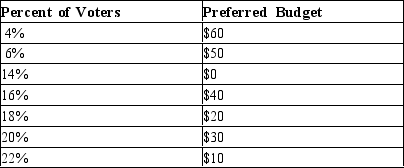 -Refer to Table 22-20. In an election, each voter will select the budget closest to his or her most preferred budget. Using this information, what is the most preferred budget of the median voter?
 (Multiple Choice)
4.9/5 (82)
(82) Table 22-6  -Refer to Table 22-6. The table shows the preferences of 100 voters over three possible outcomes: A, B, and C. If a Borda count election were held among these voters, giving three points to each voter's first choice, two points to the second choice, and one point to the last choice, which outcome would win the election?
 (Multiple Choice)
4.8/5 (87)
(87) 
Filters
- Essay(0)
- Multiple Choice(0)
- Short Answer(0)
- True False(0)
- Matching(0)