



 Chat with AI
Exam 22: Frontiers of Microeconomics

Exam 1: Ten Principles of Economics439 Questions
Exam 2: Thinking Like an Economist617 Questions
Exam 3: Interdependence and the Gains From Trade527 Questions
Exam 4: The Market Forces of Supply and Demand697 Questions
Exam 5: Elasticity and Its Application594 Questions
Exam 6: Supply, Demand, and Government Policies645 Questions
Exam 7: Consumers, Producers, and the Efficiency of Markets549 Questions
Exam 8: Application: the Costs of Taxation513 Questions
Exam 9: Application: International Trade492 Questions
Exam 10: Externalities524 Questions
Exam 11: Public Goods and Common Resources433 Questions
Exam 12: The Design of the Tax System549 Questions
Exam 13: The Costs of Production420 Questions
Exam 14: Firms in Competitive Markets543 Questions
Exam 15: Monopoly637 Questions
Exam 16: Monopolistic Competition580 Questions
Exam 17: Oligopoly488 Questions
Exam 18: The Markets for the Factors of Production564 Questions
Exam 19: Earnings and Discrimination490 Questions
Exam 20: Income Inequality and Poverty455 Questions
Exam 21: The Theory of Consumer Choice431 Questions
Exam 22: Frontiers of Microeconomics440 Questions
Exam 23: Measuring a Nations Income520 Questions
Exam 24: Measuring the Cost of Living529 Questions
Exam 25: Production and Growth505 Questions
Exam 26: Saving, Investment, and the Financial System564 Questions
Exam 27: The Basic Tools of Finance500 Questions
Exam 28: Unemployment678 Questions
Exam 29: The Monetary System515 Questions
Exam 30: Money Growth and Inflation481 Questions
Exam 31: Open-Economy Macroeconomics: Basic Concepts522 Questions
Exam 32: A Macroeconomic Theory of the Open Economy475 Questions
Exam 33: Aggregate Demand and Aggregate Supply562 Questions
Exam 34: The Influence of Monetary and Fiscal Policy on Aggregate Demand508 Questions
Exam 35: The Short-Run Trade-Off Between Inflation and Unemployment491 Questions
Exam 36: Six Debates Over Macroeconomic Policy372 Questions
Select questions type


Table 22-19
The 600 voters of Appleton are deciding by majority rule how much to spend on a new library.  -Refer to Table 22-19. If an election were held between spending $2 million and $3 million, the median voter would vote for
 (Multiple Choice)
5.0/5  (79)
(79) If A is preferred to B and B is preferred to C, then we would expect A to be preferred to C. This property is called
(Short Answer)
5.0/5 (84)
(84) Ihaveathousandfriends Social Networking firm had a remarkably profitable year. As a result, its employees expect to receive bonus checks. Which of the following insights into human behavior do the employees exhibit?
(Multiple Choice)
4.8/5 (89)
(89) Evidence from experiments in which real people play the ultimatum game supports the idea that people
(Multiple Choice)
4.9/5 (76)
(76) Pete owns a small store. He has noticed that when he is not at the store monitoring his employees, his revenue goes down. What are two changes Pete could make to wages he pays his employees to correct this problem?
(Essay)
4.9/5 (78)
(78) Table 22-6  -Refer to Table 22-6. The table shows the preferences of 100 voters over three possible outcomes: A, B, and C. Which of the following statements is true?
 (Multiple Choice)
4.9/5 (82)
(82) Table 22-23
The town of Franklin is facing a severe budget shortage. The town administrator has proposed four options to balance the budget: increase property taxes (taxes), cut the school arts budget (arts), turn off half of the streetlights in the town (streetlights), reduce police patrols (police). Exactly one of the four choices will prevail, and the choice will be made by way of pairwise voting, with the majority determining the outcome on each vote. The preferences of the voters are summarized in the table below.
Voter Type 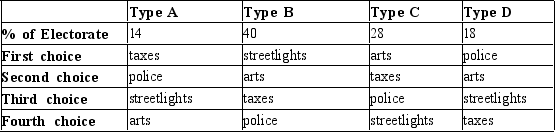 -Refer to Table 22-23. If a Borda count is used, which option will win?
 (Short Answer)
4.8/5 (66)
(66) Which of the following is a reason to think that government action may not be valuable to improve market outcomes with asymmetric information?
(Multiple Choice)
5.0/5 (78)
(78) Maria and Jose installed a "nannycamera" in their home so that they can view how the nanny is interacting with their children while they are at work. What type of problem are they trying to combat?
(Short Answer)
4.9/5 (84)
(84) Which of the following practices would indicate that an employer is trying to overcome a moral-hazard problem with his employees?
(Multiple Choice)
4.8/5 (80)
(80) Table 22-10
The town of Franklin is facing a severe budget shortage. The town administrator has proposed four options to balance the budget: increase property taxes (taxes), cut the school arts budget (arts), turn off half of the streetlights in the town (streetlights), reduce police patrols (police). Exactly one of the four choices will prevail, and the choice will be made by way of pairwise voting, with the majority determining the outcome on each vote. The preferences of the voters are summarized in the table below.
Voter Type 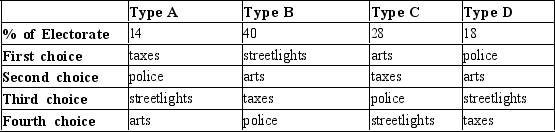 -Refer to Table 22-10. If the town administrator asks voters to choose first between increasing taxes and turning off half of the streetlights, and then between the winner of the first vote and reducing police patrols, and then between the winner of the second vote and cutting the school arts budget, which choice will win the final vote?
 (Multiple Choice)
4.8/5 (68)
(68) Which of the following sets of preferences satisfies the property of transitivity?
(Multiple Choice)
4.9/5 (76)
(76) The mathematical result showing that a majority rule voting system will produce the outcome most preferred by the voter exactly in the middle of the distribution is called the
(Short Answer)
4.8/5 (75)
(75) Moral hazard and adverse selection are similar asymmetric information problems but moral hazard involves hidden actions while adverse selection involves hidden characteristics.
(True/False)
4.9/5 (79)
(79) The majority of Americans, when asked how many states they could name, think they could name all fifty. However, when they are asked to do so, very few are able to come up with all fifty. This is an example of which systematic mistake that people make?
(Short Answer)
4.9/5 (84)
(84) Which of the following offers an explanation as to why the principal-agent problem exists for a firm?
(Multiple Choice)
4.8/5 (77)
(77) Which of the following is not an example of an adverse selection problem?
(Multiple Choice)
4.8/5 (70)
(70) Which of the following statements captures the meaning of transitivity of preferences?
(Multiple Choice)
4.9/5 (80)
(80) Table 22-1
Three friends -- Linda, Stephanie, and Jamie -- are deciding where to go together for vacation. They all agree that they should go to one of three places: France, Greece, or Italy. They also agree that they will have two pairwise votes to determine where to go on vacation, with the majority determining the outcome on each vote. The first, second, and third choices for each person are as indicated in the table below.  -Refer to Table 22-1. If the first vote pits France against Greece and the second vote pits Italy against the winner of the first vote, then the outcome is as follows:
 (Multiple Choice)
4.9/5 (81)
(81) In economics, a difference in access to relevant knowledge is called a behavioral asymmetry.
(True/False)
4.8/5 (79)
(79) 
Filters
- Essay(0)
- Multiple Choice(0)
- Short Answer(0)
- True False(0)
- Matching(0)