



 Chat with AI
Exam 22: Frontiers of Microeconomics

Exam 1: Ten Principles of Economics439 Questions
Exam 2: Thinking Like an Economist617 Questions
Exam 3: Interdependence and the Gains From Trade527 Questions
Exam 4: The Market Forces of Supply and Demand697 Questions
Exam 5: Elasticity and Its Application594 Questions
Exam 6: Supply, Demand, and Government Policies645 Questions
Exam 7: Consumers, Producers, and the Efficiency of Markets549 Questions
Exam 8: Application: the Costs of Taxation513 Questions
Exam 9: Application: International Trade492 Questions
Exam 10: Externalities524 Questions
Exam 11: Public Goods and Common Resources433 Questions
Exam 12: The Design of the Tax System549 Questions
Exam 13: The Costs of Production420 Questions
Exam 14: Firms in Competitive Markets543 Questions
Exam 15: Monopoly637 Questions
Exam 16: Monopolistic Competition580 Questions
Exam 17: Oligopoly488 Questions
Exam 18: The Markets for the Factors of Production564 Questions
Exam 19: Earnings and Discrimination490 Questions
Exam 20: Income Inequality and Poverty455 Questions
Exam 21: The Theory of Consumer Choice431 Questions
Exam 22: Frontiers of Microeconomics440 Questions
Exam 23: Measuring a Nations Income520 Questions
Exam 24: Measuring the Cost of Living529 Questions
Exam 25: Production and Growth505 Questions
Exam 26: Saving, Investment, and the Financial System564 Questions
Exam 27: The Basic Tools of Finance500 Questions
Exam 28: Unemployment678 Questions
Exam 29: The Monetary System515 Questions
Exam 30: Money Growth and Inflation481 Questions
Exam 31: Open-Economy Macroeconomics: Basic Concepts522 Questions
Exam 32: A Macroeconomic Theory of the Open Economy475 Questions
Exam 33: Aggregate Demand and Aggregate Supply562 Questions
Exam 34: The Influence of Monetary and Fiscal Policy on Aggregate Demand508 Questions
Exam 35: The Short-Run Trade-Off Between Inflation and Unemployment491 Questions
Exam 36: Six Debates Over Macroeconomic Policy372 Questions
Select questions type


Which of the following is not an example of asymmetric information?
(Multiple Choice)
4.9/5  (64)
(64) Table 22-21
The following table shows the number of voters preferring various amounts of spending to develop a river to make it more attractive for canoeing and kayaking.  -Refer to Table 22-21. Suppose on election day that the voters with a preference for less than $1.5 million do not show up to vote on a choice to spend either $2 million or $2.5 million. In this case, what is the preferred spending amount of the median voter (among those who actually cast a vote)?
 (Multiple Choice)
4.8/5 (72)
(72) Suppose you are covered under health insurance or belong to a Health Maintenance Organization (HMO), and you are insured against all or most of the costs of visits to the doctor. As a result you are likely to make greater use of medical services of all kinds. This tendency of people with insurance to change their behavior in a way that leads to more claims against the insurance company is called
(Multiple Choice)
4.9/5 (73)
(73) Table 22-7
Suppose that residents of a town are asked to vote on the best way to improve the safety of an intersection. The three choices are: a stoplight, a 4-way stop, and a 2-way stop. The voters are divided into three groups based on their preferences.
Voter Type  -Refer to Table 22-7. If the first vote pits a 2-way stop against a stoplight and the second vote pits a 4-way stop against the winner of the first vote, then the outcome is as follows:
 (Multiple Choice)
4.8/5 (71)
(71) In view of the possible need for government action in markets where asymmetric information is a problem, which of the following is a valid concern?
(Multiple Choice)
4.8/5 (75)
(75) Table 22-4
The fortunate residents of Anytown have a budget surplus. The mayor decided that it is only fair to have the residents vote on what to do with the surplus. The mayor has narrowed the options down to three possible projects: a playground, a library, or a swimming pool. The voters fall into three categories and have preferences as illustrated in the table.  -Refer to Table 22-4. Which of the following statements is correct regarding the results of pairwise voting in Anytown?
 (Multiple Choice)
4.8/5 (89)
(89) In American politics, we often observe that during a campaign, the Democratic and Republican positions on many issues are similar, which illustrates
(Multiple Choice)
4.8/5 (75)
(75) Refer to Narrative 22-1. Which of the ladies is causing a moral hazard problem?
(Multiple Choice)
4.8/5 (97)
(97) Table 22-10
The town of Franklin is facing a severe budget shortage. The town administrator has proposed four options to balance the budget: increase property taxes (taxes), cut the school arts budget (arts), turn off half of the streetlights in the town (streetlights), reduce police patrols (police). Exactly one of the four choices will prevail, and the choice will be made by way of pairwise voting, with the majority determining the outcome on each vote. The preferences of the voters are summarized in the table below.
Voter Type 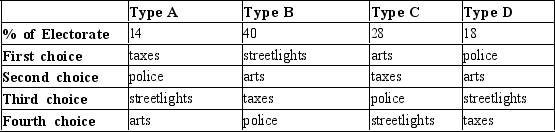 -Refer to Table 22-10. If the town administrator asks voters to choose first between reducing police patrols and increasing taxes, and then between the winner of the first vote and cutting the school arts budget, and then between the winner of the second vote and turning off half of the streetlights, which choice will win the final vote?
 (Multiple Choice)
4.9/5 (74)
(74) Table 22-14
Amy, Beth, and Connie are on a hiring committee. They have interviewed 3 candidates identified by their last names and are going to vote on which one is hired.  -Refer to Table 22-14. Which results for pairwise voting are correct?
 (Multiple Choice)
4.8/5 (67)
(67) What insight into human behavior do economist learn from observing people playing the ultimatum game?
(Short Answer)
4.9/5 (75)
(75) Scenario 22-1
Esteban and Michaela own an apartment building. They hire Nico to manage the building and deal with tenants' complaints. They also hire Ted to make any necessary repairs to the apartments or the common area and they hire Rex to be the door guard at night.
-Refer to Scenario 22-1. Which of the following is an example of a moral hazard problem?
(Multiple Choice)
4.8/5 (75)
(75) When homeowners sell a house, part of the paperwork they complete is a statement of disclosure on which the homeowners are supposed to reveal everything that they know is wrong with the house. The purpose of the statement of disclosure is to try to solve the
(Multiple Choice)
4.9/5 (73)
(73) Herbert Simon, one of the first social scientists to work at the boundary of economics and psychology, suggested that humans should be viewed not as rational maximers but as
(Short Answer)
4.9/5 (90)
(90) Bill would like to buy a gift for Ann to convey his love for her. Which of the following areas of economics would most likely study this type of decision?
(Multiple Choice)
4.8/5 (79)
(79) The Condorcet paradox implies that the order in which items are voted on under majority rule is unimportant.
(True/False)
4.9/5 (76)
(76) Which of the following is not an example of a moral hazard problem?
(Multiple Choice)
4.9/5 (78)
(78) You own an ice cream store and are concerned that an employee may be giving generous scoops to friends and relatives and smaller scoops to some other customers. This may be reducing sales. In this example, you are the
(Multiple Choice)
4.9/5 (88)
(88) 
Filters
- Essay(0)
- Multiple Choice(0)
- Short Answer(0)
- True False(0)
- Matching(0)