



 Chat with AI
Exam 22: Frontiers of Microeconomics

Exam 1: Ten Principles of Economics439 Questions
Exam 2: Thinking Like an Economist617 Questions
Exam 3: Interdependence and the Gains From Trade527 Questions
Exam 4: The Market Forces of Supply and Demand697 Questions
Exam 5: Elasticity and Its Application594 Questions
Exam 6: Supply, Demand, and Government Policies645 Questions
Exam 7: Consumers, Producers, and the Efficiency of Markets549 Questions
Exam 8: Application: the Costs of Taxation513 Questions
Exam 9: Application: International Trade492 Questions
Exam 10: Externalities524 Questions
Exam 11: Public Goods and Common Resources433 Questions
Exam 12: The Design of the Tax System549 Questions
Exam 13: The Costs of Production420 Questions
Exam 14: Firms in Competitive Markets543 Questions
Exam 15: Monopoly637 Questions
Exam 16: Monopolistic Competition580 Questions
Exam 17: Oligopoly488 Questions
Exam 18: The Markets for the Factors of Production564 Questions
Exam 19: Earnings and Discrimination490 Questions
Exam 20: Income Inequality and Poverty455 Questions
Exam 21: The Theory of Consumer Choice431 Questions
Exam 22: Frontiers of Microeconomics440 Questions
Exam 23: Measuring a Nations Income520 Questions
Exam 24: Measuring the Cost of Living529 Questions
Exam 25: Production and Growth505 Questions
Exam 26: Saving, Investment, and the Financial System564 Questions
Exam 27: The Basic Tools of Finance500 Questions
Exam 28: Unemployment678 Questions
Exam 29: The Monetary System515 Questions
Exam 30: Money Growth and Inflation481 Questions
Exam 31: Open-Economy Macroeconomics: Basic Concepts522 Questions
Exam 32: A Macroeconomic Theory of the Open Economy475 Questions
Exam 33: Aggregate Demand and Aggregate Supply562 Questions
Exam 34: The Influence of Monetary and Fiscal Policy on Aggregate Demand508 Questions
Exam 35: The Short-Run Trade-Off Between Inflation and Unemployment491 Questions
Exam 36: Six Debates Over Macroeconomic Policy372 Questions
Select questions type


Scenario 22-6
Shana owns a boutique that sells highend women's clothing and accessories. Katie works part-time at the boutique and frequently is the only employee in this small store. Shana pays Katie a wage that is higher than the market wage for this type of job. When the store is not full of customers, Katie diligently works on displays and cleans to keep the store looking its best. Belinda is a customer in the store who asks Katie's opinion on the quality of some jeans she is considering purchasing. Katie tells her the quality is great even though she's had several other customers return them due to flaws. Magda is another customer who is returning a necklace without volunteering that a gem is missing.
-Refer to Scenario 22-6. Which of the ladies, if any, is committing a moral hazard?
(Short Answer)
4.8/5  (86)
(86) Table 22-24
The citizens of Mayville are having a severe budget shortage and are faced with eliminating athletics from the town high school. The town administrator has determined that the town can afford to maintain one sport. Exactly one of the three choices will prevail, and the choice will be made by way of pairwise voting, with the majority determining the outcome on each vote. The preferences of the voters are summarized in the table below.
Voter Type  -Refer to Table 22-24. If the town administrator asks voters to choose first between hockey and basketball and then between the winner of the first vote and football, which sport will win the final vote?
 (Short Answer)
4.8/5 (81)
(81) The Condorcet paradox demonstrates that the order in which people vote on choices may influence the final outcome.
(True/False)
4.9/5 (75)
(75) In the field of study called political economy, economists make use of insights from the field of psychology.
(True/False)
4.9/5 (84)
(84) Studies of human decision-making have detected systematic mistakes that people make. Which of the following have been detected?
(Multiple Choice)
4.7/5 (83)
(83) As an alternative to pairwise majority voting, each voter could be asked to rank the possible outcomes, giving 1 point to her lowest choice, 2 points to her second-lowest choice, 3 points to her third-lowest choice, and so on. This voting method is called a(n)
(Multiple Choice)
4.8/5 (72)
(72) Which of the following relationships involves asymmetric information?
(Multiple Choice)
4.8/5 (83)
(83) On car insurance policies, Countrywide Insurance Company offers drivers an option: Policy 1 features a deductible of $1,000, and it requires a driver to pay an annual premium of $500. Policy 2 features a deductible of $250, and it requires a driver to pay an annual premium of $1,000.
(Multiple Choice)
4.7/5 (83)
(83) Table 22-9
Voter Type  -Refer to Table 22-9. The table shows the preferences of four types of voters over four possible outcomes: A, B, C, and D. In addition, the table shows the percentage of voters of each type. Suppose that, for some reason, D is eliminated as a possible option. Using a Borda count election, with 3 points for the best choice, 2 points for the second best choice, and 1 point for the last choice, which outcome would win this election?
 (Multiple Choice)
4.9/5 (77)
(77) When Republicans and Democrats offer similar platforms in an election campaign, a likely explanation is the
(Multiple Choice)
4.8/5 (83)
(83) Table 22-1
Three friends -- Linda, Stephanie, and Jamie -- are deciding where to go together for vacation. They all agree that they should go to one of three places: France, Greece, or Italy. They also agree that they will have two pairwise votes to determine where to go on vacation, with the majority determining the outcome on each vote. The first, second, and third choices for each person are as indicated in the table below.  -Refer to Table 22-1. If the first vote pits Greece against Italy and the second vote pits France against the winner of the first vote, then the outcome is as follows:
 (Multiple Choice)
4.9/5 (73)
(73) When the buyer knows less than the seller about the characteristics of the good being sold, there is
(Multiple Choice)
4.7/5 (77)
(77) Which of the following practices are, at least in part, attempts to reduce moral hazard problems?
(Multiple Choice)
4.8/5 (90)
(90) An unhealthy person would likely choose a medical insurance policy with a
(Multiple Choice)
4.8/5 (68)
(68) Table 22-9
Voter Type
-Refer to Table 22-9. The table shows the preferences of four types of voters over four possible outcomes: A, B, C, D. In addition, the table shows the percentage of voters of each type. Given pairwise voting in which voters choose first between A and B, then between the winner of the first vote and C, and finally between the winner of the second vote and D, which outcome would win?
-Refer to Table 22-9. The table shows the preferences of four types of voters over four possible outcomes: A, B, C, D. In addition, the table shows the percentage of voters of each type. Given pairwise voting in which voters choose first between A and B, then between the winner of the first vote and C, and finally between the winner of the second vote and D, which outcome would win? (Multiple Choice)
4.8/5 (78)
(78) Table 22-10
The town of Franklin is facing a severe budget shortage. The town administrator has proposed four options to balance the budget: increase property taxes (taxes), cut the school arts budget (arts), turn off half of the streetlights in the town (streetlights), reduce police patrols (police). Exactly one of the four choices will prevail, and the choice will be made by way of pairwise voting, with the majority determining the outcome on each vote. The preferences of the voters are summarized in the table below.
Voter Type 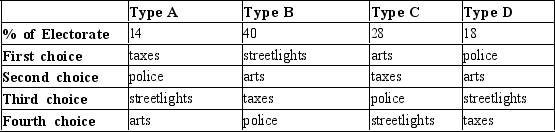 -Refer to Table 22-10. If a Borda count is used, which option will win?
 (Multiple Choice)
4.7/5 (89)
(89) A college professor hires a student to babysit her children and pays the student an efficiency-wage. Which of the following is correct about the wage the student earns?
(Multiple Choice)
4.9/5 (87)
(87) Which of the following relationships involves asymmetric information?
(Multiple Choice)
4.8/5 (84)
(84) Signaling is an action taken by an uninformed party to induce an informed party to reveal information.
(True/False)
4.8/5 (70)
(70) 
Filters
- Essay(0)
- Multiple Choice(0)
- Short Answer(0)
- True False(0)
- Matching(0)