



 Chat with AI
Exam 2: Thinking Like an Economist

Exam 1: Ten Principles of Economics439 Questions
Exam 2: Thinking Like an Economist617 Questions
Exam 3: Interdependence and the Gains From Trade527 Questions
Exam 4: The Market Forces of Supply and Demand697 Questions
Exam 5: Elasticity and Its Application594 Questions
Exam 6: Supply, Demand, and Government Policies645 Questions
Exam 7: Consumers, Producers, and the Efficiency of Markets549 Questions
Exam 8: Application: the Costs of Taxation513 Questions
Exam 9: Application: International Trade492 Questions
Exam 10: Externalities524 Questions
Exam 11: Public Goods and Common Resources433 Questions
Exam 12: The Design of the Tax System549 Questions
Exam 13: The Costs of Production420 Questions
Exam 14: Firms in Competitive Markets543 Questions
Exam 15: Monopoly637 Questions
Exam 16: Monopolistic Competition580 Questions
Exam 17: Oligopoly488 Questions
Exam 18: The Markets for the Factors of Production564 Questions
Exam 19: Earnings and Discrimination490 Questions
Exam 20: Income Inequality and Poverty455 Questions
Exam 21: The Theory of Consumer Choice431 Questions
Exam 22: Frontiers of Microeconomics440 Questions
Exam 23: Measuring a Nations Income520 Questions
Exam 24: Measuring the Cost of Living529 Questions
Exam 25: Production and Growth505 Questions
Exam 26: Saving, Investment, and the Financial System564 Questions
Exam 27: The Basic Tools of Finance500 Questions
Exam 28: Unemployment678 Questions
Exam 29: The Monetary System515 Questions
Exam 30: Money Growth and Inflation481 Questions
Exam 31: Open-Economy Macroeconomics: Basic Concepts522 Questions
Exam 32: A Macroeconomic Theory of the Open Economy475 Questions
Exam 33: Aggregate Demand and Aggregate Supply562 Questions
Exam 34: The Influence of Monetary and Fiscal Policy on Aggregate Demand508 Questions
Exam 35: The Short-Run Trade-Off Between Inflation and Unemployment491 Questions
Exam 36: Six Debates Over Macroeconomic Policy372 Questions
Select questions type


Figure 2-9
Panel (a) Panel (b) 
 -Refer to Figure 2-9, Panel (a) and Panel (b). Which of the following is not a result of the shift of the economy's production possibilities frontier from Panel (a) to Panel (b)?
 (Multiple Choice)
4.8/5  (87)
(87) Good assumptions simplify a problem without substantially affecting the answer.
(True/False)
4.7/5 (86)
(86) Figure 2-6  -Refer to Figure 2-6. If this economy moves from point F to point G, then which of the following statements is correct?
 (Multiple Choice)
4.9/5 (74)
(74) One difference between a hypothetical benevolent king implementing the best policy and the president implementing the best policy in the real world is the president has to be concerned about
(Multiple Choice)
4.9/5 (72)
(72) Using the outline below, draw a circular-flow diagram representing the interactions between households and firms in a simple economy. Explain briefly the various parts of the diagram. 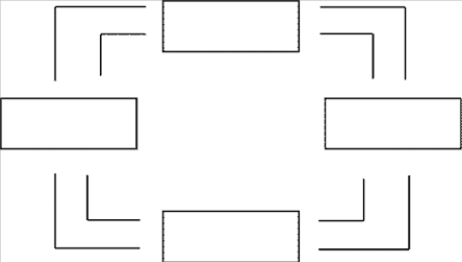
(Essay)
4.8/5 (87)
(87) The opportunity cost of obtaining more of one good is shown on the production possibilities frontier as the
(Multiple Choice)
4.8/5 (90)
(90) Figure 2-14  Consider the production possibilities curve for a country that can produce sweaters, apples (in bushels), or a combination of the two.
-Refer to Figure 2-14. What is the opportunity cost of moving from point R to point Q?
Consider the production possibilities curve for a country that can produce sweaters, apples (in bushels), or a combination of the two.
-Refer to Figure 2-14. What is the opportunity cost of moving from point R to point Q? (Short Answer)
5.0/5 (79)
(79) In the markets for the factors of production in the circular-flow diagram,
(Multiple Choice)
5.0/5 (87)
(87) Figure 2-5  -Refer to Figure 2-5. Inefficient production is represented by which point(s)?
 (Multiple Choice)
4.9/5 (89)
(89) Figure 2-2  -Refer to Figure 2-2. If Box A of this circular-flow diagram represents firms, then which box represents households?
 (Multiple Choice)
4.9/5 (65)
(65) It is difficult for economists to make observations and develop theories, but it is easy for economists to run experiments to generate data to test their theories.
(True/False)
4.8/5 (81)
(81) The concept of slope can be used to answer questions about how much one variable responds to changes in another variable.
(True/False)
4.8/5 (95)
(95) With the resources it has, an economy can produce at any point on or outside the production possibilities frontier, but it cannot produce at points inside the frontier.
(True/False)
4.8/5 (69)
(69) Figure 2-7  -Refer to Figure 2-7. If this economy devotes all of its resources to the production of engines, then it will produce
 (Multiple Choice)
4.8/5 (85)
(85) 
Filters
- Essay(0)
- Multiple Choice(0)
- Short Answer(0)
- True False(0)
- Matching(0)