



 Chat with AI
Exam 2: Thinking Like an Economist

Exam 1: Ten Principles of Economics439 Questions
Exam 2: Thinking Like an Economist617 Questions
Exam 3: Interdependence and the Gains From Trade527 Questions
Exam 4: The Market Forces of Supply and Demand697 Questions
Exam 5: Elasticity and Its Application594 Questions
Exam 6: Supply, Demand, and Government Policies645 Questions
Exam 7: Consumers, Producers, and the Efficiency of Markets549 Questions
Exam 8: Application: the Costs of Taxation513 Questions
Exam 9: Application: International Trade492 Questions
Exam 10: Externalities524 Questions
Exam 11: Public Goods and Common Resources433 Questions
Exam 12: The Design of the Tax System549 Questions
Exam 13: The Costs of Production420 Questions
Exam 14: Firms in Competitive Markets543 Questions
Exam 15: Monopoly637 Questions
Exam 16: Monopolistic Competition580 Questions
Exam 17: Oligopoly488 Questions
Exam 18: The Markets for the Factors of Production564 Questions
Exam 19: Earnings and Discrimination490 Questions
Exam 20: Income Inequality and Poverty455 Questions
Exam 21: The Theory of Consumer Choice431 Questions
Exam 22: Frontiers of Microeconomics440 Questions
Exam 23: Measuring a Nations Income520 Questions
Exam 24: Measuring the Cost of Living529 Questions
Exam 25: Production and Growth505 Questions
Exam 26: Saving, Investment, and the Financial System564 Questions
Exam 27: The Basic Tools of Finance500 Questions
Exam 28: Unemployment678 Questions
Exam 29: The Monetary System515 Questions
Exam 30: Money Growth and Inflation481 Questions
Exam 31: Open-Economy Macroeconomics: Basic Concepts522 Questions
Exam 32: A Macroeconomic Theory of the Open Economy475 Questions
Exam 33: Aggregate Demand and Aggregate Supply562 Questions
Exam 34: The Influence of Monetary and Fiscal Policy on Aggregate Demand508 Questions
Exam 35: The Short-Run Trade-Off Between Inflation and Unemployment491 Questions
Exam 36: Six Debates Over Macroeconomic Policy372 Questions
Select questions type


When economists disagree about whether the government should tax a household's income or its consumption, they are expressing a difference in
(Short Answer)
4.7/5  (87)
(87) In the circular flow diagram, when Daphne purchases a new mobile phone, she participates in the markets for
(Short Answer)
4.9/5 (78)
(78) Figure 2-5  -Refer to Figure 2-5. If this economy devotes all of its resources to the production of dryers, then it will produce
 (Multiple Choice)
4.8/5 (96)
(96) A production possibilities frontier will be bowed outward if some of the economy's resources are better suited to producing one good than another.
(True/False)
4.8/5 (85)
(85) Most economists agree that a large federal budget deficit has what type of effect on the economy?
(Short Answer)
5.0/5 (82)
(82) Which of the following is an example of using the scientific method with a natural experiment?
(Multiple Choice)
4.9/5 (86)
(86) A production possibilities frontier has a bowed shape if the opportunity cost is constant at all levels of output.
(True/False)
4.8/5 (84)
(84) A microeconomist - as opposed to a macroeconomist - might study
(Multiple Choice)
4.9/5 (79)
(79) Table 2-1
The following table contains some production possibilities for an economy for a given month. 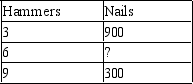 -Refer to Table 2-1. If the production possibilities frontier is bowed outward, then "?" could be
 (Multiple Choice)
4.7/5 (78)
(78) Which of the following transactions does not take place in the markets for factors of production in the circular-flow diagram?
(Multiple Choice)
4.7/5 (80)
(80) For economists, conducting experiments is often difficult and sometimes impossible.
(True/False)
4.9/5 (86)
(86) Figure 2-1  -Refer to Figure 2-1. Which arrow represents the flow of land, labor, and capital?
 (Multiple Choice)
4.8/5 (76)
(76) The prairie dog has always been considered a problem for American cattle ranchers. They dig holes that cattle and horses can step in, and they eat grass necessary for cattle. Recently, ranchers have discovered that there is a demand for prairie dogs as pets. In some areas, prairie dogs can sell for as high as $150 each. Cattlemen are now fencing off prairie dog towns on their land so these towns will not be disturbed by their cattle.
Draw a rancher's production possibilities frontier showing increasing opportunity cost of cattle production in terms of prairie dog production. Using a separate graph for each situation, show what would happen to the initial production possibilities frontier in each of the following situations:
a. The outcome is efficient, with ranchers choosing to produce equal numbers of cattle and prairie dogs.
b. As a protest against the government introducing the gray wolf back into the wild in their state, ranchers decide to withhold 25 percent of the available grassland for grazing.
c. The price of prairie dogs increases to $200 each, so ranchers decide to allot additional land for prairie dogs.
d. The government grants new leases to ranchers, giving them 10,000 new acres of grassland each for grazing.
e. A drought destroys most of the available grass for grazing of cattle, but not for prairie dogs since they also eat plant roots.
(Essay)
4.9/5 (71)
(71) Joe and Fred are economists. Joe thinks that the wealthiest 10% of the US population should be taxed a rate higher than the rest of society because they can better afford it. Fred thinks that everyone should be taxed at the same rate because that is the fairest scenario and the wealthy should not be penalized for their success. In this example, Joe and Fred
(Multiple Choice)
4.9/5 (77)
(77) 
Filters
- Essay(0)
- Multiple Choice(0)
- Short Answer(0)
- True False(0)
- Matching(0)