



 Chat with AI
Exam 2: Thinking Like an Economist

Exam 1: Ten Principles of Economics439 Questions
Exam 2: Thinking Like an Economist617 Questions
Exam 3: Interdependence and the Gains From Trade527 Questions
Exam 4: The Market Forces of Supply and Demand697 Questions
Exam 5: Elasticity and Its Application594 Questions
Exam 6: Supply, Demand, and Government Policies645 Questions
Exam 7: Consumers, Producers, and the Efficiency of Markets549 Questions
Exam 8: Application: the Costs of Taxation513 Questions
Exam 9: Application: International Trade492 Questions
Exam 10: Externalities524 Questions
Exam 11: Public Goods and Common Resources433 Questions
Exam 12: The Design of the Tax System549 Questions
Exam 13: The Costs of Production420 Questions
Exam 14: Firms in Competitive Markets543 Questions
Exam 15: Monopoly637 Questions
Exam 16: Monopolistic Competition580 Questions
Exam 17: Oligopoly488 Questions
Exam 18: The Markets for the Factors of Production564 Questions
Exam 19: Earnings and Discrimination490 Questions
Exam 20: Income Inequality and Poverty455 Questions
Exam 21: The Theory of Consumer Choice431 Questions
Exam 22: Frontiers of Microeconomics440 Questions
Exam 23: Measuring a Nations Income520 Questions
Exam 24: Measuring the Cost of Living529 Questions
Exam 25: Production and Growth505 Questions
Exam 26: Saving, Investment, and the Financial System564 Questions
Exam 27: The Basic Tools of Finance500 Questions
Exam 28: Unemployment678 Questions
Exam 29: The Monetary System515 Questions
Exam 30: Money Growth and Inflation481 Questions
Exam 31: Open-Economy Macroeconomics: Basic Concepts522 Questions
Exam 32: A Macroeconomic Theory of the Open Economy475 Questions
Exam 33: Aggregate Demand and Aggregate Supply562 Questions
Exam 34: The Influence of Monetary and Fiscal Policy on Aggregate Demand508 Questions
Exam 35: The Short-Run Trade-Off Between Inflation and Unemployment491 Questions
Exam 36: Six Debates Over Macroeconomic Policy372 Questions
Select questions type


When a production possibilities frontier is bowed outward, the opportunity cost of the first good in terms of the second good increases as more of the second good is produced.
(True/False)
4.9/5  (81)
(81) Figure 2-3  -Refer to Figure 2-3. What does the arrow going from oval B to rectangle 2 represent in the figure?
 (Short Answer)
4.8/5 (84)
(84) Figure 2-21  -Refer to Figure 2-21. Your friend John created the graph above to illustrate that snowstorms are caused by more snowblowers being sold. You inform him that his interpretation is incorrect due to
 (Multiple Choice)
4.8/5 (76)
(76) Economists believe that production possibilities frontiers are often bowed because
(Multiple Choice)
4.9/5 (76)
(76) In the circular-flow diagram, the two types of markets in which households and firms interact are the markets for goods and services and the markets for factors of production.
(True/False)
4.8/5 (80)
(80) The slope of a line that passes through the points (5, 8) and (12, 12) is
(Multiple Choice)
4.8/5 (72)
(72) The Council of Economic Advisers' Economic Report of the President discusses recent developments in the economy and presents the council's analysis of current policy issues.
(True/False)
4.9/5 (83)
(83) In the circular-flow diagram, which of the following items flows from firms to households through the markets for goods and services?
(Multiple Choice)
4.8/5 (84)
(84) The production possibilities frontier is a graph that shows the various combinations of outputs that the economy can possibly produce given the available factors of production and the available production technology.
(True/False)
4.8/5 (79)
(79) Figure 2-5  -Refer to Figure 2-5. It is possible for this economy to produce
 (Multiple Choice)
4.8/5 (74)
(74) Figure 2-12 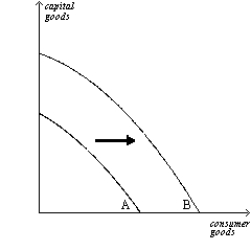 -Refer to Figure 2-12. Which of the following would most likely have caused the production possibilities frontier to shift outward from A to B?
 (Multiple Choice)
4.8/5 (85)
(85) Which of the following is an example of a normative - as opposed to a positive - statement?
(Multiple Choice)
4.9/5 (77)
(77) Which of the following is the best explanation for why President Harry Truman once said that he wanted to find a one-armed economist?
(Multiple Choice)
4.8/5 (81)
(81) The circular-flow diagram explains, in general terms, how the economy is organized and how participants in the economy interact with one another.
(True/False)
4.9/5 (73)
(73) Which markets are represented in the simple circular-flow diagram?
(Multiple Choice)
4.8/5 (73)
(73) Which of the following statements best captures the relationship between microeconomics and macroeconomics?
(Multiple Choice)
4.8/5 (74)
(74) Instead of conducting laboratory experiments to generate data to test their theories, economists often
(Multiple Choice)
4.7/5 (73)
(73) 
Filters
- Essay(0)
- Multiple Choice(0)
- Short Answer(0)
- True False(0)
- Matching(0)