



 Chat with AI
Exam 2: Thinking Like an Economist

Exam 1: Ten Principles of Economics439 Questions
Exam 2: Thinking Like an Economist617 Questions
Exam 3: Interdependence and the Gains From Trade527 Questions
Exam 4: The Market Forces of Supply and Demand697 Questions
Exam 5: Elasticity and Its Application594 Questions
Exam 6: Supply, Demand, and Government Policies645 Questions
Exam 7: Consumers, Producers, and the Efficiency of Markets549 Questions
Exam 8: Application: the Costs of Taxation513 Questions
Exam 9: Application: International Trade492 Questions
Exam 10: Externalities524 Questions
Exam 11: Public Goods and Common Resources433 Questions
Exam 12: The Design of the Tax System549 Questions
Exam 13: The Costs of Production420 Questions
Exam 14: Firms in Competitive Markets543 Questions
Exam 15: Monopoly637 Questions
Exam 16: Monopolistic Competition580 Questions
Exam 17: Oligopoly488 Questions
Exam 18: The Markets for the Factors of Production564 Questions
Exam 19: Earnings and Discrimination490 Questions
Exam 20: Income Inequality and Poverty455 Questions
Exam 21: The Theory of Consumer Choice431 Questions
Exam 22: Frontiers of Microeconomics440 Questions
Exam 23: Measuring a Nations Income520 Questions
Exam 24: Measuring the Cost of Living529 Questions
Exam 25: Production and Growth505 Questions
Exam 26: Saving, Investment, and the Financial System564 Questions
Exam 27: The Basic Tools of Finance500 Questions
Exam 28: Unemployment678 Questions
Exam 29: The Monetary System515 Questions
Exam 30: Money Growth and Inflation481 Questions
Exam 31: Open-Economy Macroeconomics: Basic Concepts522 Questions
Exam 32: A Macroeconomic Theory of the Open Economy475 Questions
Exam 33: Aggregate Demand and Aggregate Supply562 Questions
Exam 34: The Influence of Monetary and Fiscal Policy on Aggregate Demand508 Questions
Exam 35: The Short-Run Trade-Off Between Inflation and Unemployment491 Questions
Exam 36: Six Debates Over Macroeconomic Policy372 Questions
Select questions type


Between the two ordered pairs (3, 6) and (7, 18), the slope is
(Multiple Choice)
4.8/5  (83)
(83) Figure 2-14  Consider the production possibilities curve for a country that can produce sweaters, apples (in bushels), or a combination of the two.
-Refer to Figure 2-14. If this society moves from point U to point V,
Consider the production possibilities curve for a country that can produce sweaters, apples (in bushels), or a combination of the two.
-Refer to Figure 2-14. If this society moves from point U to point V, (Multiple Choice)
4.9/5 (74)
(74) Figure 2-5  -Refer to Figure 2-5. Suppose this economy is producing at point D. Which of the following statements would best explain this situation?
 (Multiple Choice)
4.8/5 (77)
(77) Table 2-2
The following table contains some production possibilities for an economy for a given year: 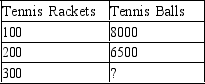 -Refer to Table 2-2. If the production possibilities frontier is bowed outward, then "?" could be
 (Multiple Choice)
4.9/5 (66)
(66) Figure 2-13  -Refer to Figure 2-13. Which of the following statements is true about point G for this economy?
 (Multiple Choice)
4.9/5 (84)
(84) You know an economist has crossed the line from policy adviser to scientist when he or she
(Multiple Choice)
4.9/5 (88)
(88) A survey of professional economists revealed that more than three-fourths of them agreed with fourteen economic propositions. Which of the following is not one of those propositions?
(Multiple Choice)
4.9/5 (92)
(92) Because it is difficult for economists to use experiments to generate data, they generally must
(Multiple Choice)
4.8/5 (92)
(92) Figure 2-9
Panel (a) Panel (b) 
 -Refer to Figure 2-9, Panel (a). The opportunity cost of moving from point M to point L is
 (Multiple Choice)
4.7/5 (73)
(73) What type of statement is a prescriptive statement about how the world ought to be?
(Short Answer)
4.9/5 (76)
(76) Points inside the production possibilities frontier represent feasible levels of production.
(True/False)
4.9/5 (88)
(88) Figure 2-22  -Refer to Figure 2-22. Is a move from point A to point R considered a shift of the curve or a movement along the curve?
 (Short Answer)
4.7/5 (84)
(84) Figure 2-15 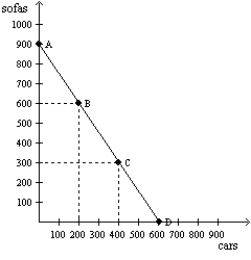 -Refer to Figure 2-15. Consider the production possibilities frontier for an economy that produces only sofas and cars. The opportunity cost of each car is
 (Multiple Choice)
4.8/5 (85)
(85) In the simple circular flow diagram, the flow of money from the markets for goods and services to the firms is called
(Multiple Choice)
5.0/5 (88)
(88) Since 1946, the president of the United States has received guidance from the Council of Economic Advisers.
(True/False)
4.8/5 (91)
(91) Table 2-5  -Refer to Table 2-5. Table 2-5 shows one set of production possibilities. What is the opportunity cost of an increase in the production of wheat from 700 bushels to 1300 bushels?
 (Multiple Choice)
4.9/5 (85)
(85) In conducting their research, economists often substitute historical events and historical episodes for
(Multiple Choice)
4.9/5 (78)
(78) Figure 2-10
Panel (a) Panel (b) 
 -Refer to Figure 2-10, Panel (a). Production is
 (Multiple Choice)
4.8/5 (73)
(73) 
Filters
- Essay(0)
- Multiple Choice(0)
- Short Answer(0)
- True False(0)
- Matching(0)