



 Chat with AI
Exam 2: Thinking Like an Economist

Exam 1: Ten Principles of Economics439 Questions
Exam 2: Thinking Like an Economist617 Questions
Exam 3: Interdependence and the Gains From Trade527 Questions
Exam 4: The Market Forces of Supply and Demand697 Questions
Exam 5: Elasticity and Its Application594 Questions
Exam 6: Supply, Demand, and Government Policies645 Questions
Exam 7: Consumers, Producers, and the Efficiency of Markets549 Questions
Exam 8: Application: the Costs of Taxation513 Questions
Exam 9: Application: International Trade492 Questions
Exam 10: Externalities524 Questions
Exam 11: Public Goods and Common Resources433 Questions
Exam 12: The Design of the Tax System549 Questions
Exam 13: The Costs of Production420 Questions
Exam 14: Firms in Competitive Markets543 Questions
Exam 15: Monopoly637 Questions
Exam 16: Monopolistic Competition580 Questions
Exam 17: Oligopoly488 Questions
Exam 18: The Markets for the Factors of Production564 Questions
Exam 19: Earnings and Discrimination490 Questions
Exam 20: Income Inequality and Poverty455 Questions
Exam 21: The Theory of Consumer Choice431 Questions
Exam 22: Frontiers of Microeconomics440 Questions
Exam 23: Measuring a Nations Income520 Questions
Exam 24: Measuring the Cost of Living529 Questions
Exam 25: Production and Growth505 Questions
Exam 26: Saving, Investment, and the Financial System564 Questions
Exam 27: The Basic Tools of Finance500 Questions
Exam 28: Unemployment678 Questions
Exam 29: The Monetary System515 Questions
Exam 30: Money Growth and Inflation481 Questions
Exam 31: Open-Economy Macroeconomics: Basic Concepts522 Questions
Exam 32: A Macroeconomic Theory of the Open Economy475 Questions
Exam 33: Aggregate Demand and Aggregate Supply562 Questions
Exam 34: The Influence of Monetary and Fiscal Policy on Aggregate Demand508 Questions
Exam 35: The Short-Run Trade-Off Between Inflation and Unemployment491 Questions
Exam 36: Six Debates Over Macroeconomic Policy372 Questions
Select questions type


Which of the following is an example of a positive, as opposed to normative, statement?
(Multiple Choice)
5.0/5  (101)
(101) Draw a production possibilities frontier showing increasing opportunity cost of hammers in terms of horseshoes.
a. On the graph, identify the area of feasible outcomes and the area of infeasible outcomes.
b. On the graph, label a point that is efficient and a point that is inefficient.
c. On the graph, illustrate the effect of the discovery of a new vein of iron ore, a resource needed to make both horseshoes and hammers, on this economy.
d. On a second graph, illustrate the effect of a new computerized assembly line in the production of hammers on this economy.
(Essay)
4.9/5 (76)
(76) Which of the following is one of the basic reasons why economists often appear to give conflicting advice to policymakers?
(Multiple Choice)
4.9/5 (81)
(81) Table 2-3
Production Possibilities for Footville 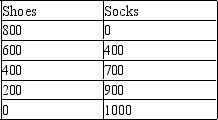 -Refer to Table 2-3. What is the opportunity cost to Footville of increasing the production of shoes from 400 to 600?
 (Multiple Choice)
4.7/5 (78)
(78) In the circular-flow diagram, firms produce goods and services using the factors of production.
(True/False)
4.9/5 (71)
(71) Is the following a positive or normative statement? The Federal Reserve should set an inflation target and employ policies to meet the target.
(Short Answer)
4.9/5 (83)
(83) Figure 2-14  Consider the production possibilities curve for a country that can produce sweaters, apples (in bushels), or a combination of the two.
-Refer to Figure 2-14. The bowed outward shape of the production possibilities curve indicates that opportunity cost of apples in terms of sweaters is
Consider the production possibilities curve for a country that can produce sweaters, apples (in bushels), or a combination of the two.
-Refer to Figure 2-14. The bowed outward shape of the production possibilities curve indicates that opportunity cost of apples in terms of sweaters is (Short Answer)
4.9/5 (80)
(80) Which of the following steps does an economist take when studying the economy?
(Multiple Choice)
4.9/5 (79)
(79) For an economist, the idea of making assumptions is regarded generally as a
(Multiple Choice)
4.8/5 (82)
(82) Table 2-4
Production Possibilities for Picnicland 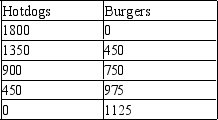 -Refer to Table 2-4. What is the opportunity cost to Picnicland of increasing the production of hotdogs from 450 to 900?
 (Multiple Choice)
4.8/5 (81)
(81) Policies such as rent control and trade barriers persist in spite of the fact that economists are virtually united in their opposition to such policies, probably because
(Multiple Choice)
4.8/5 (87)
(87) Which of the following is not an assumption of the productions possibilities frontier?
(Multiple Choice)
4.9/5 (80)
(80) Economists use one standard set of assumptions to answer all economic questions.
(True/False)
4.8/5 (82)
(82) Economists at the U.S. Department of Justice help enforce the nation's antitrust laws.
(True/False)
4.9/5 (84)
(84) When economists disagree about whether a policy is fair, they are expressing a difference in
(Short Answer)
4.9/5 (91)
(91) Microeconomics is the study of how households and firms make decisions and how they interact in specific markets.
(True/False)
4.9/5 (56)
(56) When two variables move in opposite directions, the curve relating them is upward sloping, and we say the variables are positively related.
(True/False)
4.9/5 (78)
(78) In the circular-flow diagram, which of the following items represents a payment for a factor of production?
(Multiple Choice)
4.7/5 (68)
(68) 
Filters
- Essay(0)
- Multiple Choice(0)
- Short Answer(0)
- True False(0)
- Matching(0)