



 Chat with AI
Exam 15: Monopoly and Antitrust Policy

Exam 1: Economics: Foundations and Models447 Questions
Exam 2: Trade-Offs, comparative Advantage, and the Market System492 Questions
Exam 3: Where Prices Come From: the Interaction of Demand and Supply476 Questions
Exam 4: Economic Efficiency, government Price Setting, and Taxes420 Questions
Exam 5: Externalities, environmental Policy, and Public Goods263 Questions
Exam 6: Elasticity: the Responsiveness of Demand and Supply294 Questions
Exam 7: The Economics of Health Care338 Questions
Exam 8: Firms,the Stock Market,and Corporate Governance522 Questions
Exam 9: Comparative Advantage and the Gains From International Trade377 Questions
Exam 10: Consumer Choice and Behavioral Economics300 Questions
Exam 11: Technology,production,and Costs327 Questions
Exam 12: Firms in Perfectly Competitive Markets296 Questions
Exam 13: Monopolistic Competition: the Competitive Model in a More Realistic Setting272 Questions
Exam 14: Oligopoly: Firms in Less Competitive Markets258 Questions
Exam 15: Monopoly and Antitrust Policy279 Questions
Exam 16: Pricing Strategy261 Questions
Exam 17: The Markets for Labor and Other Factors of Production281 Questions
Exam 18: Public Choice, taxes, and the Distribution of Income258 Questions
Exam 19: Gdp: Measuring Total Production and Income261 Questions
Exam 20: Unemployment and Inflation291 Questions
Exam 21: Economic Growth, the Financial System, and Business Cycles253 Questions
Exam 22: Long-Run Economic Growth: Sources and Policies262 Questions
Exam 23: Aggregate Expenditure and Output in the Short Run301 Questions
Exam 24: Aggregate Demand and Aggregate Supply Analysis286 Questions
Exam 25: Money,banks,and the Federal Reserve System281 Questions
Exam 26: Monetary Policy275 Questions
Exam 27: Fiscal Policy306 Questions
Exam 28: Inflation, unemployment, and Federal Reserve Policy257 Questions
Exam 29: Macroeconomics in an Open Economy278 Questions
Exam 30: The International Financial System258 Questions
Select questions type


Identify the type of merger in each of the following situations and indicate how the post-merger concentration ratio for the industry is affected.
a.A steel company merges with a coal and iron ore mining company.b.Staples,a retailer of office supplies,acquires Office Depot,another retailer of office supplies.c.An oil company merges with pipeline,shipping,and railroad companies as well as refineries and gas stations.
(Essay)
5.0/5  (80)
(80) If a theatre company expects $250,000 in ticket revenue from five performances and $288,000 in ticket revenue if it adds a sixth performance,the
(Multiple Choice)
4.8/5 (89)
(89) Explain whether a monopoly that maximizes profit will also be maximizing revenue and production.
(Essay)
4.8/5 (80)
(80) Network externalities refer to the situation where the usefulness of a product increases with the number of consumers who use it.
(True/False)
4.8/5 (80)
(80) Figure 15-1 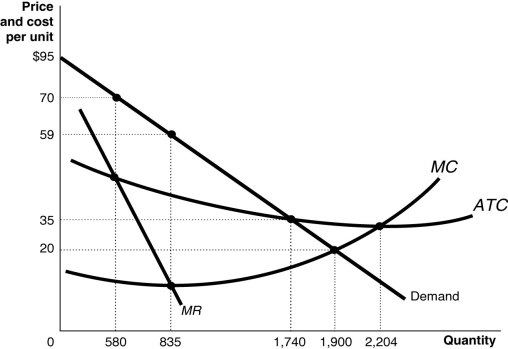 -Refer to Figure 15-1.Which of the following statements about the firm depicted in the diagram is true?
 (Multiple Choice)
4.9/5 (85)
(85) For a natural monopoly,the marginal cost of producing an additional unit of its product is relatively small.
(True/False)
4.9/5 (77)
(77) Producers in perfect competition receive a smaller producer surplus than a monopoly producer.
(True/False)
4.8/5 (76)
(76) If a monopolist's price is $50 at the output where marginal revenue equals marginal cost and average total cost is $43,then the incremental profit from the last unit sold is $7.
(True/False)
4.9/5 (72)
(72) In regulating a natural monopoly,the price strategy that ensures the highest possible output and zero profit is one that sets price
(Multiple Choice)
4.8/5 (68)
(68) How do the price and quantity of a monopoly compare to that of a perfectly competitive industry?
(Essay)
4.8/5 (75)
(75) Suppose an industry is made up of 25 firms,all with equal market share.The four-firm concentration ratio of this industry is
(Multiple Choice)
4.9/5 (76)
(76) What is the difference between a monopoly's marginal revenue curve and a perfect competitor's marginal revenue curve?
(Essay)
4.8/5 (75)
(75) What is a public franchise? Are all public franchises natural monopolies?
(Essay)
4.9/5 (85)
(85)
Price per Unit Quantity Demanded (units) Total Cost of Production (dollars) \ 85 10 \ 530 80 11 540 75 12 550 70 13 560 65 14 575 60 15 595 55 16 625 A monopoly producer of foreign language translation software faces a demand and cost structure as given in Table 15-1.
-Refer to Table 15-1.When producing the profit-maximizing output,what is the amount of the firm's profit?
(Multiple Choice)
4.9/5 (61)
(61) A monopoly is a firm that is the only seller of a good or service that does not have
(Multiple Choice)
4.8/5 (80)
(80) Peet's Coffee and Teas produces some flavorful varieties of Peet's brand coffee.Is Peet's a monopoly?
(Multiple Choice)
4.9/5 (82)
(82) If we use a narrow definition of monopoly,then a monopoly is defined as a firm
(Multiple Choice)
4.7/5 (64)
(64) For which of the following firms is patent protection of vital importance?
(Multiple Choice)
4.7/5 (82)
(82) 
Filters
- Essay(0)
- Multiple Choice(0)
- Short Answer(0)
- True False(0)
- Matching(0)