



 Chat with AI
Exam 15: Monopoly and Antitrust Policy

Exam 1: Economics: Foundations and Models447 Questions
Exam 2: Trade-Offs, comparative Advantage, and the Market System492 Questions
Exam 3: Where Prices Come From: the Interaction of Demand and Supply476 Questions
Exam 4: Economic Efficiency, government Price Setting, and Taxes420 Questions
Exam 5: Externalities, environmental Policy, and Public Goods263 Questions
Exam 6: Elasticity: the Responsiveness of Demand and Supply294 Questions
Exam 7: The Economics of Health Care338 Questions
Exam 8: Firms,the Stock Market,and Corporate Governance522 Questions
Exam 9: Comparative Advantage and the Gains From International Trade377 Questions
Exam 10: Consumer Choice and Behavioral Economics300 Questions
Exam 11: Technology,production,and Costs327 Questions
Exam 12: Firms in Perfectly Competitive Markets296 Questions
Exam 13: Monopolistic Competition: the Competitive Model in a More Realistic Setting272 Questions
Exam 14: Oligopoly: Firms in Less Competitive Markets258 Questions
Exam 15: Monopoly and Antitrust Policy279 Questions
Exam 16: Pricing Strategy261 Questions
Exam 17: The Markets for Labor and Other Factors of Production281 Questions
Exam 18: Public Choice, taxes, and the Distribution of Income258 Questions
Exam 19: Gdp: Measuring Total Production and Income261 Questions
Exam 20: Unemployment and Inflation291 Questions
Exam 21: Economic Growth, the Financial System, and Business Cycles253 Questions
Exam 22: Long-Run Economic Growth: Sources and Policies262 Questions
Exam 23: Aggregate Expenditure and Output in the Short Run301 Questions
Exam 24: Aggregate Demand and Aggregate Supply Analysis286 Questions
Exam 25: Money,banks,and the Federal Reserve System281 Questions
Exam 26: Monetary Policy275 Questions
Exam 27: Fiscal Policy306 Questions
Exam 28: Inflation, unemployment, and Federal Reserve Policy257 Questions
Exam 29: Macroeconomics in an Open Economy278 Questions
Exam 30: The International Financial System258 Questions
Select questions type


Compared to perfect competition,the consumer surplus in a monopoly
(Multiple Choice)
4.8/5  (75)
(75) Suppose a monopoly is producing its profit-maximizing output level.Now suppose the government imposes a lump-sum tax on the monopoly,independent of its output.As a result the monopoly's profit will fall.
(True/False)
4.7/5 (67)
(67) A product's price approaches its marginal cost as market concentration increases.
(True/False)
4.9/5 (79)
(79)  Figure 15-16 shows the market demand and cost curves facing a natural monopoly.
-Refer to Figure 15-16.If the regulators of the natural monopoly allow the owners of the firm to break even on their investment the firm will produce an output of ________ and charge a price of ________.
Figure 15-16 shows the market demand and cost curves facing a natural monopoly.
-Refer to Figure 15-16.If the regulators of the natural monopoly allow the owners of the firm to break even on their investment the firm will produce an output of ________ and charge a price of ________. (Multiple Choice)
4.8/5 (79)
(79) If a monopolist's marginal revenue is $25 a unit and its marginal cost is $25,then
(Multiple Choice)
4.7/5 (79)
(79) Figure 15-13 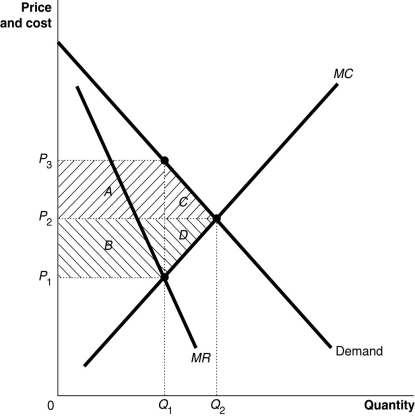 -Refer to Figure 15-13.From the monopoly graph above,identify the area representing the deadweight loss.
Would the deadweight loss be larger if the demand curve was more elastic or less elastic?
-Refer to Figure 15-13.From the monopoly graph above,identify the area representing the deadweight loss.
Would the deadweight loss be larger if the demand curve was more elastic or less elastic? (Essay)
4.8/5 (86)
(86) What happens to a monopoly's revenue when it sells more units of its product?
(Essay)
4.9/5 (65)
(65) Which of following is the best example of a monopoly if we use a broader definition of monopoly?
(Multiple Choice)
4.8/5 (75)
(75) Figure 15-19 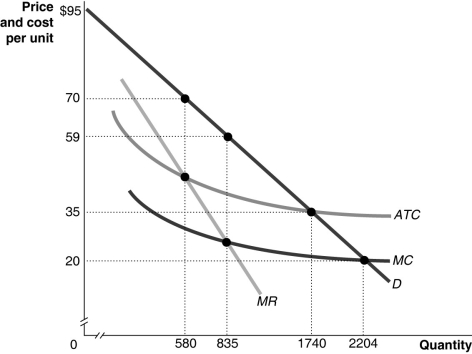 -Refer to Figure 15-19 to answer the following questions.
a.What quantity will this monopoly produce and what price will it charge?
b.Suppose the monopoly is regulated.If the regulatory agency wants to achieve economic efficiency,what price should it require the monopoly to charge?
c.To achieve economic efficiency,what quantity will the regulated monopoly produce?
d.Will the regulated monopoly make a profit if it charges the price that will achieve economic efficiency?
e.Suppose the government decides to regulate the monopoly by imposing a price ceiling of $35.What quantity will the monopoly produce and what price will the monopoly charge?
f.With the price ceiling of $35,what profit will the monopoly earn?
-Refer to Figure 15-19 to answer the following questions.
a.What quantity will this monopoly produce and what price will it charge?
b.Suppose the monopoly is regulated.If the regulatory agency wants to achieve economic efficiency,what price should it require the monopoly to charge?
c.To achieve economic efficiency,what quantity will the regulated monopoly produce?
d.Will the regulated monopoly make a profit if it charges the price that will achieve economic efficiency?
e.Suppose the government decides to regulate the monopoly by imposing a price ceiling of $35.What quantity will the monopoly produce and what price will the monopoly charge?
f.With the price ceiling of $35,what profit will the monopoly earn? (Essay)
4.8/5 (81)
(81) Which one of the following is not a possible barrier to entry high enough to keep competing firms out of a monopoly industry?
(Multiple Choice)
4.9/5 (69)
(69)  Figure 15-3 above shows the demand and cost curves facing a monopolist.
-Refer to Figure 15-3.What happens to the monopolist represented in the diagram in the long run?
Figure 15-3 above shows the demand and cost curves facing a monopolist.
-Refer to Figure 15-3.What happens to the monopolist represented in the diagram in the long run? (Multiple Choice)
4.9/5 (78)
(78) Firms that face downward-sloping demand curves for their output in the product market are called
(Multiple Choice)
4.7/5 (94)
(94) The Aluminum Company of America (Alcoa)had a monopoly until the 1940s because
(Multiple Choice)
4.7/5 (80)
(80)  Figure 15-6 shows the cost and demand curves for a monopolist.
-Refer to Figure 15-6.The monopolist earns a profit of
Figure 15-6 shows the cost and demand curves for a monopolist.
-Refer to Figure 15-6.The monopolist earns a profit of (Multiple Choice)
5.0/5 (72)
(72) The reason that the Fisherman's Friend restaurant in Stonington,Maine had a monopoly on selling seafood dinners in that town is most likely due to
(Multiple Choice)
4.9/5 (84)
(84) Figure 15-17  Your college decides to offer a psychology course as a MOOC that can be taken by students anywhere in the world,whether they are actually enrolled in your college or not.The demand and cost situation for the MOOC is shown in the figure.
-Refer to Figure 15-17.You are a member of a student government and are asked to recommend a price for the course and you argue: "I think the college should charge a price so that it just breaks even on the course." What price should you recommend?
Your college decides to offer a psychology course as a MOOC that can be taken by students anywhere in the world,whether they are actually enrolled in your college or not.The demand and cost situation for the MOOC is shown in the figure.
-Refer to Figure 15-17.You are a member of a student government and are asked to recommend a price for the course and you argue: "I think the college should charge a price so that it just breaks even on the course." What price should you recommend? (Multiple Choice)
4.9/5 (68)
(68) Figure 15-8 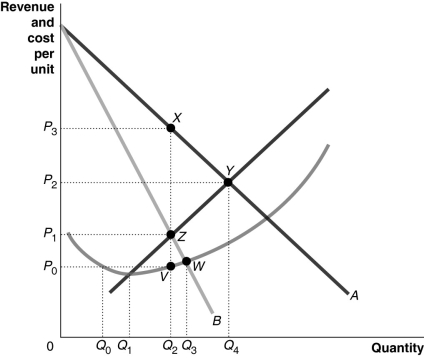 Figure 15-8 reflects the cost and revenue structure for a monopoly that has been in business for a very long time.
-Refer to Figure 15-8.Use the figure above to answer the following questions.
a.Identify the curves labeled A and B.Identify the curve which contains both point Y and point Z.Identify the curve which contains both point V and point W.
b.What is the profit-maximizing quantity and what price will the monopolist charge?
c.What area represents total revenue at the profit-maximizing output level?
d.What area represents total cost at the profit-maximizing output level?
e.What area represents profit?
f.What is the profit per unit (average profit)at the profit-maximizing output level?
g.If this industry was organized as a perfectly competitive industry,what would be the profit-maximizing price and quantity?
h.What area represents the deadweight loss as a result of a monopoly?
Figure 15-8 reflects the cost and revenue structure for a monopoly that has been in business for a very long time.
-Refer to Figure 15-8.Use the figure above to answer the following questions.
a.Identify the curves labeled A and B.Identify the curve which contains both point Y and point Z.Identify the curve which contains both point V and point W.
b.What is the profit-maximizing quantity and what price will the monopolist charge?
c.What area represents total revenue at the profit-maximizing output level?
d.What area represents total cost at the profit-maximizing output level?
e.What area represents profit?
f.What is the profit per unit (average profit)at the profit-maximizing output level?
g.If this industry was organized as a perfectly competitive industry,what would be the profit-maximizing price and quantity?
h.What area represents the deadweight loss as a result of a monopoly? (Essay)
4.8/5 (76)
(76) 
Filters
- Essay(0)
- Multiple Choice(0)
- Short Answer(0)
- True False(0)
- Matching(0)