



 Chat with AI
Exam 28: Inflation, unemployment, and Federal Reserve Policy

Exam 1: Economics: Foundations and Models447 Questions
Exam 2: Trade-Offs, comparative Advantage, and the Market System492 Questions
Exam 3: Where Prices Come From: the Interaction of Demand and Supply476 Questions
Exam 4: Economic Efficiency, government Price Setting, and Taxes420 Questions
Exam 5: Externalities, environmental Policy, and Public Goods263 Questions
Exam 6: Elasticity: the Responsiveness of Demand and Supply294 Questions
Exam 7: The Economics of Health Care338 Questions
Exam 8: Firms,the Stock Market,and Corporate Governance522 Questions
Exam 9: Comparative Advantage and the Gains From International Trade377 Questions
Exam 10: Consumer Choice and Behavioral Economics300 Questions
Exam 11: Technology,production,and Costs327 Questions
Exam 12: Firms in Perfectly Competitive Markets296 Questions
Exam 13: Monopolistic Competition: the Competitive Model in a More Realistic Setting272 Questions
Exam 14: Oligopoly: Firms in Less Competitive Markets258 Questions
Exam 15: Monopoly and Antitrust Policy279 Questions
Exam 16: Pricing Strategy261 Questions
Exam 17: The Markets for Labor and Other Factors of Production281 Questions
Exam 18: Public Choice, taxes, and the Distribution of Income258 Questions
Exam 19: Gdp: Measuring Total Production and Income261 Questions
Exam 20: Unemployment and Inflation291 Questions
Exam 21: Economic Growth, the Financial System, and Business Cycles253 Questions
Exam 22: Long-Run Economic Growth: Sources and Policies262 Questions
Exam 23: Aggregate Expenditure and Output in the Short Run301 Questions
Exam 24: Aggregate Demand and Aggregate Supply Analysis286 Questions
Exam 25: Money,banks,and the Federal Reserve System281 Questions
Exam 26: Monetary Policy275 Questions
Exam 27: Fiscal Policy306 Questions
Exam 28: Inflation, unemployment, and Federal Reserve Policy257 Questions
Exam 29: Macroeconomics in an Open Economy278 Questions
Exam 30: The International Financial System258 Questions
Select questions type


What can the Federal Reserve do to increase the natural rate of unemployment?
(Multiple Choice)
4.8/5  (82)
(82) Figure 28-9  -Refer to Figure 28-9.A follower of the new classical macroeconomics would argue that a contractionary monetary policy to lower inflation after a supply shock,like that pursued by Volcker in 1979,would result in a movement from
 (Multiple Choice)
4.8/5 (92)
(92) The expansionary monetary and fiscal policies of the 1960s resulted in
(Multiple Choice)
4.8/5 (88)
(88) Figure 28-1  -Refer to Figure 28-1.Suppose that the economy is currently at point A,and the unemployment rate at A is the natural rate.What policy would the Federal Reserve pursue if it wanted the economy to move to point C in the long run?
 (Multiple Choice)
4.9/5 (83)
(83) Figure 28-5 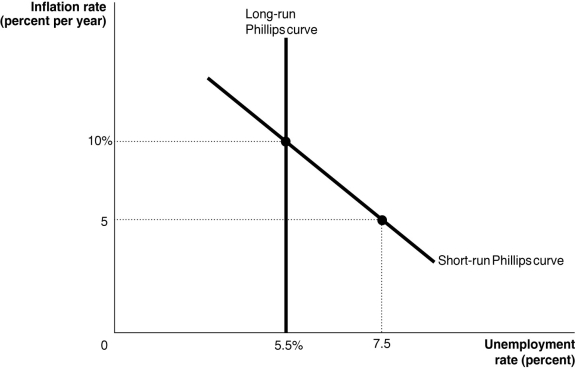 -Refer to Figure 28-5.Consider the Phillips curves shown in the above graph.We can conclude from this graph that
 (Multiple Choice)
4.8/5 (82)
(82) Which of the following would be the source of a "real" business cycle?
(Multiple Choice)
4.9/5 (75)
(75) If firms and workers have rational expectations,including knowledge of the policy being used by the Federal Reserve
(Multiple Choice)
4.9/5 (77)
(77) Figure 28-9
-Refer to Figure 28-9.A(n)________ would be depicted as a movement from A to D to C.
-Refer to Figure 28-9.A(n)________ would be depicted as a movement from A to D to C. (Multiple Choice)
4.9/5 (85)
(85) A falling price level is called ________ and a fall in the rate of inflation is called ________.
(Multiple Choice)
4.8/5 (79)
(79) If inflationary expectations on the part of the public increase,the trade-off between inflation and unemployment becomes worse.
(True/False)
4.8/5 (81)
(81) Last year,the unemployment rate was 4 percent and the inflation rate was 3 percent.If the natural rate of unemployment is 3 percent,how do you expect inflation to change?
(Essay)
4.8/5 (94)
(94) During a time when the inflation rate is increasing each year for a number of years,are adaptive expectations or rational expectations likely to give the more accurate forecasts? Briefly explain.
(Essay)
4.8/5 (77)
(77) If actual inflation is greater than expected inflation,what is the relationship between the actual real wage and the expected real wage?
(Multiple Choice)
5.0/5 (82)
(82) Figure 28-8 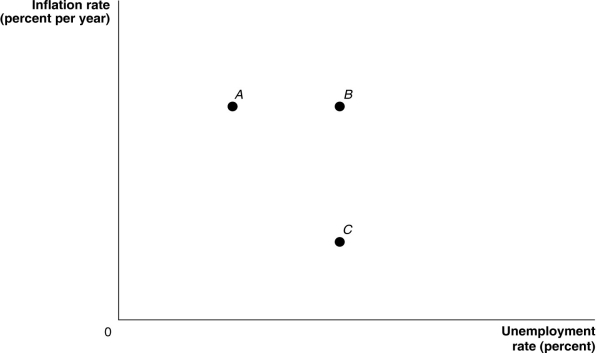 -Refer to Figure 28-8.A typical long-run Phillips curve would have the appearance of a curve running through points
 (Multiple Choice)
4.9/5 (87)
(87) The expansionary monetary and fiscal policies of the 1960s resulted in ________ inflation rates and ________ rates of unemployment.
(Multiple Choice)
4.7/5 (78)
(78) Which of the following could decrease unemployment and inflation simultaneously?
(Multiple Choice)
4.9/5 (76)
(76) According to the ________ Phillips curve,the unemployment rate and the inflation rate are negatively related.
(Multiple Choice)
4.8/5 (75)
(75) 
Filters
- Essay(0)
- Multiple Choice(0)
- Short Answer(0)
- True False(0)
- Matching(0)