



 Chat with AI
Exam 28: Inflation, unemployment, and Federal Reserve Policy

Exam 1: Economics: Foundations and Models447 Questions
Exam 2: Trade-Offs, comparative Advantage, and the Market System492 Questions
Exam 3: Where Prices Come From: the Interaction of Demand and Supply476 Questions
Exam 4: Economic Efficiency, government Price Setting, and Taxes420 Questions
Exam 5: Externalities, environmental Policy, and Public Goods263 Questions
Exam 6: Elasticity: the Responsiveness of Demand and Supply294 Questions
Exam 7: The Economics of Health Care338 Questions
Exam 8: Firms,the Stock Market,and Corporate Governance522 Questions
Exam 9: Comparative Advantage and the Gains From International Trade377 Questions
Exam 10: Consumer Choice and Behavioral Economics300 Questions
Exam 11: Technology,production,and Costs327 Questions
Exam 12: Firms in Perfectly Competitive Markets296 Questions
Exam 13: Monopolistic Competition: the Competitive Model in a More Realistic Setting272 Questions
Exam 14: Oligopoly: Firms in Less Competitive Markets258 Questions
Exam 15: Monopoly and Antitrust Policy279 Questions
Exam 16: Pricing Strategy261 Questions
Exam 17: The Markets for Labor and Other Factors of Production281 Questions
Exam 18: Public Choice, taxes, and the Distribution of Income258 Questions
Exam 19: Gdp: Measuring Total Production and Income261 Questions
Exam 20: Unemployment and Inflation291 Questions
Exam 21: Economic Growth, the Financial System, and Business Cycles253 Questions
Exam 22: Long-Run Economic Growth: Sources and Policies262 Questions
Exam 23: Aggregate Expenditure and Output in the Short Run301 Questions
Exam 24: Aggregate Demand and Aggregate Supply Analysis286 Questions
Exam 25: Money,banks,and the Federal Reserve System281 Questions
Exam 26: Monetary Policy275 Questions
Exam 27: Fiscal Policy306 Questions
Exam 28: Inflation, unemployment, and Federal Reserve Policy257 Questions
Exam 29: Macroeconomics in an Open Economy278 Questions
Exam 30: The International Financial System258 Questions
Select questions type


Workers and firms are currently expecting the price level to increase from 110 to 114.The Federal Reserve then announces that it will be reducing the growth rate of the money supply.If the Fed's announcement is credible,and firms and workers have rational expectations,describe how the expectations of firms and workers will be affected and how the change in expectations will affect the unemployment rate.
(Essay)
4.8/5  (83)
(83) If actual inflation is less than expected inflation,which of the following will be true?
(Multiple Choice)
4.9/5 (91)
(91) Two actions by the Fed during Alan Greenspan's term as chairman have been identified as possibly contributing to the financial crisis in 2008.Which of the following was one of those actions?
(Multiple Choice)
4.9/5 (85)
(85) Figure 28-2  -Refer to Figure 28-2.Suppose the Fed used expansionary policy to push short-run equilibrium to point B.If the short-run equilibrium remained at point B long enough
 (Multiple Choice)
4.8/5 (81)
(81) The long-run aggregate supply curve is ________,while the long-run Phillips curve is ________.
(Multiple Choice)
4.9/5 (74)
(74) Figure 28-6 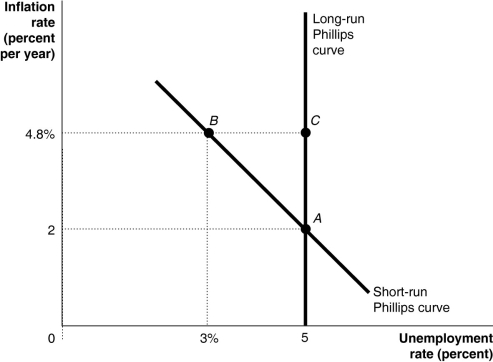 -Refer to Figure 28-6.If firms and workers have rational expectations,an expansionary monetary policy will cause the short-run equilibrium to move from
 (Multiple Choice)
4.9/5 (73)
(73) The short-run Phillips curve is ________ than the long-run Phillips curve.
(Multiple Choice)
4.8/5 (75)
(75) If people assume that future rates of inflation will follow the pattern of inflation rates in the past,they are said to have
(Multiple Choice)
4.8/5 (86)
(86) In August 1979,President Jimmy Carter appointed ________ as chairman of the Board of Governors of the Federal Reserve System.
(Multiple Choice)
4.9/5 (92)
(92) Ceteris paribus,an increase in the current or actual rate of inflation will cause
(Multiple Choice)
4.7/5 (74)
(74) Use the information below to explain adjustments that move the economy to a long-run equilibrium.Assume that firms and workers have adaptive expectations.
The current unemployment rate = 7%.
The natural rate of unemployment = 5.5%.
Last year's inflation rate = 5%.
This year's inflation rate = 4%.
(Essay)
4.8/5 (85)
(85) The FOMC no longer sets targets for M1 and M2 to meet its goals of price stability and high employment.
(True/False)
4.9/5 (76)
(76) When individuals use ________ about an economic variable to make a decision,expectations are rational.
(Multiple Choice)
4.9/5 (68)
(68) Models that focus on factors other than changes in the money supply to explain fluctuations in real GDP are called
(Multiple Choice)
4.8/5 (70)
(70) Workers at a local construction company are paid $32.50 per hour,and they have incorporated a 4 percent annual raise in their contracts to account for expected inflation.Explain how unexpected inflation of 2 percent will affect the real wages earned by these workers and the unemployment rate of these workers.
(Essay)
4.9/5 (75)
(75) Figure 28-9  -Refer to Figure 28-9.A supply shock,such as rising oil prices,would be depicted as a movement from
 (Multiple Choice)
4.8/5 (81)
(81) Gretchen expects the price level to rise from 104 this year to 108 next year,and she is able to incorporate these expectations into her wage contract.If the price level rises to 106 next year instead of 108,which of the following will occur?
(Multiple Choice)
4.9/5 (85)
(85) 
Filters
- Essay(0)
- Multiple Choice(0)
- Short Answer(0)
- True False(0)
- Matching(0)