



 Chat with AI
Exam 28: Inflation, unemployment, and Federal Reserve Policy

Exam 1: Economics: Foundations and Models447 Questions
Exam 2: Trade-Offs, comparative Advantage, and the Market System492 Questions
Exam 3: Where Prices Come From: the Interaction of Demand and Supply476 Questions
Exam 4: Economic Efficiency, government Price Setting, and Taxes420 Questions
Exam 5: Externalities, environmental Policy, and Public Goods263 Questions
Exam 6: Elasticity: the Responsiveness of Demand and Supply294 Questions
Exam 7: The Economics of Health Care338 Questions
Exam 8: Firms,the Stock Market,and Corporate Governance522 Questions
Exam 9: Comparative Advantage and the Gains From International Trade377 Questions
Exam 10: Consumer Choice and Behavioral Economics300 Questions
Exam 11: Technology,production,and Costs327 Questions
Exam 12: Firms in Perfectly Competitive Markets296 Questions
Exam 13: Monopolistic Competition: the Competitive Model in a More Realistic Setting272 Questions
Exam 14: Oligopoly: Firms in Less Competitive Markets258 Questions
Exam 15: Monopoly and Antitrust Policy279 Questions
Exam 16: Pricing Strategy261 Questions
Exam 17: The Markets for Labor and Other Factors of Production281 Questions
Exam 18: Public Choice, taxes, and the Distribution of Income258 Questions
Exam 19: Gdp: Measuring Total Production and Income261 Questions
Exam 20: Unemployment and Inflation291 Questions
Exam 21: Economic Growth, the Financial System, and Business Cycles253 Questions
Exam 22: Long-Run Economic Growth: Sources and Policies262 Questions
Exam 23: Aggregate Expenditure and Output in the Short Run301 Questions
Exam 24: Aggregate Demand and Aggregate Supply Analysis286 Questions
Exam 25: Money,banks,and the Federal Reserve System281 Questions
Exam 26: Monetary Policy275 Questions
Exam 27: Fiscal Policy306 Questions
Exam 28: Inflation, unemployment, and Federal Reserve Policy257 Questions
Exam 29: Macroeconomics in an Open Economy278 Questions
Exam 30: The International Financial System258 Questions
Select questions type


If workers and firms expect that inflation will be 5 percent next year,and real wages are not changing over time,by how much will nominal wages increase?
(Multiple Choice)
4.8/5  (81)
(81) A higher inflation rate can lead to lower unemployment if ________ mistakenly expect the inflation rate to be lower than it turns out to be.
(Multiple Choice)
4.8/5 (76)
(76) Figure 28-4 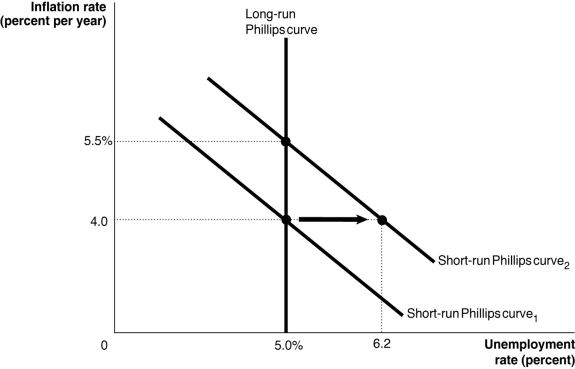 -Refer to Figure 28-4.Consider the shift in the short-run Phillips curves shown in the above graph.This shift may be explained by
 (Multiple Choice)
4.9/5 (81)
(81) In order to change inflationary expectations in 1979,the Fed's monetary policy under Paul Volcker's leadership resulted in ________ and ________.
(Multiple Choice)
4.8/5 (70)
(70) What can the Federal Reserve do to reduce the natural rate of unemployment?
(Multiple Choice)
4.8/5 (83)
(83) During which of the following time periods did inflation remain above 5 percent every year?
(Multiple Choice)
4.8/5 (80)
(80) Figure 28-1  -Refer to Figure 28-1.Suppose that the economy is currently at point A,and the unemployment rate at A is the natural rate.What policy would the Federal Reserve pursue if it wanted the economy to move to point B in the long run?
 (Multiple Choice)
4.8/5 (92)
(92) Figure 28-2  -Refer to Figure 28-2.Suppose the economy is at point C in the figure above.If workers adjust their expectations of inflation,which of the following will be true?
 (Multiple Choice)
4.8/5 (82)
(82) Alejandro expects the price level to rise from 105 this year to 108 next year.If the price level rises to 110 next year instead of 108,which of the following will occur?
(Multiple Choice)
4.7/5 (78)
(78) The experience of Paul Volcker's fight against inflation during the late 1970s and early 1980s indicates that firms and workers may have
(Multiple Choice)
4.9/5 (77)
(77) If unemployment persists for a long period of time,the natural rate of unemployment rises.
(True/False)
4.9/5 (77)
(77) Figure 28-2
-Refer to Figure 28-2.At which point is the unemployment rate equal to the natural rate of unemployment?
-Refer to Figure 28-2.At which point is the unemployment rate equal to the natural rate of unemployment? (Multiple Choice)
4.7/5 (71)
(71) According to the short-run Phillips curve,which of the following would result in low rates of unemployment?
(Multiple Choice)
4.9/5 (87)
(87) 
Filters
- Essay(0)
- Multiple Choice(0)
- Short Answer(0)
- True False(0)
- Matching(0)