



 Chat with AI
Exam 5: Thermochemistry: Energy Changes in Reactions

Exam 1: Matter and Energy: The Origin of the Universe103 Questions
Exam 2: Atoms, Ions, and Molecules: Matter Starts Here144 Questions
Exam 3: Stoichiometry: Mass, Formulas, and Reactions141 Questions
Exam 4: Solution Chemistry: The Hydrosphere148 Questions
Exam 5: Thermochemistry: Energy Changes in Reactions139 Questions
Exam 6: Properties of Gases: The Air We Breathe164 Questions
Exam 7: A Quantum Model of Atoms: Waves and Particles166 Questions
Exam 8: Chemical Bonds: What Makes a Gas a Greenhouse Gas156 Questions
Exam 9: Molecular Geometry: Shape Determines Function188 Questions
Exam 10: Intermolecular Forces: The Uniqueness of Water165 Questions
Exam 11: Solutions: Properties and Behavior150 Questions
Exam 12: Solids: Crystals, Alloys, and Polymers130 Questions
Exam 13: Chemical Kinetics: Reactions in the Atmosphere155 Questions
Exam 14: Chemical Equilibrium: How Much Product Does a Reaction Really Make111 Questions
Exam 15: Acidbase Equilibria: Proton Transfer in Biological Systems122 Questions
Exam 16: Additional Aqueous Equilibria: Chemistry and the Oceans127 Questions
Exam 17: Thermodynamics: Spontaneous and Nonspontaneous Reactions and Processes186 Questions
Exam 18: Electrochemistry: The Quest for Clean Energy167 Questions
Exam 19: Nuclear Chemistry: Applications to Energy and Medicine165 Questions
Exam 20: Organic and Biological Molecules: the Compounds of Life168 Questions
Exam 21: The Main Group Elements: Life and the Periodic Table96 Questions
Exam 22: Transition Metals: Biological and Medical Applications142 Questions
Select questions type


Which statement A-D about the first law of thermodynamics 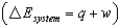 is not correct?
 (Multiple Choice)
4.7/5  (76)
(76) Which statement A-D about the relationship between energy and work is not correct?
(Multiple Choice)
4.7/5 (87)
(87) In an experiment, 74.3 g of metallic copper was heated to 100.0C and then quickly dropped into 200.0 mL of water in a calorimeter. The heat capacity of the calorimeter with the water was 875 J/C. The initial temperature of the calorimeter was 27.5C, and the final temperature after addition of the metal was 29.8C. What is the value of the molar heat capacity of copper?
(Multiple Choice)
4.7/5 (89)
(89) A diver jumps off a diving board. At which point in the diagram below will the diver possess the greatest kinetic energy? 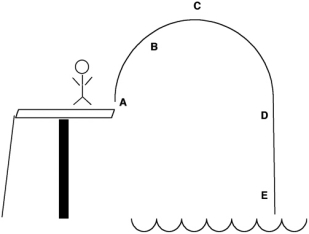
(Multiple Choice)
5.0/5 (73)
(73) During the expansion of steam inside the cylinder of a steam engine, the piston moves and the volume of the cylinder increases by 45 mL. The external pressure is a constant 4 atm. Calculate the change in the energy (in joules) of the steam caused by doing this work. Conversion factors are provided on the information page.
(Short Answer)
4.9/5 (81)
(81) Isooctane is a good model compound for gasoline. When 1.14 g of isooctane (C8H18, molar mass 114 g/mol) reacted with excess oxygen in a constant volume calorimeter, the temperature of the calorimeter increased by 5.83C. The calorimeter consisted of two components: a steel vessel with a heat capacity of 1.00 kJ/C and 2.00 L of water surrounding it. The density and specific heat capacity of water are 1.00 g/mL and 4.184 J/(g C), respectively. Use these data to determine the molar enthalpy of combustion of isooctane.
(Multiple Choice)
4.8/5 (81)
(81) A student dissolving some ammonium nitrate (NH4NO3) in water notices that the beaker gets cooler as the solid dissolves. This is an example of ________
(Multiple Choice)
4.8/5 (70)
(70) Lightweight camping stoves typically use a mixture of C5 and C6 hydrocarbons, which is called white gas. Assuming white gas is 100% C5H12 with an enthalpy of combustion of 3,550 kJ/mol, how many grams of it must be used to heat 1.50 L of water from 20C to 80C? Assume all the energy is used to heat the water.
(Multiple Choice)
4.8/5 (78)
(78) Energy that an object has by virtue of its motion is called ________
(Multiple Choice)
4.9/5 (83)
(83) In a Reuters news report dated February 3, 2010, President Obama is quoted as saying, "By 2022 we will more than double the amount of biofuels we produce to 36 billion gallons, which will decrease our dependence on foreign oil by hundreds of millions of barrels per year." Use the following information to estimate the fraction of farmland in the United States that will be needed to meet this target in order to assess the impact on other uses of farmland, such as the production of food. (M mega 106)
Farmland in the U.S. 1.4  square miles
Energy density of biofuels 100 MJ/gal
Annual biofuel production from farmland 1,000 gal/acre
640 acres 1 square mile
1 gal 3.785 L
Mass density of biofuels: 800 g/L
square miles
Energy density of biofuels 100 MJ/gal
Annual biofuel production from farmland 1,000 gal/acre
640 acres 1 square mile
1 gal 3.785 L
Mass density of biofuels: 800 g/L (Multiple Choice)
4.9/5 (87)
(87) The change in enthalpy and the change in internal energy of a system always will be equal when ________
(Multiple Choice)
5.0/5 (78)
(78) Which statement A-D about the first law of thermodynamics 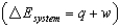 is not correct?
 (Multiple Choice)
4.8/5 (84)
(84) If a mass of 100.0 g moves through a distance of 50.0 m with an acceleration of 25.0 m s-2, how much work was necessary to move the mass? F = ma, where F is force, m is mass, and a is acceleration. (1 J = 1 kg m2 s-2)
(Multiple Choice)
4.9/5 (101)
(101) Which of the following hydrocarbons has the greatest fuel value?
(Multiple Choice)
4.9/5 (78)
(78) When 1.14 g of octane (molar mass 114 g/mol) reacts with excess oxygen in a constant volume calorimeter, the temperature of the calorimeter increases by 10.0C. The heat capacity of the calorimeter is 6.97 kJ/C. Determine the energy flow, q (reaction).
(Multiple Choice)
4.8/5 (84)
(84) Which substance has an enthalpy of formation equal to zero at 25C and 1 atm?
(Multiple Choice)
4.7/5 (73)
(73) The following diagrams illustrate the flow of energy (q) and work (w) in different processes. Which one is definitely not an endothermic process?
(Multiple Choice)
4.8/5 (77)
(77) When 2.50 g of sucrose (molar mass 342.30 g/mol) reacts with excess oxygen in a constant volume calorimeter, the temperature of the calorimeter increases by 9.17C. The heat capacity of the calorimeter is 4.90 kJ/C. Determine the heat of combustion per mole of sucrose.
(Multiple Choice)
4.8/5 (81)
(81) In a Reuters news report dated February 3, 2010, President Obama is quoted as saying, "By 2022 we will more than double the amount of biofuels we produce to 36 billion gallons, which will decrease our dependence on foreign oil by hundreds of millions of barrels per year." Use the following information to determine the fraction of our projected 2022 total energy demand this target represents to assess its significance. (M mega 106) U.S. projected annual energy demand in 2022: equivalent of 22 103 Mbarrels of oil
Energy density of oil: 5.9  MJ/barrel
Energy density of biofuels: 100 MJ/gal
Mass density of petroleum: 900 g/L
Mass density of biofuels: 800 g/L
1 gal 3.785 L
MJ/barrel
Energy density of biofuels: 100 MJ/gal
Mass density of petroleum: 900 g/L
Mass density of biofuels: 800 g/L
1 gal 3.785 L (Multiple Choice)
4.8/5 (82)
(82) 
Filters
- Essay(0)
- Multiple Choice(0)
- Short Answer(0)
- True False(0)
- Matching(0)