



 Chat with AI
Exam 7: A Quantum Model of Atoms: Waves and Particles

Exam 1: Matter and Energy: The Origin of the Universe103 Questions
Exam 2: Atoms, Ions, and Molecules: Matter Starts Here144 Questions
Exam 3: Stoichiometry: Mass, Formulas, and Reactions141 Questions
Exam 4: Solution Chemistry: The Hydrosphere148 Questions
Exam 5: Thermochemistry: Energy Changes in Reactions139 Questions
Exam 6: Properties of Gases: The Air We Breathe164 Questions
Exam 7: A Quantum Model of Atoms: Waves and Particles166 Questions
Exam 8: Chemical Bonds: What Makes a Gas a Greenhouse Gas156 Questions
Exam 9: Molecular Geometry: Shape Determines Function188 Questions
Exam 10: Intermolecular Forces: The Uniqueness of Water165 Questions
Exam 11: Solutions: Properties and Behavior150 Questions
Exam 12: Solids: Crystals, Alloys, and Polymers130 Questions
Exam 13: Chemical Kinetics: Reactions in the Atmosphere155 Questions
Exam 14: Chemical Equilibrium: How Much Product Does a Reaction Really Make111 Questions
Exam 15: Acidbase Equilibria: Proton Transfer in Biological Systems122 Questions
Exam 16: Additional Aqueous Equilibria: Chemistry and the Oceans127 Questions
Exam 17: Thermodynamics: Spontaneous and Nonspontaneous Reactions and Processes186 Questions
Exam 18: Electrochemistry: The Quest for Clean Energy167 Questions
Exam 19: Nuclear Chemistry: Applications to Energy and Medicine165 Questions
Exam 20: Organic and Biological Molecules: the Compounds of Life168 Questions
Exam 21: The Main Group Elements: Life and the Periodic Table96 Questions
Exam 22: Transition Metals: Biological and Medical Applications142 Questions
Select questions type


Arrange the following ions in order of increasing size:
Na, F, Mg2, N3, Al3, O2.
(Short Answer)
4.8/5  (78)
(78) Determine the wavelength of the line in the hydrogen atom spectrum corresponding to the n1 4 to n2 8 transition.
(Multiple Choice)
4.8/5 (65)
(65) If the principal quantum number is seven (n  7) and the angular momentum quantum number is three (
 3), which of the following values is not an allowed value of the magnetic quantum number (ml)?
7) and the angular momentum quantum number is three ( 3), which of the following values is not an allowed value of the magnetic quantum number (ml)? (Multiple Choice)
5.0/5 (83)
(83) What is the speed of an argon atom that has a de Broglie wavelength of 5.2 pm?
(Multiple Choice)
4.8/5 (83)
(83) Which of the transitions in the following hydrogen atom energy-level diagram involves the shortest wavelength photon? 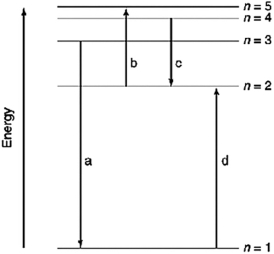
(Multiple Choice)
4.7/5 (79)
(79) Which combination of quantum numbers is possible for an atom with five orbitals in one subshell?
(Multiple Choice)
4.9/5 (74)
(74) What is the wavelength (, in m) of a radio station operating at a frequency of 99.6 MHz?
(Multiple Choice)
4.8/5 (76)
(76) What is the ground state electron configuration for sulfur?
(Multiple Choice)
4.9/5 (81)
(81) Which of the following metals would be an appropriate choice for the construction of a photon detector for 550 nm light?
(Multiple Choice)
4.9/5 (88)
(88) What is the photon energy of the yellow-orange light ( 589 nm) produced by sodium vapor streetlights?
(Multiple Choice)
4.7/5 (74)
(74) Indicate which metal requires the shortest wavelength photons to eject photoelectrons based on the following graph. 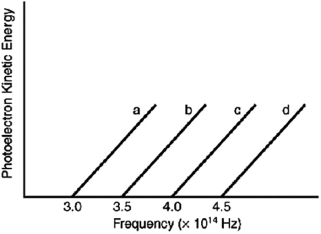
(Multiple Choice)
4.8/5 (89)
(89) What are the principal and angular momentum quantum numbers for a 4f orbital?
(Multiple Choice)
4.9/5 (82)
(82) Early photoelectric light detectors were based on cesium. Cesium metal has a work function of 3.43  J. What is the longest wavelength of light that could be detected with one of these detectors?
 (Multiple Choice)
4.9/5 (63)
(63) Radiation with a wavelength of ________ nm is produced by the n 5 to n 2 transition in the hydrogen atom, and this transition occurs in the ________ region of the electromagnetic spectrum.
(Short Answer)
4.7/5 (84)
(84) Two elements that have np3 in their ground-state electron configuration are ________
(Multiple Choice)
4.8/5 (70)
(70) Which of the following is a possible set of quantum numbers for a 4p orbital?
(Multiple Choice)
4.8/5 (86)
(86) 
Filters
- Essay(0)
- Multiple Choice(0)
- Short Answer(0)
- True False(0)
- Matching(0)